Dead Sea – the funnest place ever!!

Being in the Dead Sea is probably one of the most fun things in the world. The salinity of the Dead Sea is 31% which is about 9 times higher than the ocean; as a result everything is very buoyant. I was looking forward to floating around in the water because I could never stay afloat by sitting and extending my legs out like most Europeans you see on the Mediterranean. And Eug planned to take Christine and I to a spa by the Dead Sea, which we found out later wasn’t just any spa, it was the Zara Spa at the Movenpick, justifiably renowned as one of the best in the Middle East. It was quite a treat after a few nights of two star hotel stays and camping out in the desert.
We drove our trusty but not so powerful Toyota Yaris from Aqaba to the Dead Sea in three hours on the Dead Sea highway. The landscape turned from all desert to a body of smooth oily blue water. It kind of resembled the road in Hawaii without the tides, and Israel was just on the opposite shore. The Dead Sea is the lowest spot on earth at 408m below sea level, and when we passed by the marker on the highway that indicated we were below sea level I started to get excited. We were ecstatic when we saw the Movenpick sign emerging on the side of the highway. We first went to the private beach at the back of the hotel and self administered a mud wrap by covering ourselves with mud from a big clay pot next to the water. The Dead Sea mud contains high concentrations of minerals including calcium and magnesium, which have health-giving properties. It was funny seeing everyone patting and rubbing mud on themselves. It reminded me of Mystique in X-men but in mud colour. Even Eug got into it. He covered his face with mud too which Christine and I didn’t dare to. Then we all jumped into the Dead Sea. It’s so amusing when you just can’t sink in water! The very first thing I tried was extending my legs out and sitting in the water like the Europeans. I could finally do it! We also tried to stand straight holding a pencil dive pose but it was impossible to hold that position for long. We ended up bouncing awkwardly sideways back to a floating position, kind of like that inflatable toy with a weight in the bottom that keeps reverting to its starting position after you punch it. We also tried sitting crossed legged, which was fairly easy to do. Christine and I tried some synchronized swimming poses, but it turned out Eug was the best at that (jk). I tried the Bikram airplane pose, super fun. I couldn’t stop smiling and laughing the whole time. If you haven’t been to the Dead Sea yet, you must! It is 3 million years old but it has shrunk by 30% in recent years, about half a meter per year which means it’s disappearing. I must give credit to Christine for being a real trooper. She had all kinds of wounds on her body from the days before but she sucked it all up and spent as much time in the salty water as we did and had a blast too. It must’ve stung like hell for her. One of the life guards (not sure why they were there since you couldn’t possibly drown in the Dead Sea) even called her to the side at the end and bandaged up her wounds. We then tried all the spa pools. There were three indoor Dead Sea pools, one aqua-pressure pool, foot-massage pool, and one gorgeous infinity pool with a view of the sunset. We spent about 4 hours in the spa altogether, it was a relaxing haven.
We headed back to Amman after the Dead Sea spa. Christine’s friend hooked us up with a pimp suite at a very reasonable rate, which wrapped up our Jordan journey very nicely. She decided to stay in Amman for one more day to hang out with her friend and meet us in Israel the next day. So Christine’s story continues. Thankfully Eug and I had a very boring border crossing to Israel (we were told we would have trouble since we had Syrian and Lebanese stamps in our passport) compared to Christine’s. The next day, we were waiting for her at our hospice in Jerusalem when we received an email from her saying ‘You guys go ahead and don’t wait around for me; they evacuated the entire border crossing building, it might take awhile’. I thought ‘uh oh… that doesn’t sound good’. Because when we were in Aqaba, a Taiwanese mom restaurant owner told us that three Taiwanese boys were scared out of their minds when they couldn’t tell the custom officer what was in one of the bags their friend asked them to bring back for him. The next thing you know, they blew up the bag without trying to find out what was inside. When Christine finally made her way to us, we found out that they evacuated the building because of the purse her friend gave her in Amman. It was a Thomas Wylde purse with tons of studded metal skull heads. I guess the border security people couldn’t identify what they were looking at through the x-ray machine, so they called Christine in after evacuating and questioned her for awhile. Luckily they didn’t blow up her purse.
Christine should really write a book about her 2 week adventure with us. I hope it’ll be smooth sailing for her from now on.
Our poor friend Christine
Christine arrived in Amman, Jordan on a long, 2 day connecting flight from Vancouver ready to spend 2 weeks with us on our adventure. I think she’s regretting coming already.
The first place the 3 of us went to was Jerash, an old Roman town about an hour north of Amman. Though the ruins are quite nice, I think Di and I are pretty happy that they are the last ones we’ll see on this trip as collectively we’ve seen more than 15. Anyways, in the Roman theatre the last step, about one inch high, is of different height than the rest of the steps. Christine missed this as we were coming down, resulting in her falling and rolling on the ground on her first day here. Her knee and hand were quite scraped up but after she got up and dusted herself off we were all able to laugh as it honestly looked pretty funny. It was a really slow fall and roll, so she called it her slow-motion-fail.
The next morning we rented a car really early and drove to Petra, the ancient rose-red city that is the highlight of anyone’s trip to Jordan. The Nabataeans, who built it, were an Arab tribe who settled in the region and were able to generate massive wealth through controlling the lucrative trade routes of the desert caravans. They also had control of water supplies through innovative hydraulic engineering, creating an artificial oasis that only added to their prosperity. This wealth enabled them to cut this beautiful city out of rock, a city that is now on everyone’s list of “places you must see before you die”. This was my second time here, and this time was equally as fascinating, if not better than the last. The only thing that was worse was the preposterous entrance fee which is currently 33 JD (about 50 USD) but will be rising to 50 JD (70 USD) in November of this year. I think since they’ve been voted on that ridiculous list of “The New 7 Wonders” they’ve raised the prices significantly.
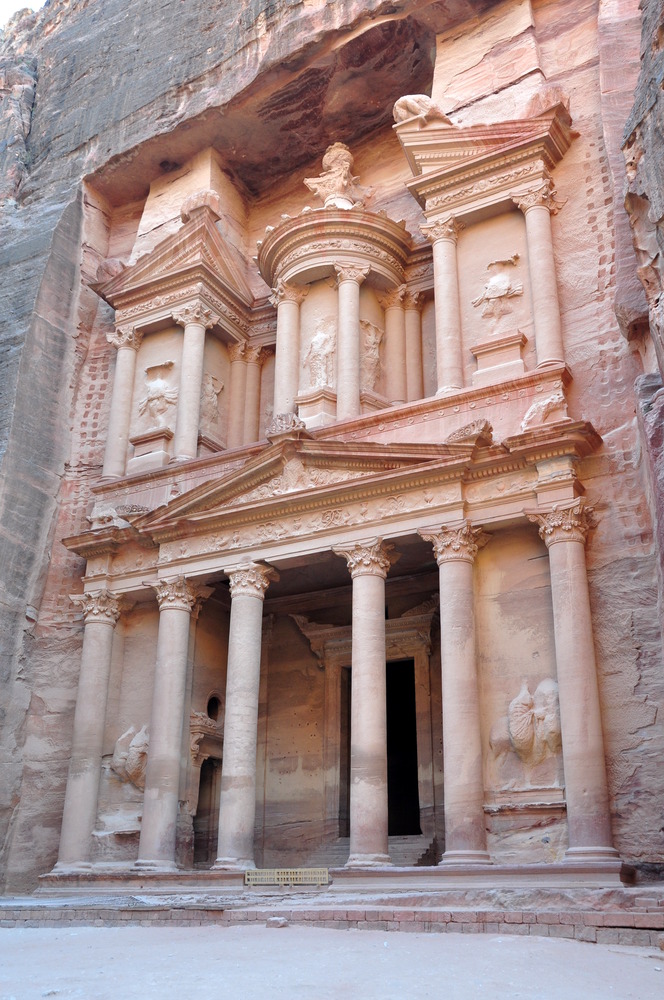
About a kilometre after you pass the entrance gates of Petra you hit the Siq. The canyon-like Siq is 1.2 km long, with walls up to 200 m high on either side. At parts the width of the path between the walls is only 2 metres. Technically it’s not a canyon as it’s a block that’s been ripped apart by tectonic forces. Either way it’s my favourite part of Petra and as you emerge from the darkness of its looming walls your first sight is the Treasury (pictured above), bathed in daylight and absolutely stunning. The treasury is Petra’s signature building, and seeing it as you come out of the Siq is Petra’s most ethereal experience. I actually enjoyed it more the second time because I knew what was coming and the anticipation of it approaching was pretty exciting, unlike my first time when I had no idea how long the Siq was or what was at the other end of it. Way at the other end of the city about a 2 hour hike away (over 800 steps uphill are involved) is the Monastery, Petra’s second most famous building. The Treasury was used in Indiana Jones and the Monastery was used most recently in Transformers 2. The plan was to walk from the Siq to the Monastery and back, admiring all the other amazing structures in between. Christine (a high powered lawyer in a famous downtown firm who is not used to walking) wanted to hire a donkey to cover the distance. Di and I did not want donkeys, so being the team player that Christine is she decided to try this crazy thing called hiking. Much to our delight she made it all the way to the Monastery! We stayed there for about an hour to take pictures, drink water, and rest before making our way back down. All in all, we were probably hiking for at least 5 hours. Unfortunately all this walking created a massive blister on the sole of Christine’s foot, and she decided not to tell us.
The next morning we drove down to Wadi Rum, a desert made famous by TE Lawrence (Lawrence of Arabia). I actually like it more than the Sahara due to its amazing landscape and colour. Here large sandstone and granite mountains emerge from the pinkish desert, with wide sandy valleys separating these pillars. It reminded me of the limestone islands of Asia (Halong Bay or Krabi or Palawan), except you replace the ocean with sand and the limestone islands with these sandstone ones. When we arrived, Bedouins met us and took us around in 4x4s for the day to different attractions in the desert. One of these attractions was a natural bridge that you could hike up to. The Bedouin guide told us to take off our sandals to walk as the slope was quite steep and would be better walked barefoot. Christine, though scared of heights, was a good sport and did exactly as she was asked (though deep down I’m pretty sure she wasn’t so thrilled about it). Unfortunately, the hill was a little rough and it cut open her blister. Imagine having an open blister on your foot while you’re in the sand-filled desert. Yes it would suck. She kept it together and that night we slept on mattresses underneath the countless stars with no tent in the middle of the desert. I actually really enjoyed it as it was warm (unlike the Sahara) and I decided to listen to old songs and reminisce (think R&B songs from the mid-late 90s, I think my haircut from Barbie in Kuwait got me in the mood) while all the other people were sleeping.
The next morning we awoke and drove to the town of Aqaba on the Red Sea. By this time Christine could barely walk as her blister was filled with sand (and looking pretty nasty if you ask me). So we went to a pharmacy where the pharmacist, a 250 pound dude, asked her to sit down so he could clean her wound before bandaging her. For the next 20 minutes, he was my new hero. First he told her to put her foot on his lap, and then he proceeded to tear off the tape that Christine had on covering her blister. She was in obvious pain while he was slowly peeling this off, and as she was gasping he looked up at her and told her to ”stop being such a baby”. Immediately I started to like this guy. After this he wiped the wound with iodine which elicited a larger pain response from her. Di ran over to hold her hand, and the pharmacist looked at Di disapprovingly and said “she’s not having a baby”. Awesome! He then proceeded to bandage everything up really nicely and when he was done he finally smiled and started to joke around. I would love to be able to be that stern with my patients in certain situations, but alas that would not fly in North America. After this Christine went back to the hotel to rest while Di and I did some spectacular snorkelling in the Red Sea.
Now we’re off to the Dead Sea before heading to Israel. Christine, who is walking with a significant limp, still has about 9 days left with us. Let’s see if we can keep the remaining parts of her body injury free.
A little something from home…
Our friend Christine brought a surprise for us from one of our best friends at home. Along with it came a little note:
Ahhhh, the life of the ex-pat wife

Our friend Christine was flying from Vancouver to meet us in Jordan on June 16th, which gave us just over 3 weeks to cover Syria and Lebanon before meeting her. However, since we ended up traveling with other people in these 2 countries we shared private cars instead of taking public transport. This allowed us to see 2 or 3 sights a day instead of one, effectively leaving us with too much time to cover these 2 countries. We could have stayed in Lebanon for a few more days to relax and party, but Beirut is pretty expensive so for the sake of our budget we decided to move on. Here we were, with about a week extra to kill before meeting our friend and we didn’t know where to go. We took a look at our map to see which countries were close by and there on the Gulf was our answer, Kuwait.
My aunt and uncle (pictured above) have been living in Kuwait for the past 7 years. My uncle works for Chevron and is one of many qualified and highly educated ex-pats running this tiny country. My aunt is a lady of leisure, pretty much like all of the other ex-pat wives here. I gave them an email, wondering if they would take in 2 poor, tired, and starving travelers. Much to the delight of Di and I (and our stomachs), they said yes. We hopped on a flight from Beirut to Kuwait city and about 2 hours later there was my aunt, waiting for us at the airport with a driver from the Hilton, sweet!
The first thing you notice here when you exit the airport is the heat, it is scorching. It was 50 degrees Celsius while we were there. 50 degrees! Supposedly this has been an abnormally hot summer though, usually it’s a balmy comfortable and cool 45 degrees, we were just unlucky.
The driver took us back to the Hilton where my aunt and uncle are living in one of the chalets (thankfully with an extra guest bedroom for us). The ride there was interesting as we were sitting with an American working for the White House who was en route to Iraq the next day. Not often do you hear someone in government telling you how badly their government has screwed up, but that was his view. I think his exact words were “We completely destroyed Iraq, and for what?” Though the car ride was only about 30 minutes it was interesting to say the least.
When we got to the Hilton, we were greeted by 2 fresh glasses of OJ at the check in counter before getting another ride to our chalet. Inside there was a room for us with fresh ironed sheets, plump white pillows, and A/C. My aunt then proceeded to make us some Chinese food. Not that we don’t like Middle Eastern food, but 3 and a half months without white rice or soy sauce has been giving me withdrawal symptoms. It hit the spot.
From that moment on, we spent the next week living the life of an ex-pat wife. It goes something like this: breakfast, meet friends for coffee, meet other friends for lunch, shop, maybe play bridge, meet husband for dinner, watch tv. I know that sounds hectic, but luckily you can usually squeeze in a nap or some time to read a book somewhere in that busy schedule.
As my aunt had a scale, we weighed ourselves. I won’t tell you how much Di weighed, but I dropped down to 139 pounds. One of my goals for the week was to gain back at least 5 of the 15 pounds I’d lost. They had a great gym at the hotel and we were going to be eating a lot so I was quite confident I could do it. My other goal for the week was to get a haircut as I hadn’t had one since I left Canada almost 4 months ago.
I was going to get a haircut in Syria, but one of the guys we were traveling with got one there. He emerged with a buzz cut after asking for a trim. That was motivation enough to not go to a Syrian barber. When I told my aunt I needed a cut, she said she knew someone who could do it and who wasn’t too expensive. There was a Toni & Guy salon here, but I decided to go with her suggestion instead as everything in Kuwait is super expensive and I was worried about the Toni & Guy price. Her suggested salon was in a mall with stores like Tiffany & Co, pretty high end, so that inspired some confidence. The stylist was a Filipino named Barbie, and I thought to myself with a name like that you’ve gotta be pretty good at cutting hair. He proceeded to first give me a wash which went smoothly, but once I got back in the chair it started to go downhill. He asked what I wanted, and since my hair looked like a mop top schlop I asked for a book of haircuts to show him. He gave me a picture book from 1993 with categories like “Business”, “Casual”, and “Party”. I tried my best to keep a straight face as I put the book down and just politely asked for a trim. I was hoping he didn’t give me the “business” look as I wasn’t auditioning for a part in the movie remake of Dallas or LA Law. Anyways, he cut my hair, giving me something really neat and tidy. After that he decided to blow dry it, giving me as much body as possible. I emerged from the chair biting my upper lip trying not to laugh as I thanked and paid him. My hair looked like it belonged to a Hong Kong pop star (more Andy Lau than the others), circa 1993…score. I walked down to Starbucks where Di and my aunt and uncle were waiting, only to be greeted by laughter. Even my quiet uncle made a remark that I had a bouncy pillow on the back of my head. I kinda liked it for the day, too bad I didn’t have a suede vest and light blue high-waisted tapered jeans with a tucked in baggy shirt to match.
There isn’t much to see in Kuwait. For sights we went to one small private museum and we checked out the Kuwait towers. It is a socially interesting place though. The malls look identical to ones you’d see in any nice suburb in the states, right down to the stadium seating cinemas and the 5 starbucks stores. However, not one Kuwaiti works in any of the stores. All of the service staff are either Filipino or Indian or Sri Lankan etc. In fact, it’s basically all expats that run this country, with more highly educated ones working in the oil companies (like my uncle) and the less educated doing all the service and cleaning jobs. Supposedly there are about 1 million “real Kuwaitis” and 2 million foreigners here to help the country run. Though many women wear burkas, that hasn’t been unlike many other Middle Eastern countries we’ve been to. The big difference is many of the men here are decked out in full Arab Gulf wear (the long white one piece tunics with the red and white head scarf held down on their heads with a black band).
A few months ago I wrote about the “curse of oil” as an observation of Libya. Here, it’s a lot more noticeable. Kuwait is a far richer country with (in relation to the small population) basically unlimited oil. When you go to the supermarkets the only product that is Kuwaiti is the fish, reeled in from the Gulf. Everything else, all the produce available, is imported from the rest of the world. Educated ex-pats come here in droves to collect a heavy pay check before going home, none I met want to stay. Other workers from poorer countries are treated badly but don’t really have a choice as they need to make a living.
Social issues aside, we had a great time here. Having a nice bed, clean laundry and fantastic meals daily does wonders for your energy levels. Hanging out with my aunt’s friends everyday, other ex-pat ladies of leisure, was super entertaining. Plus seeing my aunt and uncle was really nice, especially since it’s been a while since I’ve seen any family. They were great hosts and the week blew by. As my uncle is retiring and moving back to the States in a few months this will probably be the last chance we have to visit the Gulf for a while, unless I figure out a way to convince Di to be a high earning ex-pat out here. I have 7 months to achieve this before we return home; I’ll start learning bridge in the meantime to prepare myself for that lifestyle.
Lebanon – home to Prada and Palestinians

A short 3 hour taxi ride (including border crossing) took us from Damascus to Beirut, ‘Paris of the East’. Besides the 10 degree temperature drop from a scorching 40C to 30C, Eug was ecstatic to see girls wearing tank tops, shorts, and skirts again… something he hasn’t seen since Istanbul. Even I caught myself staring at some girls. We were too accustomed to seeing women in burkas everywhere that it was almost strange to be able to see girls from head to toe again. For the first 3 nights we stayed in the Hamra area close to the American University of Beirut. We heard English being spoken in every corner of the streets. We also found the comfort of Starbucks once again. And as good as middle eastern cuisine is, we couldn’t take anymore hummus or shawarmas after 3 months of them, so we headed straight for some wholesome western food. A hamburger and Lipton ice tea never tasted so damn good! We were both excited and relieved to find the long lost western refuge again and decided to slow down and nestle in its welcoming familiarity.
After Eug recovered from Damascus belly, we did our usual routine of finding the hostels listed in Lonely Planet to look for the tours we wanted but weren’t able to do on our own. They usually offer the same tours as the nicer hotels but at a much more reasonable rate. And we could usually recruit interesting, independent travellers to join us to share the fun and the cost. It’s been working out great so far. We ended up renting a Honda Odyssey van for 2 days with 4 other travellers; two of which we’ve been running into almost daily since Turkey (so it was no surprise to see them again in this hostel), 1 girl from Germany, and 1 guy from Uzbekistan. Yes, Uzbekistan!
The first day we explored the eastern part of Lebanon, Baalbek and Aanjar. The impressive Baalbek ruins were known as the Heliopolis or ‘Sun City’ of the ancient world. There were a few spectacular temples, a theatre, and 6 huge standing columns. What we also found interesting was that the town of Baalbek is the administrative headquarters for the Hezbollah (Party of God) party and we could see the yellow and green Hezbollah flags fluttering along the main street of the city. Outside the ruins people were trying to sell us Hezbollah souvenir T-shirts. Eug double-dared me to buy one to wear for when we crossed into Israel. We didn’t find Aanjar’s 1300 year-old Umayyad City to be extraordinary but we had a great time chatting with our fellow travel mates while strolling along the site. And some local visitors picked some fresh mulberries right off the trees and shared some with us. We also visited the stunning Jeita Grotto, a huge limestone cave (the biggest I’ve ever seen) full of stalactites and stalagmites. Just imagine a cave full of icicle-like rocks that might just fall down and jab a hole in your skull, and big rock tubes that look like white half-melted candles all morphed together (like the ones you see in Subeez cafe). We walked through the upper cave and took a boat ride in the lower cave. It was like an awesome Disneyland ride! It was hard to imagine that the cave was used as ammunition storage during the civil war.
The next day we headed north towards Byblos (Jbail), Tripoli, Bcharre, and Qadisha Valley. The Qadisha valley (picture above) was particularly stunning, as it is extremely steep and deep. The other Canadian girl in our van was gripping the seat handles in fear the whole way up. On either side there are many towns, predominantly Christian with cave chapels and churches all around. Above the town of Bcharre is the Cedars, a ski resort in the winter with an ancient grove of the cedar trees. The cedar tree has been synonymous with Lebanon forever and is the centrepiece of their flag, like our maple leaf. We chilled in Beirut for the last few days in Lebanon. There are nice high end malls with LV, Prada, and Jimmy Choo, etc. stores, tall modern glass buildings, a Parisian like boardwalk, and bubbling-hot nightlife. It’s not uncommon to see a new Mercedes or Porsche driving by you. However don’t let this fool you into thinking Beirut is a rich happy oasis in the Middle East, as a 20 minute drive from the city centre will take you into areas riddled with poverty. In the midst of all the modern glitz and glamour of downtown stands the remains of the infamous deserted Holiday Inn Hotel. During the civil war that started in 1975, snipers would shoot from it as it was the tallest building around, and the returning gunfire has left the scars that remain to this day. Now it’s just a skeleton of a building, a gloomy reminder of this cities’ recent past.
Lebanon is an extremely interesting place and no matter what you read in books or papers you really need to be here to experience it. You’ll get many who are extremely proud of this small country, and yet there are others who seem to want to identify a lot more with the West than Lebanon. All around you’ll hear Lebanese speaking English with a heavy Arabic accent to each other. A waiter (educated in the States but back for the summer) at a really nice restaurant confirmed that this was his greatest annoyance, people speaking to their friends and the service staff in mediocre English instead of their native Arabic tongue, even when he would respond in Arabic. In the mountains you’ll see stunning Christian towns that look untouched by war, and yet in a town like Baalbek you’ll see mosques, Hezbollah flags and pictures of Ayatollah Kohmeini. In downtown Beirut you’ll see signs marketing new steel and glass high-rise developments saying Beirut is the new “it” destination, yet you venture south and you’ll find poverty stricken Palestinian refugee camps whose inhabitants care a lot more about their next meal than if Lebanon is considered cool on the world wide stage. Overshadowing all this contradiction is a sense of fear that war could easily return. It was only 2005 when former Prime Minister Hariri was killed in a car bomb. This led to the withdrawal of Syrian troops, troops which had been occupying Lebanon for 30 years. It was only 2006 when Hezbollah killed and kidnapped 10 Israeli soldiers, with the resulting Israeli military response leaving over 1000 Lebanese civilians dead. Peace will be hard to find as long as Hezbollah (who has strong ties to Syria and Iran) wants the destruction of Israel, and Israel has the military might to inflict seriously tragic damage. Beirut is hoping economic growth and stability will unite people and pave the way to political reform. Unfortunately Lebanon cannot just count on itself to bring peace, as all the other players in Middle Eastern politics also have a part. Even with all the hope in the minds and attitudes of the people and government, you can feel that everything is currently resting on a delicate equilibrium, an equilibrium that could easily be upset.
“Go back as far as you will into the vague past, there was always a Damascus…She is a type of immortality” – Mark Twain
Our last four days in Syria were spent in the ancient city of Damascus, which competes with its sister city of Aleppo for being the oldest city that’s still inhabited in the world. We stayed in the walled Old City, and after being in a bunch of walled old cities in the past 3 months, this is the one that was the most intact. When I say intact I mean untarnished by time and tourism. The locals are still by far the biggest patrons of all things within the souq (covered market). At night the small tables at a tea house are filled by Syrians smoking their nargileh (water pipe) as they listen to a professional storyteller un-weave his tale (as I can’t understand Arabic I imagine it to be The Thousand and One Nights). Women in burkas form line-ups outside Damascene ice cream shops which serve a delicious pistachio covered tapioca concoction. Beautiful courtyard restaurants load tables with Syrian dishes that haven’t been altered to appeal to foreign tongues. Though the mosques open to tourists in other cities are filled with them, we the tourists are overwhelming minorities in the ones here. Pretty much everyone we met in Syria had nothing but praise for this city, and it lived up to the hype. We were living in the Christian quarter of the old city, and every time we walked back to our residence I would notice something new and subtle in the beautiful architecture surrounding us, especially on the second floors of the old houses. It was a charming place, and we really liked it. We’ve heard that this is what the old city in Marrakesh used to be like before tourists took over (kind of like how Vietnam is now sort of what Thailand used to be) and I totally believe that. Fashionable boutique hotels are sprouting up in old Damascene houses, following the Moroccan blueprint of having boutique Riads (guest houses) in old renovated Moroccan houses. I wonder how long it’ll take for Damascus to become as fashionable as Marrakesh to the desirable high-end (ahem big-spending) tourist.
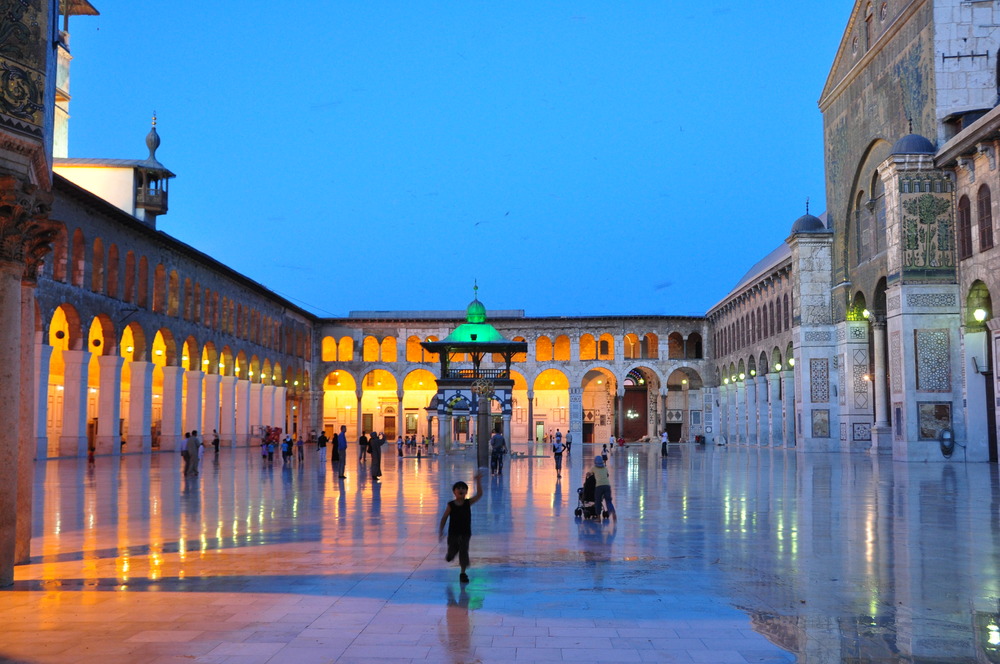
We spent some time in Damascus’ marquee religious building, the Ummayad Mosque which is pictured above. The Shrine of Hussein (Prophet Mohammed’s grandson) is here and is an important site of pilgrimage for Shiite Muslims. Beside the mosque lies the mausoleum of Saladin, a Kurdish-born hero of the Muslim world who kicked the Crusaders out of Jerusalem (also the antagonist to dreamy Orlando Bloom in the movie “Kingdom of Heaven”). The interior of this mosque is lined with stunning golden mosaics which supposedly represent the paradise Prophet Mohammed saw in Damascus. Though it was a religious place, the immense courtyard was filled with children running around laughing and chasing each other. We were enjoying the experience, but many of the eyes were curiously looking at us the whole time we were inside. Though not unwelcoming, we were unsure of how we were supposed to react in this place of worship to all the eyes and whispers. Then finally one woman came up with her young son and camera phone and asked to take a picture with us. After her the floodgates opened, and Di, Jon (a fellow Canadian we were traveling with) and I were smiling for cameras for a good half an hour until darkness descended upon the courtyard. This has happened to Di and I quite consistently on this trip so far (almost daily in fact, I guess Asians aren’t common around these parts) but this mosque was definitely where we were photographed most. People were actually lining up, but they were excited so we were happy to oblige.
One day 6 of us decided to hire a driver to take us to the ’Disengagement Zone’ of the Golan Heights, a region between Israel and Syria that is now under UN control. This was a sobering reminder of the political issues that plague the region. In the 6 day war of 1967, Israel took this area from Syria and expelled almost all of its residents. With UN negotiations, Israel agreed to leave the area as a demilitarized zone administered by the UN, but they bulldozed much of everything remaining before they left. The former town of Quneitra here is now comprised of flattened concrete, twisted steel, mine-filled fields, and a bullet riddled hospital (supposedly used for target practice after all residents left). UN vehicles are the only ones really still using these roads. Visiting here was definitely heavy, similar to how I felt being in the demilitarized zone between the two Koreas. Except here, there was no theatre, museum or tourists like in Korea. It was just us, our driver, and UN soldiers; quite an experience.
It’s quite unfortunate that the western world views Syria as a ‘rogue state’ (George W Bush’s exact words). For a ‘rogue state’, its people are pretty darn friendly. We’ve never heard the word “Welcome” so many times in our life. Children would run up to us to say this, drivers and passengers would yell this out their windows, and fellow pedestrians would always smile and try to shake our hands. Anytime we took out a map someone was eager to help us or walk/guide us, and this always had no strings attached. Syrians were constantly giving us tea or drinks, asking if we liked their country. Though we’ve experienced hospitality everywhere, I would say so far here and Libya take the cake. (Though as an unfortunate aside, Libya and Syria are also the only 2 countries where we’ve gotten a little sick. I had a case of ‘Damascus Belly’, not fun. One day of Cipro though and I was fine).
Syria has been held by Phoenicians, Egyptians, Persians, Greeks, Romans, Arabs, Crusaders, Mongols, Turks…basically a who’s who of the empires of the region. As such they’ve all left their marks: architectural, cultural, culinary, artistic, religious etc. Finding these relics in the everyday life of this ancient land is fascinating, but don’t be fooled by the word ‘ancient’. Syria is modernizing quickly, so if you want to catch it before tourists outnumber locals in the old city walls, now would be the time. It’s an easy country to travel as it’s not large and all sites are within driving distance of Aleppo or Damascus. The travelers that make it here also tend to be very experienced, as Syria is usually not on the top of a newbie’s list like Thailand or Western Europe would be. As a result, there are ample opportunities to discover the country with sociable, adventurous and extremely open-minded explorers who are on the same route as you. What I’m trying to say is that making new friends, both local and foreign, will not be a problem at all. Just don’t try to add them to facebook here, it’s banned.
The Oldest Cities of the World

Right after crossing the land border to Syria, our driver stopped by a gas station to fill up gas. It was a ghetto looking gas station and it had a ghetto looking slurpee machine with three colours – florescent orange, blinding yellow, deadly purple. Just as I was thinking ‘eew gross!’ our nice driver opened up Eug’s door with one of each in his hands and gestured Eug to choose. Eug politely took the two of the less deadly looking ones and our driver gestured us to taste them. We reluctantly took a small sip each and nodded until he gave a satisfying smile and continued driving towards Aleppo. For the rest of the car ride, we were thinking of ways to get rid of these fatal liquids without him noticing. It was only our first day in Syria and neither of us wanted to risk the chance of getting traveler’s diarrhoea. We ended up finishing the small bottle of water we had in our bag so we could pour the slurpees into the empty bottle. But because of the ice, Eug couldn’t pour it directly into the water bottle, so he ended up using the slurpee straw to transfer the slush into the bottle one straw-full at a time using his index finger to retain and release. At the same time he was pretending to be enjoying the border town scenery too. It took a good half an hour but his mad straw skills saved our stomach.
Syria isn’t a big country. Our itinerary was to start with Aleppo in the North, followed by a picturesque train ride to a coast town Lattakia, then the famous water wheel town Hama, next the desert town Palmyra, and we were to end in the capital Damascus. All cities were within 3 hours drive of each other.
Aleppo is one of the oldest inhabited cities in the world. The main sights in the city that we visited were the Citadel, the Old City, and the Christian Quarter. We made the Christian district of Al-Jdeida our base for three days. It’s a much quieter neighbourhood than the hustling and bustling souq of the Old City, and this charming cobbled area has a few age-old townhouses being converted into beautiful boutique hotels. The Citadel sits atop a huge mound east of the Old City, it was quite an enjoyable walk inside the citadel after having a fit and FPH to Eug right before that. We also took a day tour outside Aleppo to visit the Basilica of St. Simeon (Qala’at Samaan). He built a pillar to preach from, and kept making it higher and higher so people couldn’t touch him, and at night he would chain himself to it so that he wouldn’t fall off the pillar in his sleep. Quite a peculiar guy if you ask me. After the Basilica we went to the Dead Cities of Al-Bara and Serjilla. These are ancient deserted ghost towns that still have some remaining ruins. Even though Al-Bara is supposed to be the most extensive of the Dead Cities, we found Serjilla to be more interesting. It has been deserted for about 15 centuries but the buildings’ stone facades are remarkably well preserved. We also met some nice young Syrian guys who were just having a picnic under one of the columns. They immediately invited us to join them for lunch when we walked by and after we gestured ‘we are full’ by patting our stomach, they insisted for us to have something to drink by shoving 2 full cups of Sprite into our hands. Since we didn’t speak Arabic and they didn’t speak English, it was one of the longest Sprite drinking moments ever, until eventually one of them bent down and picked up a dried weed and split it in half and asked Eug to teach him how to use chopsticks. He was quite talented and was able to pick up an olive after 10 seconds of practicing.
After Aleppo, we headed towards the coast to Lattakia. Lonely Planet says it has some fine beaches so we decided to relax there for a few days. It turned out to be a busy port town with high cranes and countless shipping containers so we ended up spending only one night and we took off the next day to Hama.
Besides seeing the water wheels in Hama, many tourists stay in Hama to visit the impressive Roman ruins of Apamea and Crac Des Chevaliers, which TE Lawrence (Lawrence of Arabia) simply called ‘the finest castle of the world’. We enjoyed both very much, especially the castle. It’s a Crusader fortress in Syria. We’ve visited a few castles on this trip already and this one is definitely our favourite so far.
We then went east towards Palmyra (Tadmor in Arabic), the Bride of the Desert (the picture above). In ancient times it was a vital caravan city for travelers crossing Syria. Now the sandstone ruins of the city are one of the premier ancient sites in the Middle East. We started our visit with the temple of Ba’al, and then walked along a colonnaded street which led to the rest of the ancient city. We didn’t get to see the theatre since there was a movie being filmed at the time. It was quite funny to see scrawny teenaged Syrian gladiator extras all lined up on top of a small theatre. We also went up to the citadel to get a panoramic view of the city around sunset. It was quite amazing how we could actually picture the ancient city from its remains.
We’ve been seeing a lot of great sites so far, but starting in Syria, we met a lot of travelers also traveling the same regions. So we ended up visiting the sites with them and traveling to different towns together when our itineraries happened to coincide. It’s been really fun and enjoyable with them!
 fromwonderintowonder
Recent Comments