The Parts of India That We Began to Fancy

Her husband was murdered by his business partner for 40,000RMB (that’s about 1000USD), and because of a bribe the murderer’s sentence was only 1 year in jail. She was left with 2 boys aged 7 and 9. Being in the Brahmin caste, she was not allowed to work and for 45 days after the death of her husband, she had to cover her head up entirely with her sari. There was no money for her and her children so her boys ended up secretly collecting travellers’ laundry from guest houses for her to wash, just so they could afford to eat plain naan with chilli sauce to ease their hunger. By chance, a foreign traveller came upon her cooking and enjoyed it very much; he suggested she teach people how to cook. So she did. She remembered very clearly that her first students were an Australian couple, and since she spoke no English she just used hand gestures to communicate with them. Another traveller offered to help her print her extensive list of recipes in English. Others came along to translate into their own languages and one of them designed a website for her. She eventually learned English from her students and her sons. It’s been 4 years since her first cooking class, and she is now considered wealthy in her community. She helps the poor and she helps travellers buy spices from the market for the “Indian” price since it was Westerners who first helped her. This is the story of Shashi, our cooking class teacher in Udaipur. Her English was not fluent but her usage of simple words, direct and to the point, brought tears in my eyes when she told her compelling story. We spent 5 hours with her in her cozy 25 sq ft kitchen and learned to make almost all of the northern Indian food that we see in restaurant menus: masala chai, pakora, paneer, naan, curries, you name it. We loved every single dish we made. We (mostly Eug since he’s a more talented cook) will make some for you guys when we get home.
After two weeks of experiencing the infamous madness of India that you hear about, we decided to chill for the rest of the trip. What better place to start than the most romantic city in the country, Udaipur. Besides taking Shashi’s cooking class, we did one day of sightseeing to see the City Palace, Rajasthan’s largest palace overlooking Lake Pichola. We spent some time in the City Palace Museum where there were collections of weapons, textiles, mosaics, glass and mirror work, and ornamental tiles. There are two islands on Lake Pichola, on one of which stands the romantic Lake Palace Hotel (picture above). It was a palace built by a maharaja in 1620 and it is said that the Taj Mahal was inspired by this palace. Most of the guest houses in Udaipur are around the old city by the lake, so most of them have rooftop restaurants with a breathtaking view of the floating Lake Palace. We chilled at the rooftop of our guest house a couple of times to soak up the serenity of this view and forgot all about the hectic week before. It was without doubt a relaxing break.
We initially planned to go down to the south Indian states Goa and Kerala for the remainder of our time in India. However, after doing some research we decided to skip Goa since it’s now apparently another overly commercialized tourist location. So we chose Kerala and the Andaman Islands instead to finish off our trip in this country. We wanted to do a yoga ashram in Kerala, but we didn’t want a fixed schedule that started at 5:00am daily. And I bet Eug wouldn’t be able to keep a straight face around a roomful of devoted yogis chanting and singing. So I found a yoga homestay instead. It was in a very small town 4 hours away from Kochi called Kuttikkanam. It wasn’t even on any of our India Lonely Planet maps. The homestay was on top of the hills nestled amongst tea and rubber plantations. It’s a nice big house surrounded by gardens of vegetable and fruit trees. The amazing host and owner, Matthew, is an Indian originally from the area who lived in New Zealand for 15 years. His cook made us a fantastic variety of south Indian meals for all the 6 days we were with them. They were vegetarian but they made chicken for us as well. Matthew taught us how to eat the Indian way, which is to eat with our right hand. It wasn’t hard to eat the naan, roti, or chipati, but it got tougher as we moved onto the rice. It was fun to eat with our hands and it was interesting to feel the texture of the food on the fingertips. Matthew also taught 2 yoga classes daily. We were the only guests staying with him then so we were the only students. I’ve taken many yoga classes before but this was my first time having almost 1-on-1 instruction. Not only did Matthew tailor make the classes just for us, he also corrected our postures. On his own vacations he likes to go to monasteries and ashrams to meditate and see what some self-proclaimed gurus or monks have to offer. For those who want, he has no problem discussing issues of spirituality, meditation, or ways of living your life, without all the weird stuff that sometimes can be associated with those subjects. He also has a nice little library devoted to those topics. We really appreciated our time here so if you want to check him out he’s at www.mundax.com.
One day we took the local buses to Kottayam to take the public boat to Alleppey on the famous Keralan backwaters. We paid 10 Rupees each (that’s about 25 cents) for the 2.5 hour ride. There are tourist boats that you can hire for 1000 Rupees for the same route, or houseboats for 2 days around the same area for 20,000 to 40,000 Rupees depending on how nice the boats are. We were glad we did the 2.5 hour public boat because we got to see the local villagers hopping on and off as we went along. The backwaters were peaceful and really nice, understandably making them the number one tourist attraction in Kerala. The bus rides were amusing and adventurous too. We received countless head bobbles as the locals hopped on and off the bus walking by us. And on the way back, we were pointed to the wrong bus station when making a transfer to get back to Kuttikkanam. Long story short, the helpful locals led us back safely. Two men took us all the way back to our stop. They told us to take the seats right behind them to make sure we were ok. They didn’t speak much English but they tried to make conversation with us every now and then. A few passengers sitting close to us dropped by and told us approximately how far we still needed to ride before they got off the bus themselves. We are really grateful for how helpful and friendly everyone was when we needed help.
Kerala is also famous for its ayurvedic treatments. In Sanskrit, Ayu means life and veda means knowledge. Matthew briefly explained the ayurvedic massage and how people either love it or hate it. Since we were already there, we were obliged to experience it for ourselves. We did it at a famous ayurvedic hospital close-by. A doctor first checked our blood pressure and weight to make sure we were suitable for the one hour ayurvedic massage, then we were led to 2 separate rooms. I had a girl masseuse, and Eug had a smiley little guy masseuse (I’m sure you know where this is going). I was told to change into something that looked like a shoelace with an attached paper-thin piece of cloth down the middle that was about the same length and a third the width of a standard hand towel. I was completely lost as to what to do with it. Turned out that I was supposed to tie the string around my waist with the paper-thin piece in front of me, then loop it back and tuck the end of it to the string on the back my waist. It worked out fine for me but in Eug’s words, it was kind of like a sumo wrestler outfit that doesn’t really cover your package. In this new outfit, I was asked to sit on a stool for the head and face massage. By this point I was really laughing inside just thinking about Eug in the other room experiencing the same thing but with a dude. Then I was asked to lie on the massage table facing down and that’s when she untucked the paper piece on my back. I was on the verge of cracking up very badly thinking about Eug lying face down with his exposed naked butt. She poured warm oil all over my back and started the massage which was really not a massage but more like a rub down. Then she asked me to turn around to lie on my back and that was when I couldn’t control my laughter anymore, prompting my concerned masseuse to ask if I was ok. Finally, after an hour we got to shower the grease off. She told me to sit on a stool, but I almost slipped off because I was so oily. She then showed me 2 buckets, one big and one small. She took the small bucket and scooped warm water from the big bucket and poured it on me. That’s when it clicked. We’ve been seeing the big and small bucket combination in the washrooms of the places we stayed at. I thought they were for cleaning the washrooms, but they are really for showering! Anyway, when I met Eug outside, he had the same look as when he came out of the Hamman in Essaouira, Morocco (if you remember from our Morocco entry). I don’t think he’ll be doing the ayurvedic massage ever again.
We thoroughly enjoyed our stays in Udaipur and Kuttikkanam. Thanks to Shashi and Matthew and the people in the small town in Kerala, we began to fancy India.
The Kama Sutra, The Taj Mahal, The Pink City, and The Indian Head Bobble
After our time in Varansi (or Verynasty, as Ron so affectionately called It in our previous blog entry’s comments section) we took another quick flight to Khajuraho. Khajuraho is a small town famous for its thousand year old temples. The temples, in turn, are famous for their art, most notably their erotic carvings of the Kama Sutra. After entering the temple grounds I immediately was reminded of Angkor Wat in Cambodia. There were far fewer buildings here, and these temples were Hindu and not Buddhist, but the intricate carvings and the shape of the pillared pavilions were definitely reminiscent. The carvings themselves were really beautiful, and though this place is known for its eroticism, the non-sexual sculptures (gods, warriors, animals, etc.) were far more prevalent. Ok back to the stone-porn. There were a lot of well endowed ladies in sensuous positions all around (so far so good), but the ones with one or more men were what held many peoples’ attention. There were orgy scenes aplenty, with the crazier ones involving people in headstands and/or strength defying positions. Women “helping” each other out was not uncommon, though no homosexual male carvings were to be seen. However, there was one scene involving a man and his unlucky horse. I’m pretty sure that’s not in the Kama Sutra, but if I’m wrong please correct me. The temple complex itself was extremely relaxed compared to Delhi and Varanasi as it was calm, clean, and quite empty inside its walls. It took about 3 hours to check out the whole thing, and even if there was no erotic art on the walls the temples would have still been magnificent (though just not as awesome).
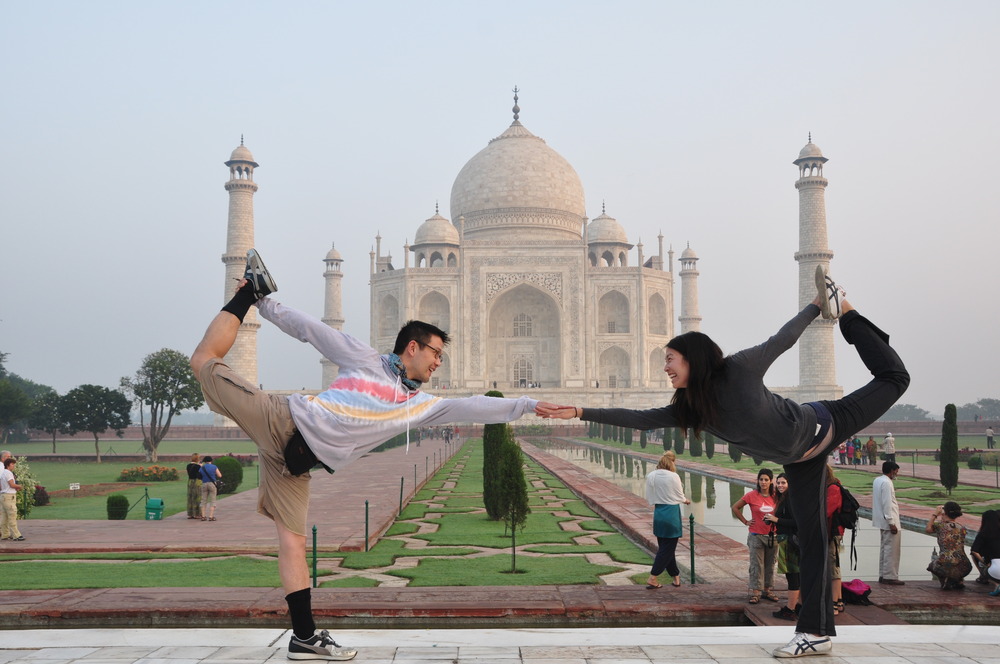
The next day we headed to the town of Agra to see the Jewel of India, the Taj Mahal. We first hired a car to Jhansi before boarding a train in coach class to Agra, which was an interesting and crowded 3 hour experience (before Di’s friends scold me, first class was sold out!). We arrived in the evening after a long day of travelling and crashed early so we could wake up in time for sunrise, supposedly when the Taj Mahal is visually at its best. The Taj, completed in 1653, was erected by Shah Jahan, ruler of the powerful Muslim Mughal empire at the time. He built it in memory of his second wife, Mumtaz Mahal, after she died giving birth to their 14th child. Legend has it that he was so distraught when she passed his hair turned grey pretty much overnight. We woke up at 5 to make it in time for dawn, and when we got there the Taj Mahal not only lived up to the hype, it blew it away. It was the most beautiful building I had ever laid my eyes on, and just looking at it actually invoked an emotional response in me, the first of any edifice to ever do that. Maybe it was its faultless symmetry, or its elegant lines and perfect proportions, or its sparkling white marble with the gentle pink dawn sky as its backdrop. Maybe it was because it was built out of love, or the grieving heartbreak of death. Maybe it was all of that, and something else indescribable. Whatever it was, it was a wonder to behold and something I couldn’t remove my gaze from. It was not only stunning from afar; a view up close revealed the unparalleled skill and mastery of its builders. The carvings, the calligraphy, the domes and arches, they were all amazing. Though obviously biased, when Shah Jahan beheld the finished building he said it made ‘the sun and the moon shed tears from their eyes’. I don’t think he was too far from the truth.
Afterwards we hopped on a bicycle rickshaw for 2 kms to check out the Agra Fort, nicely made of red sandstone and white marble. Much to the rickshaw driver’s delight Ron switched spots with him and pedaled the last bit to see what it was like. The palace/fort actually ended up becoming a prison for Shah Jahan during the last 8 years of his life as his son forced him there after usurping the throne. If we saw that fort anywhere else in India, I would have said it was pretty sweet. The unfortunate truth was that we saw it immediately after the Taj, so it was painfully underwhelming in comparison. Even writing this in hindsight I really don’t have much more to add as I couldn’t hold my attention to the structure while I was there, which is a shame.
Early next morning we parted ways with Ron as we went to Jaipur in the province of Rajasthan while he headed to Egypt. We caught the train (in 1st class this time) and made it in about 6 hours. After we checked into our guesthouse we quickly headed to the Amber Fort just outside of town to fill our afternoon. With a long train ride to compare it to instead of the Taj Mahal, I found the huge hilltop fort to be pretty cool. We actually got lost for a bit inside while checking out its maze of rooms. With a picturesque lake and garden below and defensive battlements all around the fort is definitely a worthy setting for an epic Bollywood story of love and war. The next day we headed to the old part of Jaipur, otherwise known as the Pink City. It was painted “pink” back in 1876 by the then Maharaja to welcome the Prince of Wales and it has remained that colour ever since. I put “pink” in quotation marks because it looked more like an ugly orange with a thick covering of mildew and pollution added in for extra flavour. We first checked out the city palace which also doubled as a museum, housing an impressive collection of art, weapons, and fabrics. We then walked around the corner to Hawa Mahal, Jaipur’s landmark. It’s a 5-story honeycombed structure that was built for the royal ladies so they could people watch in safety. The face of this building was definitely the cleanest and up kept of all the buildings in town, thus giving its viewer a glimpse of what the old city may have looked like at one time if not dirtied by the stains of time and pollution. We did find the unique honeycombed façade to be a lot more impressive than the building’s comparatively plain interior. After sightseeing we walked around the streets of the old city checking out the bazaars and daily Jaipurian activities. The mad traffic, dirty streets, thick smog, aggressive shopkeepers and general craziness prompted us to stop that quickly. Our guidebook recommended that for a break we should experience afternoon tea at Rambagh palace, an ex-residence of the Maharaja now converted to a luxury hotel which costs up to 5000 USD a night. So we walked up to the gates of the massive property looking forward to some cucumber sandwiches and scones. Our eagerness was met with rejection by the gate staff. Ouch, in our face! Supposedly the hotel was fully booked so its courtyard and restaurants were open to guests only. Disappointed, we headed for coffee at a far classier joint, McDonalds. Back in your face Rambagh!
After our sultry coffee in aristocratic red and yellow plastic surroundings we decided to head back to our hotel to call it a day. When we got outside to the waiting rickshaw drivers they surrounded us, vying for our rupees. I showed them our hotel business card, written in Hindi and English, when something very humbling happened. I realized that most (if not all) of them were illiterate as they all asked me to tell them the name of the hotel after blankly looking at the card. I looked up the stats and as of 2008, 40% of India still could not read. I offered 50 rupees to the group to anyone who would take us back, and they all denied, as usual. I turned around to walk away, which usually prompts one to grab me and say OK. I should have known there was something wrong when only a young guy agreed to the price while all the others were shaking their heads. We hopped in, and within 10 minutes we knew he was completely lost. He kept taking our hotel card and showing randoms on the street, asking for directions. These conversations would always attract others, and every time he asked there seemed to be a conglomeration of strangers trying to help us. After about 20 minutes he realized he was in over his head and said in broken English that our hotel was too far and he wanted more money. I could tell by the dejection in his face that he wasn’t lying (plus all the more experienced guys were not willing to take us for that price), but I was still kinda pissed off at the situation as he adamantly said he knew where our lodgings were when we hopped in. So I just gave him his 50 rupees and Di and I got off and started walking away, with both us and him being quite disappointed. We then entered the nearest store and showed the 2 guys there the hotel card and asked for directions. They discussed the issue for maybe a minute before one of them, with a wide smile and decent English, told us to get in his car. He drove us for about a kilometre and dropped us off at the front of our hotel, shaking our hands and wagging his head, grinning as he left. That experience actually sums up a lot of what we’ve felt while in India. At times it can be mind-numbingly frustrating, but then the cheerful help and the warm smile of a stranger inevitably comes, more than balancing out the initial negative experience. Di and I are working on our head-bobble so that hopefully before we move on to the next country we can respond to all the random acts of kindness here with that uniquely Indian gesture we are starting to love.
Bustling Delhi and Holy Varanasi

Eug and I are very lucky people. Right after we parted with our dear friends in Bhutan, we met up with one of my best friends Ron in Delhi, India. Ron had one week in India with us and one week in Egypt on his own before heading home to Seattle. He really wanted to see the Taj Mahal and the rest was up to us. Our one week itinerary with him was to visit the sights in Delhi, Varanasi, Khajuraho, and saving the best for last, the Taj Mahal in Agra.
Eug and I were in Delhi a day before Ron arrived, and we were running errands like there was no tomorrow. I felt more like a local who just moved to a new city than a tourist. It was a bit frustrating having to run around everywhere, especially when we ended up not being able to get anything done. We wanted to mail our wedding outfits back home, get Myanmar visas, and fix the most essential gadget of our trip, our SONY netbook. Unfortunately our netbook was dropped by the cleaning lady in Bhutan, and it turned very slow ever since. We need it to upload pictures, research places to stay, and most importantly keep up with our blog! We were sent to a few places and given a few telephone numbers, but they all led to dead ends. The netbook is useable still but it’s slowly dying day by day. For example, Didi gave us some of the wedding pictures he took for us but they all disappeared from our hard drive. Thanks Susan for uploading them on Facebook for us! I hope our netbook can survive 3 more months before it completely dies. And yes, only 3 more months left for our around the world trip, crazy hey? Due to the Diwali holiday (the Festival of Lights, India’s most widely celebrated Hindu event) we weren’t able to get visas, and the post office was not helpful either. So big thanks to Ron for offering to take our wedding outfits back home with him.
I was very excited to see Ron in Delhi. The last time I saw him was in March in Portugal which seemed like a decade ago. And I was looking forward to doing some sightseeing again like worry-free tourists and not having to run more errands. We first visited the Red Fort, a massive 2 km long structure. The Mughal Emperor, Shah Jahan completed this fort in 1648 but never moved his capital from Agra because he ended up being imprisoned in Agra Fort by his own son Aurangzeb. The fort was pretty cool and we walked across the street to the market in Old Delhi after to see Jama Masjid, India’s largest mosque. To our dismay the mosque was closed to tourists that day. We weren’t sure why but a scrawny uniformed man with a bamboo stick came out of nowhere and shooed us away without providing an explanation. Even though we didn’t see the mosque, we had quite an eye opening experience just walking through the market (Chandni Chowk). We certainly had never seen such poor hygiene and stunning poverty in the countries we visited so far and Ron had never seen anything like that, period. Eug and I walked through numerous busy Middle Eastern medinas and souqs, so we thought were used to the sensory overload. But we definitely weren’t prepared to witness something like ‘Slum Dog Millionaire’ right before our own eyes. It served as another reminder of how lucky and blessed we all are. Afterwards we checked out Humayun’s tomb which was very pleasant and peaceful to walk through in comparison. The city of Delhi itself was beautifully covered in lights and flowers due to the Diwali festival. The lights were meant to guide the Hindu god Lord Rama home from exile, and at night there was a constant barrage of festive fireworks.
We then took a short flight (instead of a long overnight train ride, thanks to Ron since he only had a limited amount of time with us) to Varanasi. Varanasi (picture above) is one of the holiest places in India. Hindus believe that they can wash away a lifetime of sins in the sacred waters of the Ganges River, so a lot of them come to bathe in this water. They also come here to cremate their loved ones so their ashes can become one with the holy river. Lastly, many Hindus come here to die with the belief that it offers liberation from the reincarnation cycle of birth and death. As soon as we checked into our guest house on the riverbank, we quickly got ready, eager to take a stroll down the Ganges to see some action. Our eagerness soon dissipated after walking no more than 20 minutes down the river. First of all, the street was covered in cow and goat and who-knows-what droppings left and right. If you only looked up for a second, you could easily step on one of the dangerous fresh poopie-traps. There were a ton of stray cows walking around aimlessly, as they are holy to Hindus and this is their holiest city. Lots of locals (both adults and kids) were just walking around barefoot, not caring if they stepped on crap. What I found to be the most disturbing was seeing a street dog eating a pile of faeces. I was seriously grossed out. Secondly, everyone who passes by you seems to want to shake your hand and talk you into visiting their stores or accepting their massage or shaving service. No thank you! I was lucky that they didn’t try to shake my hands because I am a girl. Poor Eug and Ron had to stick their hands in their pockets to avoid the constant physical contact because once they grabbed your hand, they wouldn’t let go. Thirdly, witnessing 4 visibly clear corpses being publicly burnt on top of 4 separate stacks of wood didn’t exactly make us feel particularly pleasant. The sight and smell of everything foul combined together was just unbearable. It was not an easy stroll I tell ya. Finally, the Ganges River from up close was very obviously dirty. There was garbage floating around everywhere and the water was dark greyish brown in colour. All 116 cities on the Ganges dump raw sewage into it. Water safe for swimming is supposed to have less than 500 faecal bacteria per litre; the Ganges has 1.5 million/L! Even with all that, the river was full of people bathing, swimming, drinking, and submerging themselves in its waters repetitively. We turned back after walking across the cremation site and found refuge in the rooftop restaurant of our guest house. It had an amazing view of the Ganges minus the distractions from the street. That evening, Eug and I got a sore throat and Ron got a severe bug bite on his cheek that didn’t stop draining pus for the rest of the night. We should’ve done what the Japanese tourists did and wear those SARS masks. We recovered shortly but oh boy, what an introduction to the city.
We woke up very early the next day and hopped on a boat ride down the Ganges to catch the sunrise and the dawn prayer ceremony from the water. The boat ride was much more comfortable than being on foot. The devout prayers and washings of the pilgrims were fascinating to see but the most memorable part of the river trip was seeing a dead corpse floating face-down on the river. When I saw it, I quickly looked away and asked Eug and Ron in Cantonese if it was what I thought it was. Eug was like “no, it’s a mannequin”. Then there was a long pause before Eug and Ron both agreed it was indeed a body. We learned that there were dead bodies in the Ganges from other travellers and our research, however, I didn’t think we’d really see one. Supposedly some poor families can’t afford to buy firewood so their relatives’ bodies would just be placed in the water. Others would buy wood but not enough due to lack of funds, so partially cremated bodies would also be placed in the water. Our boat driver was considerate enough to row away from it, but not another boat that was just 5 feet away from us. There were 3 western tourists on that boat, and their boat actually rowed into the corpse as it got knocked away. One of the girls covered her mouth immediately, she looked like she was about to throw up; I felt so bad for her. At this point, Ron was trying to hold in his laughter so badly that his body was vehemently shaking. He didn’t laugh because it was funny, but because the whole thing was just so far-fetched that you couldn’t help but to react in some way. I just had a very grossed out face. Needless to say, for the rest of the day we chilled in our guest house to recuperate both mentally and physically. We did manage to find a nice restaurant with an excellent view of the river to have dinner. In the evening, the river was beautifully lit with lotus flower candles set adrift from the shore, and there were fireworks on land because of the Diwali festival. We also checked out an evening ceremony which attracted a huge friendly crowd. In contrast with the day, it was a rather delightful evening.
That was quite an experience for our first 3 days in India. I am not sure if I’ve digested all that myself yet, but I know our eyes have definitely been widely opened. Ron, Eug, and I talked about some of the living conditions we’ve observed and if there could be any feasible solutions to improve these conditions. Hopefully with the massive economic growth in India we all hear about the government will be able to increase funding in education, infrastructure and housing, thus putting India’s poor on the first rung of the ladder of economic development, lifting them out of abject poverty.
Bhutan – Land of The Thunder Dragon

In an age where most countries measure their achievement by their Gross Domestic Product, Bhutan’s fourth King, Jigme Singye Wangchuck, decided to measure his countries’ success by the overall wellbeing of his people. He thus created his now famous Gross National Happiness (GNH) index. He believed that “unless an inward change in human consciousness and perception occurs, the mere creation of wealth and economic growth alone cannot guarantee collective human happiness”. This approach was quite easily implemented in his kingdom for a few reasons. Firstly, his subjects absolutely admire him and truly believe he is an enlightened and selfless ruler. There is no other country we’ve been to so far where everyone so universally loves their leader. They all call him wise, farsighted, and passionate about their wellbeing, and from what I can see that does actually seem to be the case. Secondly, Bhutan is a deeply Buddhist nation, and Buddhist ideology stresses the impermanence of material things. The notion that happiness comes from within is deeply rooted in its teachings. We, on the other hand, are constantly bombarded by commercials that tell us happiness is measured by how big our house is or how many cars are sitting in our garage or how many Apple gadgets we have. Though I’m not saying one approach is right and another is wrong, I think it’s great that Bhutan has a different (and arguably better) take than the rest of us. If you want to learn more about GNH, I suggest you check out www.grossnationalhappiness.com. It’s pretty cool stuff and a completely different perspective on nation development than any other county on Earth.
I forgot to mention that the King recently did one thing that was quite unpopular with his adoring citizens. He abdicated his throne back in 2006 at the age of 51 after ruling for 34 years. Was it because of some scandal or some ridiculously unsuccessful war effort? Nope. It was because research has shown that citizens are generally happier in democracies than in Kingdoms, and he wanted to do what he thought was beneficial to the welfare of his people (from a happiness and a democratic governing standpoint). Have you ever heard of an all-powerful King doing something like that? Ya, me neither.
We visited the Western part of the country, staying in towns like Paro, Thimpu, and Punakha. We hiked high up to the mystical Tigers nest monastery (pictured above) that literally clings to the side of a steep cliff, straight out of the pages of some epic movie. Punakha has a beautiful dzong (fortress/monastery) that looks like it’s built from what mythical Himalayan legends are made of. Bhutan even has a unique animal called the Takin. Legend says it was created by a magical saint/monk who combined a goat with a cow (which is exactly what it looks like) when asked to perform a miracle. Eat that Napoleon Dynamite, your Liger has nothing on a Takin. But even with all those spectacular sights, it truly was the spiritual, humble, and peaceful aura of the people that touched us the most.
Bhutan is by no means a wealthy country; you’re not going to be seeing a Porsche dealership opening here anytime soon. However, it also doesn’t seem like a poor country either. The roads are all paved, infrastructure is good, cities are quite clean, and there are no signs of homelessness or extreme poverty. Its citizens are definitely not rich, but they do seem very happy. In fact, I don’t think we’ve seen more genuine smiles from people of all ages in any other country. It also helps that the Bhutanese valley is strikingly gorgeous. Add to that the beautiful, well-preserved and busy monasteries, temples, and dzongs with hundreds of red-robed monks and you’ve got an amazing place. Driving on the road you’ll have no problems seeing archery contests (where dudes hit small targets 145 m away!) among farmers harvesting rice, you’ll see big penises painted onto the sides of houses as a sign of fertility (awesome), and you’ll see groups of children in traditional Bhutanese wear running to school. Since it’s so isolated, the almighty tourist dollar doesn’t seem to have seriously affected the monastic way of life or the peoples view of tourists. English is spoken amazingly well by the average citizen and they had no problem, be it monk or student or waiter, engaging us in friendly conversation. Bhutan’s strict tourism laws, which everyone groans about, actually seem to be a very good thing now that I’ve seen the results. For those who don’t know, in order for you to visit Bhutan, you must spend a minimum of 200USD a day per person and be on a personalized tour. You basically have to wire the money over first to them before you can get a visa. Though this does include hotel and food, it is still extremely pricey. This part of our trip has hands down been the most expensive portion. However, by forcing people to spend that much, the Bhutanese have been able to attract the type of tourist they want. They’re typically getting the traveller that is very interested in their culture and less interested in drinking as much alcohol as they can at a hotel’s open bar (which very quickly creates a jaded general population). Also by making it that expensive, it really limits the number of visitors coming into this tiny nation of 700 000 people so the locals really don’t get overwhelmed.
So what do we think of Bhutan? We love it. A lot. It’s a truly, truly amazing place unlike anywhere else on Earth. Much of the world believes happiness is the physiological response to a favourable stimulus, like a new big-screen TV. Governments have thus created policies and economies which have the ultimate goal of making more money for its citizens. Bhutan’s more humanistic (as opposed to materialistic), holistic, and spiritual approach to happiness gives it an unrivalled uniqueness among its peers. You can definitely feel the positive effects this has had on its populace. But as with everything, things can change. Bhutan is still investing in economic growth as well as it does want to increase its level of development. The younger people (who really are the future) are wearing traditional clothes less and less, and with easy access to the internet they have a larger understanding of the outside world and its many luxuries. Bhutan has made huge investments into the education of its youth and the promotion of its culture internally. Only time will tell if they will modernize and progress into the 21st century while maintaining their distinctive view on what constitutes a happy society. I’m really hoping that they can achieve their goal of socio-economic development paired with the preservation of their Buddhist and Bhutanese cultural values. It’s a fine line to walk, but I’m highly optimistic that they can do it.
Bye-Bye Bachelorhood

He Said:
Up here in the extraordinary land of Bhutan, nestled in the Himalayas, Diana Chen married me with the blessings of the head monk at the Dechen Phodrang monastery in Thimpu. Yes, a real-life beautiful girl married me! Even I’m having a tough time believing that.
After learning more about Bhutan, Di and I made the decision to get married there a few weeks before we went. We asked the tour company to organize a small ceremony for us, which they graciously did. Though Bhutan doesn’t have much of a wedding industry (none in fact, catered to foreigners) they were able to provide a wedding bouquet freshly cut from someone’s yard that morning. We could tell it was fresh because there were still small caterpillars crawling inside the flower petals. They also took us to a shop the night before to get us fitted in traditional Bhutanese wear. The ladies all got a Kira each and Didi and I bought a Goh. Susan and Lorea decided to buy identical outfits to fill the bridesmaid role, while Didi looked pretty sweet in his Goh combined with my Converse kicks. I had to borrow the dress shoes he brought instead, since the Bhutanese guys wear a Goh with black leather shoes at formal events. Di looked graceful, elegant and absolutely beautiful in her Bhutanese Kira. After we got all prettied up, we headed around town to visit a couple of auspicious sites for good luck before our ceremony. One was a large stupa that we had to walk around 3 times in a clockwise direction, and another was an old monastery on top of the hill overlooking Thimpu where we were to ask for blessings. We then made it to the monastery where we got married amid monks chanting and playing music. The chanting was monotonous and the music was quite basic but put altogether with the monastery and monks it was a surreal experience and I don’t think we could have picked a better place to do it on this trip.
After letting everything settle in we took a few pics with the monks and our guests (who included the people from the tour company). Didi then got us to change into the western clothes that he brought for us. Di was stunningly gorgeous in her white dress! Seeing her was breathtaking, and no I’m not exaggerating. We took pics around the monastery with the young monks all running around. Some of the teenage monks were playing volleyball so I decided to join in with them. Even Di came to serve a couple of times in her wedding dress. Pretty soon we had the whole place surrounding us watching the game and laughing. I never thought I’d be playing volleyball in a suit with a team of monks in a Bhutanese monastery, but I’m super happy I did. After that we headed to the centre of Thimpu to take a few pictures as well. It was quite a sight, for all the Bhutanese! Our guide told us that everyone watching on the street had probably never seen a girl in a white wedding dress before. A large crowd of onlookers quickly amassed around us, taking pictures with their cell phone cameras. When we wanted to take shots on the road, the traffic cops helped us out. When we wanted to take shots in people’s cars or from peoples windows, they quickly let us in. Everyone was extremely accommodating. As I’ve said before in this blog, I’m no model; uncomfortable is an understatement of how I felt with the crowds watching us and Didi shooting. But the pics turned out great, especially if you focus more on Di’s face and less on mine. Thanks Didi (and his assistants for the day Susan, Lorea, and our guide Dhendup)!
I’m extremely grateful to Bhutan, its monks, and its people for giving us the wonderful opportunity to get married in a place that felt perfect for us. The people at Blue Poppy travel and our guide Dhendup (dhendupnill84@hotmail.com) did a remarkable job. We were originally planning to do a wedding with just the 2 of us somewhere on this trip, but having Didi, Susan and Lorea join was a fantastic surprise.
Di and I have had an incredible journey for the past 8 months, and now we’ll have the rest of our live to continue the fun. Rock On!
Oh I forgot to add that technically we aren’t married yet by Canadian law as they don’t really recognize the marriage certificate given by the Bhutanese monastery. We’ll still have to register back home, so you know what that means? Bachelor paaarrrttaay!
The Happiest Moment in the Happiest Country

She said:
“Are we married yet?” I whispered, Eug replied “I have no idea.” I looked back at the monks chanting in unison and one of them gestured us to walk up to the head monk. We shuffled along (alright, it was mainly me because I was in the traditional Bhutanese kira and I kept on stepping on it) and came to a stop when we reached the head monk sitting higher up on a raised platform. He had looked very serious when he was chanting earlier but he instantaneously broke into a warm smile and gave us his blessings. He then handed us a certificate (only our names were legible to us, the rest was in Bhutanese) and sent us back to our seats. “We are married?!” I asked Eug while trying hard to refrain from jumping up and down since the monks continued on chanting. “Yeah, I guess so.” Eug replied quietly. He looked like he was about to let out some tears of joy, or was it tears of sadness parting with his bachelor-hood? Then we decided to do a quick ring exchange on the side to say the magical “I Do’s” to each other before a cup of hot milk tea was brought to us. We were told to take turns feeding each other some tea to signify that we were one together (or something like that). I was too excited to remember the details but I did remember the tea being very good and the biscuits that came with the tea were delicious too. I couldn’t stop eating because I was famished by then. And I couldn’t stop smiling because I was ecstatic. We got married!!!
That all took place in the Dechen Phodrang monastery in Thimpu, Bhutan. We took a short flight from Kathmandu to Bhutan and the time change was a difference of 15 minutes. I thought that was strange. Bhutan is supposedly the happiest place in the world. It measures neither GDP nor GNP but GNH – Gross National Happiness. Since then 90% of the people have been ‘happy’, so we were told by our passionate and enthusiastic guide Dhendup. Dhendup also pointed out that there aren’t any traffic lights in the entire country. They aren’t necessary because the drivers tend to let others go first. I might also add that there aren’t any Stop signs either. The Bhutanese people lead simple lives and their beloved King encourages the people to strive for true happiness derived from within and not from materialism. McDonald’s and almost any stores we are used to seeing don’t exist in this country. In such a place, you might question how did Eug get a suit and how did I get my wedding gown and makeup? Especially since you can probably count out all the times I’ve actually worn makeup, which is not much at all. Thanks to our dear friends, Didi, Susan, and Lorea, everything worked out perfectly. Eug looked like a rock star (yeahhhhh! That’s my husband!) and I was able to get the most gorgeous wedding dress, ample makeup supplies, and even a curling iron! They brought everything necessary. Didi is also an excellent photographer and a professional model himself, so the pictures he took were absolutely amazing. I really can’t thank them enough. When we booked our Bhutan trip, we only expected to be in some Bhutanese traditional wear with our jeans and our guide would help to snap a few pictures here and there for us during the ceremony. Initially, Susan and Lorea were going to join us in India, but they couldn’t make it in November so they decided to join us earlier instead in Bhutan. And Didi offered to shoot some pictures for us in Bhutan around the same time too. It all worked out incredibly well somehow. Thanks for everything guys!
We will have a celebration back at home with everyone next year. Stay tuned! 🙂
Krazy Kathmandu

Once we crossed the border from Tibet into Nepal the group of us hired a car to take us to the travellers district of Thamel in the heart of Kathmandu where we were all staying. I had stayed there 5 years earlier, also in the high season of October, but back then Nepal was in civil war. As a result there were not many travellers and Thamel felt almost like a ghost town. This time around was the complete opposite. The streets were crowded with cars, bikes and a wide assortment of travellers, from the older tour bus crowd to the new-age hippy to the hardcore mountaineer. There were a ton of busy restaurants, cafes, bars, hotels, and shady dance clubs. It was like a Nepali version of Khao San Road in Bangkok.
Our original plan way back when was to stay for 2 weeks in Nepal so that we could hike the Annapurna circuit. We had booked our flight to leave to Bhutan on the 28th (which had to be planned way before) and had allocated about 6 weeks for China/HK. We ended up staying a lot longer in Hong Kong than we expected, therefore cutting our time to only 4 days in Nepal. With such little time we didn’t have many options for trekking. We therefore decided to spend a few days exploring Kathmandu city and its surrounding valley, and another day doing some white water-rafting on one of Nepal’s famous rivers. After checking in to our hotel we went to a café with wifi where we were able to log in to facebook for the first time in over a month. What was crazy was that through facebook status updates we were able to find out that our Australian buddy Kent, who we travelled all of Syria with a few months earlier, was also in town at the exact same time. After Syria we parted ways as we continued heading south while he made his way to Europe. We immediately met up with him as he was also staying in Thamel and we had a great night catching up. Ahh the magic of facebook.
We spent one afternoon in Kathmandu’s Durbar square, about 15 minutes away from Thamel. This square is the heart of old Kathmandu and has a pretty cool collection of ancient architecture. The last time I was here the only foreigners were my buddy Adrian and I, and a bunch of Hare Krishna dudes. This time the place was deservedly packed with tourists. We spent the next day in the old town of Bhaktapur and at the Changu Narayan temple, about 25 km out from the heart of Kathmandu. Changu Narayan had a nice little temple on top of a hill and an excellent collection of Hindu stone sculptures dating back to the 5th century. Bhaktapur was the place we liked the most of Kathmandu’s sights though. Its Durbar square (pictured above) is a lot less busy than Kathmandu’s and the area is refreshingly traffic free. The town seems a lot more intact, physically and culturally, than Kathmandu’s old town. The Newari style architecture with its intricate wood carvings was a pleasure to admire, and the laid back atmosphere of its streets and residents was a far cry from Thamel’s hustle. In fact, if you’re not into air pollution and loud music I think Bhaktapur is a fantastic place to make as a base in the Kathmandu valley instead of Thamel as it’s still very close but it’s a lot nicer and quieter.
The next day we went white water rafting in the Trisuli river. The bus left early in the morning, only to be delayed by 3 hours due to really heavy traffic before reaching the drop off point. Not fun. The river itself was decent with some Class II and III rapids. Not exciting enough to write home about, but still enjoyable. The better rafting trips were farther out with camping on the riverbanks mandatory for at least one night, an extra night we didn’t have. Thus we stuck with this one day trip and completed our journey about 4 hours after getting in the water. The rafting company assured us a ride back on a bus to Kathmandu when the trip was over. What they didn’t say was that meant waiting by the side of the road for a random bus to Kathmandu to stop for us. Since the morning bus ride to the rafting point took so long, by the time we were ready to go back to the city it was late and not many buses were passing by. When we finally got one, it was already pretty full. This meant the ladies got to sit inside, and 2 Korean guys and I had to get on the roof where a luggage rack also doubled as “extra seating”. The luggage-less luggage rack was just a series of one-inch thick metal rods running front to back and a guardrail about 6 inches high all around. You know how when you travel to a foreign country you want to live life like the locals to maximize your experience and understanding? This was not one of those times. I sat down with a nice hemorrhoid-inducing rod right in between my butt cheeks, just like the rest of the Nepali dudes who were chilling up on the roof. Things only went downhill from there. When the ancient bus started up I quickly grabbed some metal bars on either side of me for stability. The highway was windy and the driver was driving damn fast, and with each pitch and roll I could feel myself holding on for dear life as I tried to lean into each turn so I wouldn’t tumble over the edge. The driver was passing cars, motorbikes, and trucks like he was driving the Daytona 500. I tried to think positive the whole time to make myself feel better. For example, I was like “my shorts were soaking wet after finishing rafting, but they’ve become dry super quickly up here with all the wind in my trunks”. However as our bus came around a blind corner another oncoming bus approached in our lane as it was trying to pass a truck. Both vehicles slammed on their brakes to come a complete halt. As I saw the other bus come around the corner I heard the 2 Koreans yell in unison “WHOOAAAAAAAA”. I, on the other hand, was far cruder as I heard the words “HOLEEEE SH*******T!!” coming out of my mouth while I held onto the bars as hard as I could in case we hit each other. Have you ever thought about what you want your last words to be? I have now, and I’m 100% positive I don’t want them to be “Holy Sh*t”. Thankfully both busses were able to just miss crashing into each other head-on. My recently dried swimming trunks I was trying make myself feel better about almost became soaked again, only this time with my own urine instead of river water. After about an hour of this the bus driver stopped at a rest stop and I quickly got down from the rooftop, grateful for being alive as I touched solid ground. Di and the other ladies were laughing at us as they waited for us to climb down from the top. Di said with much amusement that with every sharp turn or bump in the road she would look out the window, expecting to see my body rolling off the roof. Though I’m down with the jokes, that wasn’t too comical to me at the time as I just endured an hour long ride from hell with the sensitive part of my ass on a cold metal rod. When the bus started up again, the 2 Koreans and I forced ourselves inside as we refused to get back up on the roof. They ended up sitting in the aisle, and I cozied up beside the driver. I took a look at his speedometer for the rest of the 2 hour ride back to town, and he was consistently between 50-80 km/h the whole time. That might not sound like much, but when you’re on the roof of a bus it feels damn fast. And what were the rest of the Nepali dudes doing up there as the 3 of us newbies were having the crap scared out of us? They were enjoying the scenery or listening to their mp3 players, calm as Hindu cows. Though I’m sure experience has a lot to do with that, I’m not willing to build up my hours on the roof of a bus to find out. So yes you Nepalis out there who have no problem bus surfing, I commend your bravery and concede that I am a wimp compared to you.
Nepal, being wedged between Tibet and India, has been influenced heavily by both of those countries and their respective religions. Thus a lot of their architecture and culture has aspects of Indian Hinduism and Tibetan Buddhism, which is a pretty cool combination. In addition, its outdoor activities of biking, rafting, canyoning, and especially trekking are obviously world famous. Kathmandu is far from a picturesque town nestled in the shadow of the Himalayas. There is enough for you to see here for a few days (like what we did) before heading into the mountains to really enjoy what Nepal has to offer. It’s too bad we didn’t have enough time, as we heard the Annapurna trek is gorgeous. With Everest Base Camp or Langtang as other amazing trekking options in Nepal you could easily spend well over 3 weeks here. I know I’ve said this about other countries on this blog, but Nepal is definitely one we’ll need to come back to. The next time around though I’ll just hire a driver.
 fromwonderintowonder
Recent Comments