Groovin…On a Sunday Afternoon

Growing up with a silver spoon meant my family spent a lot of time in the Caribbean when I was a kid. This was the era of Tom Cruise in Cocktail, so I was surrounded by older dudes in Hawaiian shirts with overly tanned wives drinking colourful concoctions that always had a mini umbrella out the top. One of many things I fondly remember about those vacations was the soundtrack of the beach; songs like Groovin (the Young Rascals), Red Red Wine (UB40), and Baby I Love Your Way (Peter Frampton) were constantly playing. When I got older and started heading to the beaches of California a new soundtrack started to form, one that I thought was infinitely cooler since I, as a teenager, was infinitely cooler (or so I thought) than overweight drunk lawyers in the Cayman Islands. Songs by the Dove Shock, Warren G and Sublime were always in my Sony Discman (with 9 second ESP I might add, pretty awesome). The reason I bring up this music is because I’m currently looking out at the turquoise waters of the Andaman sea on Klong Dao beach, a beautiful stretch of sand on the Thai Island of Koh Lanta. Here, the music of Jack Johnson has taken over. I have nothing against Jack Johnson, I used to like him a lot (I still do but less than before, overexposure tends to do that to an artist) but I do find it a little unfortunate that the islands and beaches of SE Asia, which I like more than those of the Caribbean, don’t have their own home-grown sound that matches the vibe of the ocean. I will make the statement that when it comes to music on the beaches all over the world though, there is still one king to rule them all, one king to find them, one king to bring them all and in the music bind them. That king, deservedly, is Bob Marley. He’s still the one voice common to every beach we’ve ever been to. I’m hoping you can tell by my reference to the Lord of the Rings that I no longer think I’m infinitely cooler than anyone else, including overweight drunk lawyers having fun, dancing and singing to Kokomo in the Caymans. However, I do hope that one day I won’t be that drunk, overweight dentist trying to get people to do the Macarena with me. Fingers crossed.
After Myanmar we returned to Bangkok for a night so that we could have my stitches finally removed. Once that was done we headed to Phuket for a night before taking a ferry to the island of Koh Lanta, briefly stopping at Koh Phi Phi. Phuket is kind of the resort hub of the area, with all the big hotel brand names setting up shop. Further south are the islands of Koh Phi Phi, made famous by dreamy Leonardo Di Caprio in the movie The Beach. Phi Phi, like many other Thai Islands, used to be a backpackers haven, but the place has completely changed with overdevelopment and speedboat day trippers from Phuket. Some still think it’s paradise while others, especially those who knew what it once was, are on the verge of tears when they see what has happened. The Thai government had a chance, under horrific circumstances, to redevelop Phi Phi sustainably (supposedly it’s currently an environmental disaster waiting to happen due to its fragile ecosystem) when it was basically wiped out by the tsunami in 2004. However things now, unfortunately, look just like they did immediately pre-tsunami. Di and I decided to head further south to the larger and less-famous Island of Koh Lanta, which has a more groovin (I’m bringing that word back for this post) vibe and extremely long stretches of beach along its coastline. Since we had been moving around a lot, we also decided to spend 5 full nights here without checking out the rest of Krabi province even though it’s considered Thailand’s most beautiful.
The first thing we noticed when we arrived was that most everyone had really blonde hair and blue eyes. Further questioning provided some answers; most of the tourists were from Sweden, with the rest being largely from other Scandinavian countries. We had barely met any Scandinavians over the past 10 months, and now we were surrounded by them. Most of them were families on their Christmas vacation. Supposedly once the infrastructure was set up and direct flights opened up from Stockholm word of mouth got back to Sweden and they all started to come to Koh Lanta. The Swedes, however, don’t sound like the dude in the funny IKEA commercials back home, their English is far better. That was a shame really for me, as I’m a fan of hilarious accents.
Anyways, we went scuba diving with a recommended Swedish company, and the service was amazing compared to our other dive trips so far. We basically didn’t have to do anything but put on our mask, BCD and fins and jump in the water; everything else was done for us. We went diving around the islands of Koh Ha Yai. When we told our German divemaster that our last dives were in Palau, he conceded that here the diving was catered to families who rarely dived anywhere else. He thought we should try diving around Thailand on a liveaboard, which is a boat you live aboard (hence the name) and where all you do is scuba dive, sleep and eat for as many days as you want. He, and other hardcore divers, was of the opinion that the underwater experience would be unparalleled. He was basically implying that though the tourists on the boat would find the diving awesome at Koh Ha Yai, we might not. He was right. The diving was still good and enjoyable though so no complaints. We also did have fun hanging out with a Swedish couple on the boat and we met up with them later on the island for food and drinks. The rest of our days were just basically spent groovin; we scootered around the island checking out other beaches, paddle surfed, got Thai massages, and ate delicious Thai food. Life was good, and we could definitely see ourselves retiring somewhere in the south of Thailand in the future. Being surrounded by Swedes but not knowing their writers, I also decided to read the Stieg Larsson Millenium trilogy which Di recommended and which turned out to be pretty entertaining. I’ve mostly been reading non-fiction on this trip so Swedish mystery novels were a nice change.
We spent Christmas day here yesterday, my first without my large extended family around in a long time. I did miss them a lot but we skyped them to send our xmas greetings. Our xmas dinner was pad thai and curry, nothing like my aunt and uncles’ turkey and stuffing but Di and I were still happy to spend it together and thankful for our amazing year so far. We also decided that though we’ve enjoyed travelling mostly in the developing world, we’re ready to slow things down as our trip is coming to an end and we are starting to get tired of harder travel. So, from here on out, life will be on easy street; no more “tough” countries. We’re going to head to Kuala Lumpur after this just for a couple of days before flying to Taipei for New years with our friends. After that, if all goes well, we’ll finish things off in Australia, HK and Japan where we also have friends. Groovin! (I don’t think that word works here but I’m using it anyway)
So in the immortal words of Trooper (in the lyrics of a song that happily reminds me both of Caribbean beaches and my days at UBC where it was a sort of theme song for the sunny days in our residence house) I’d like to finish off by saying:
We’re here for a good time, not a long time, so have a good time, the sun can’t shine every day.
Merry Xmas everyone
The Temples of Bagan and The Waters of Inle Lake

After Mandalay, we took a very short flight covering 190km south to Bagan. Bagan is officially known as the “Bagan Archaeological Zone” consisting of approximately 2000 temples. The ambitious Bagan kings built about 4400 temples on the riverside plain over a 230 year period in this area, but some were lost to erosion, earthquakes, and neglect over the years. Bagan includes three main areas, Nyaung U, Old Bagan, and New Bagan. Nyaung U is the biggest town housing most guest houses for independent travellers and a supposedly vibrant restaurant street. Old Bagan is within the old city walls in the core of the archaeological zone. There’s no one living in Old Bagan now except for tourists occupying the high end hotels in the area. New Bagan is where the inhabitants of Old Bagan were relocated to in 1990 by the government. It has some restaurants and middle range accommodations. Needless to say, with the way we roll on this trip, we settled in Nyaung U and paid $20 a night for our accommodation. That’s a $20 crisp new bill without Eug commenting on how stupid the banks here are when he paid the owner. There are three ways to experience the multitude of temples scattered throughout Bagan, either by taxi, bicycle, or horse carriage. Because we only had one full day here to cover 30km, a bicycle would be too slow and a taxi wouldn’t be able to get into the less accessible sites, so we settled on the romantic horse carriage option. We shared the horse carriage with a German girl whose boyfriend got sick a few days earlier from eating something that upset his stomach leaving him in the hotel. It was a shame for him but we ended up having an amazing day visiting the sights. The temples themselves were pretty cool, some Indian-ish, one was all white like a castle, one was shaped like the pyramids. But what we couldn’t stop raving about was the landscape of the archaeological zone viewed from atop of the temples. As Lonely Planet put it, “imagine all the medieval cathedrals of Europe sitting on Manhattan island”, but replace the cathedrals with temples or payas, as they call them in Myanmar, all around the archaeological zone. Whenever we could hike to the top of a tall paya, we would take our time to soak up the incredible landscape of endless temples stretching all the way out to the horizon. We were able to catch the sunset from the top of one of them as well. The views were utterly stunning.
The next day we flew to Heho from Bagan. Heho was an hour away from our guest house in Nyaungshwe, a town on the shores of Inle Lake which was our next discovery point. By our guest house we ran into four Singaporean travellers we had seen before in Mandalay and Bagan. It turned out that they were also travelling independently and had planned the exact same itinerary as us for the 9 days in Myanmar. In addition, one of the girls was recently transferred to Hong Kong and she worked together with one of our friends there. Talk about a small world! They were going to bike around Inle that afternoon, and since we didn’t have any plans for the day we decided to join them. Our Asian bicycle entourage biked through the country side roads of Inle passing through many small villages. The narrow cement road we rode on was surrounded by vast plots of farmland on both sides. Almost all the villagers who noticed us going by smiled and waved madly at us to say hi. The children always gave a curious look at first followed by the cutest innocent smile. The playful naughty ones would run up to us while reaching out their small palms to give us high fives as we rode by. The purity of their welcoming gestures left us feeling warm and fuzzy all over. About half way through our ride, we needed to hop on a boat to take us across the lake to continue our journey home. The size of the boat was about half that of a dragon boat we see back at home on false creek. I couldn’t believe our boatman (a 60 year old grandpa) was able fit all 6 of us and our 6 bikes plus himself onto his boat. We meandered through blocks of houses sitting on stilts on the water. It was very interesting to see the local people in these houses washing clothes, eating meals, or just chatting away and hanging out with their neighbours having a good time. By the time we reached the other side of the lake it was already approaching sunset. Since Eug and I were still traumatized from the unpleasant memory of riding bikes in the dark, we tried our best to keep on pedaling so we could get back to Nyaungshwe before night fell. We all made it back just a bit after sunset. What a relief! Our travel companions were saying how fit we were because we didn’t stop cycling, little did they know we just wanted ‘safety first’. The next day the 6 of us hired a boat to go around Inle Lake, one of Myanmar’s treasures. Inle Lake is 22km long and 11km wide. It is home to 17 villages on stilts inhabited by the Intha people. We started off the day with a visit to a market. The boat ride there took about an hour and it was peaceful. We passed by a few fishermen along the way (picture above). The hardworking Intha people are known for propelling their flat bottom boats by standing at the rear of the boat on one leg while wrapping their other leg around the oar to row the boat. I eventually fell asleep for a bit on the comfortable boat ride and Eug just daydreamed. It was one of those perfect quiet moments where you could just relax and enjoy the scenery without having to worry about anything. The market had the usual tourist souvenir stands but also a lot of local produce where the locals go and shop. We spent much of our time wandering around the fruits and vegetable stands to people watch. Too bad there weren’t a lot of tourists there, because we learned that watching the tourists with the locals can be pretty fun and entertaining too. We were taken to several shops on stilts along the way to see how the local lotus and silk scarves were weaved and how tobacco, paper (like the ones in the Papyrus store), silver jewellery, etc were made. It’s incredible to see how everything was fabricated using the most basic tools; there’s definitely no modern machinery involved here. However the highlight of the day long boat trip for us was really the dazzling scenery. Almost every picture we took possessed a post card quality because of the clean black water reflecting everything above it. It’s no wonder that Louis Vuitton did a beautiful advertising campaign with its photo shots all taken on Inle. A simple wooden house on stilts with some grass on the side sitting on the placid clear water reflecting a mirror image of itself against the blue sky was all it took to make the day perfect. It was a photographer’s dream and we were spoiled by seeing tons of that.
I remembered feeling like “ugh, can we get out of here already?” upon arriving in Yangon, eating not-so-good street food and sleeping in smelly bed sheets. It was dirty (though not as dirty as India) and ghetto and I was tired of travelling in developing countries again after having a taste of luxury that a clean and modern city like Bangkok offered. Eug then told me to give it a chance since that was only our first day in Myanmar. I’m glad he gave me that advice because having spent the last few days in Bagan and Inle, I actually wished we had more time in Myanmar! Most travellers we met allocated 3 weeks to a month in Myanmar and we were only able to spend a short 9 days here. It’s a huge country with a lot more to see and we agreed this is somewhere we will definitely return in the future for a more thorough visit. Hopefully by that time the military regime will have changed and the citizens will have a better quality of life. Just in case, we’ll make sure we bring all virgin bills next time.
Burmese Days

The title of this entry is my tribute to George Orwell, who lived in Burma for a while and wrote a book with the same title. I’ve rediscovered his writings on our voyage with a new appreciation.
With the doctor’s OK we took a flight to Yangon to start our time in Myanmar, formally known as Burma. We were originally going to stay here for 2 weeks but had to shorten our trip to 9 days because of our unintended longer stay in Bangkok. In our limited time we decided to visit Myanmar’s ‘Big Four’: Yangon, Mandalay, Bagan, and the Inle Lake area.
Myanmar, nestled between India/Bangladesh on one side and China/Thailand/Laos on the other, is one of those countries that is quite isolated from the international community. It is ruled, quite brutally in many instances, by a repressive military junta. Many western countries have enforced full economic sanctions against Myanmar because of this regime, and there is an active debate among travellers on whether to even visit this country since some of your money will inevitably end up in the governments’ dirty hands. However, everyone we spoke to who had been to Myanmar had nothing but amazing things to say about the land and its people. Their collective advice was to visit the country but to avoid giving as much money as possible to the government, ie don’t stay in government hotels or take government transport etc. So Di and I followed their recommendations to go, and our only regret is that we had too little time here.
Yangon is the capital of this large country (about the size of France) and is home to 5 million people. Yangon’s landmark is the Shwedagon Paya, the most sacred of all Buddhist sites in the country and on the top of every citizen’s pilgrimage list. At the centre of the grounds was a huge golden domed stupa (picture above), purportedly enshrining some hairs of the Buddha. The stupa was surrounded by a myriad of other temples and buildings, all filled with different Buddha statues. Though the site itself from an architectural standpoint was pretty interesting, what made the afternoon we spent here more worthwhile was the people watching. Unlike the famous Buddhist temples in Bangkok where tourists far outnumber the devout, I counted 7 of us foreigners among the hundreds of local worshippers, monks and nuns. Though many were praying and chanting, the atmosphere was very casual with families running around and smiling faces more plentiful than solemn ones. The picture above may make the place look rather ominous with the cloudy weather, but really the mood there was the exact opposite. When Buddha-statue-overload started to kick in, we headed to the Bogyoke Aung Sang Market to check out Myanmar’s famous jewellery stores and their world renowned jade and ruby collections. When we arrived it was actually quite intimidating, as there were hundreds of shops and the jewellery section was overwhelming. We were hoping to learn why Myanmar’s jades and ‘pigeon’s blood’ rubies were so famous but we weren’t willing to listen to the hard sell (which was what this market seemed to be about) so we just walked through and glanced at the gems. Luckily for my wallet Di didn’t buy. As an aside companies like Tiffany & Co, Cartier and Bulgari have stopped buying Myanmar’s gems (though their rubies are supposed to be the best in the world) as profits help fund the suppressive military regime. There are counterpoints by others who say that bans and sanctions only repress economic development which hurts the average Burmese citizen more than the government.
After Yangon we went to Mandalay, Myanmar’s other big city. When we checked in to our hotel I tried to pay with our US 20 dollar bills. We were warned by other travellers that there is a pretty strict policy here where you have to pay in USD and the bills have to be in really good condition, ie no stains, tears, or even creases. This is supposedly because the Myanmar bank only takes good quality bills from locals and if the bank doesn’t want them they’re SOL. Getting bills rejected is a pretty big problem for travellers because there are no banks in this country for you to take out money and no one accepts credit cards. Knowing about this beforehand, I actually performed the ridiculous job of ironing all my American money at our guest house in Bangkok the night before we came to Myanmar. Anyways, the lady at this check in counter was just being ridiculous and she rejected the first four 20s that I gave her. We were trying to convince her that they were fine but she wasn’t having it. I got severely frustrated because if people were going to reject all of our bills for the next week then we would have had to leave Myanmar much earlier than we wanted to. So I looked at Di, shook my head and said “this is soooo stupid”. All of a sudden the lady’s cold and businesslike demeanour (thankfully she was the only one who was like this during our whole time here) turned defensive and aggressive as she yelled back at me “I NO STUPID”. Great, she thought I said she was stupid. For the next 5 minutes Di tried to pacify the situation by trying to explain that I was talking about the Myanmar banks and not about her, much to the amusement of everyone watching in the lobby. Eventually she accepted 2 of our bills, but she gave us change with a stain (if you could call it that, it was about 2mmx2mm) slightly larger than one of the bills she rejected from me. I was kinda pissed at this point, so I took my rejected bill to show her how unfair she was being by giving us ‘dirty’ change. She was also pissed, and just kept saying ‘NO’ and ‘YOU TAKE CHANGE’. Di eventually calmed me down and took the change as she joked she didn’t want to go back to our room later on to see a snake lying in our bed. Thankfully for the rest of our trip owners of other hotels happily took our USD. And you might ask “what about the local currency, is it subjected to the same scrutiny?” Well since you need local currency (called Kyats) to pay for meals and taxis and stuff, I was able to find out. A ton of bills here looked like they were first run over by a stampede of elephants on the filthy streets of India before being handled by Freddy Kreuger, who then left Elm Street to give them to Di’s 18 month old niece to scotch-tape back together. When I was given these as change I tried returning them to the proprietors, but they all said that they would work at other stores and they told me not to worry with a big smile. To my surprise, these Kyat bills were gladly accepted everywhere.
Anyways, in Mandalay we first went to check out the Mahamuni Paya which houses a Buddha where male worshippers apply gold leaf with lacquer to its surface. Currently the 4m tall bronze Buddha has a 15 cm thick golden shell comprised of this gold leaf which has been applied over the years. That stat was amazing to me considering how thin each little square sheet of gold being applied was. We then went to the ancient cities of Sagaing, Inwa, and Amarapura just outside of Mandalay. We climbed a hill in Sagaing that was covered in over 500 Buddhist stupas and which offered great views of the Ayeyarwady river. We took a boat across said river to Inwa where life was quieter and ancient temples were empty and inviting. Our highlight though was hanging out on the U Bein Bridge in Amarapura. The foot bridge, at a length of 1.2 kms, is the world’s longest teakwood bridge, requiring over 1000 teak posts to hold it up. We lingered there for over 2 hours while waiting for the sun to set. During that time we watched fishermen around us and conversed with monks walking by. The exercise in patience awarded us with one of the most spectacular sunsets we have ever seen. Unfortunately we were short on time and had to leave to Bagan the next day, or we would have returned to watch the sunset again.
When we got back to the hotel that night thankfully the woman I had a disagreement with was off (and our bed was snake-free!). I’ve learnt my lesson and have decided to never use the emotionally charged word ‘stupid’ in front of someone with a weak command of the English language again.
Bangkok and Chiang Mai
As soon as we arrived at the Bangkok airport, we felt relieved to see modern amenities like soap, toilet paper, and paper towels available in public washrooms again, something we hadn’t seen much of in the past month. As Eug mentioned before, by this time his leg was as swollen as an elephant’s, and we were in desperate need of a comfortable place with four walls to sleep in. Our tent on the island was not bad, but we are city people after all. We were soon reassured by the sight of our spotless b and b. We arrived at 6am and our considerate host Charn made us breakfast and directed us to a private hospital so Eug could get his fat leg looked at as soon as possible. The hospital, complete with valet parking, looked like a five star hotel and the emergency nurses called the doctor right away. The competent general surgeon showed up very quickly and took care of the wound. From that day on, he saw through Eug’s progress with great care and attention. We paid daily visits to the hospital for the 8 days that we were in Bangkok. We didn’t plan to stay that long initially but we had to because of Eug’s infection. That in turn, gave us a different perspective of Bangkok. Usually people just fly into this city to transfer to other beach destinations in Thailand. We were also just planning to transit through to Yangon in Myanmar. However, having spent more time here, this city eventually grew on us.
For the first few days in Bangkok we didn’t do much sight-seeing. We re-organized our itinerary after the doctor confirmed that Eug could not get stitched up so soon. We decided to postpone our Myanmar visit until his leg was healthy enough. Good thing we paid for full fare tickets so we could change the dates without having to pay a fee. Our new itinerary was to head to Chiang Mai for a few days, then back to Bangkok to visit the doctor again before going to Myanmar. We started sight-seeing in Bangkok when Eug felt better. Our first sight was to see the golden Buddha in Wat Trimit. As we were walking there, these 2 nice and talkative Thai moms came up to us and started chatting with us. Long story short, we ended up taking a private boat ride with them on the Chao Phraya River and got scammed! Sigh. In hindsight it was pretty stupid of us not to have asked the price before we hopped on the boat. We both assumed they were locals so they would know or get the local rate. We must have been pretty exhausted mentally to let all our guard down. At the same time, we didn’t want to think that everyone who tries to be friendly is up to no good either. That’s a tough one. We ended up having to pay the boatman (their partner in crime) $100 which was a lot considering the public boat is only $5 and renting the whole boat privately would have cost about $30. We were even too tired to get really pissed at them, we were just really mad at ourselves. We’ve been generally good at gauging locals, and for our 1 year trip this is the first time we got scammed so I guess it’s not that bad, especially since we’ve followed friendly locals many times in many different countries.
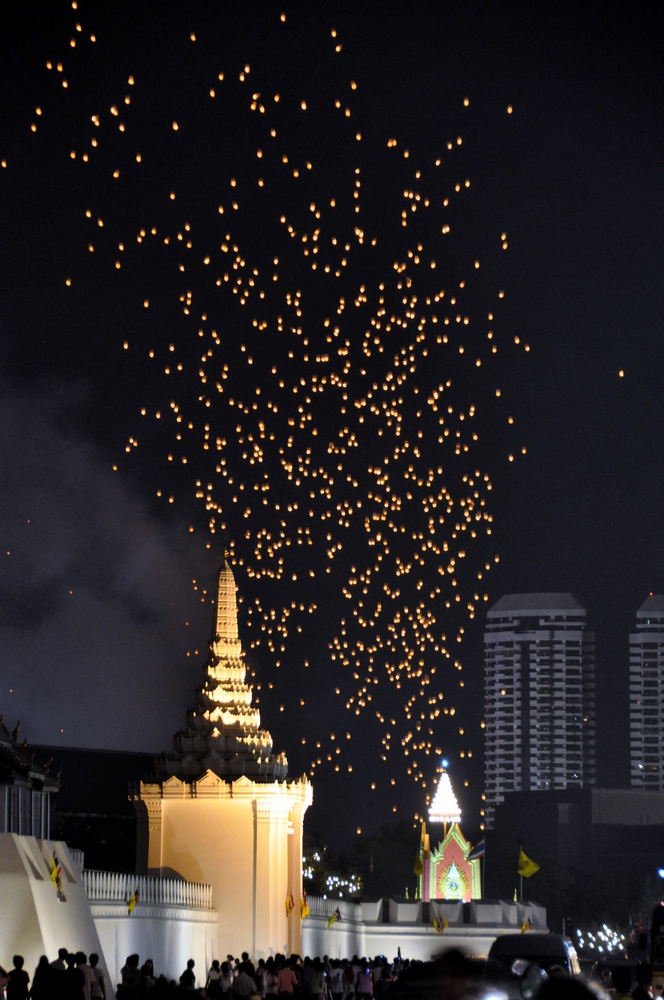
The next day we visited the Grand Palace, Wat Phra Kaeo, and Wat Pho where the enormous reclining Buddha lies. It was my first time seeing Thai temples, and I found them impeccably well kept. They looked brand spanking new! Usually when we visit heritage sights we can tell which parts are restored and which have remained untouched since the beginning of time. But all the temples here looked as if they were just built yesterday. The golden blinged out exteriors and the clean and simple interiors of the temples were definitely unique to see. We didn’t plan this but the weekend we were here just happened to be the King’s birthday. There were various celebrations throughout the country and we managed to follow the crowd to the busiest area where people were lighting their own candles while jointly singing the royal anthem. There were many fireworks and innumerable lanterns being released into the sky. It was priceless to see people’s faces as they sent their lanterns floating off (check out the pictures we took in Flickr under Bangkok and Chiang Mai set). We decided to follow suit and it turned out to be the most unforgettable experience. Watching thousands of lanterns drifting across the evening sky above the temples was incredibly magical. We later did walk long enough to see the lanterns burn out and fall to the floor. Some were caught by pedestrians like us and some just landed on the rooftops or the ground. I felt badly for whoever had to clean them up. We also tried to tackle the countless street food vendors in hopes to try at least half of all the different Thai food on offer. I’m glad to declare that we did a pretty decent job. From chicken rice, curries, and pad thai, to wonton noodle soup, grilled pork neck salad, and street meat skewers, we were very satisfied after one week’s time.
Up north In Chiang Mai, we visited the famous Wat Phra That Doi Suthep. Besides the soothing ancient temple and a good view of the city, we really enjoyed the short blessing ritual performed by this elder monk. We knelt in front of him as he dipped a miniature broomstick into a pot of water and flicked the stick so drops of water splashed our way as he chanted along. He was skilled in making sure everyone got plenty of drops of water before he tied a white wrist band around each and everyone’s wrist. Eug liked him a lot. We also did a cooking course in Chiang Mai. That was super fun! We spent a day with Yui from A Lot of Thai cooking school. She’s probably the friendliest person I’ve ever met. She didn’t stop smiling at all the entire day we were with her. She had the cooking school for a few years and among her students was Gordon Ramsey, the British celebrity chef that swears all the time. He did a show with her too. We learned to make pad thai, tom yam kung (hot and sour prawn soup), green and panaeng curry chicken, chicken with cashew, spring rolls, and mango sticky rice. As you all know, I’m not a good cook at all, but I really liked what I made that day. Yui’s class was awesome.
We had an amazing time in Bangkok and Chiang Mai. Chiang Mai is easily liked by most tourists because of its relaxed atmosphere, chill vibe, and cultural sites. Bangkok, on the other hand, is a dynamic metropolis with a new and efficient metro, ancient temples, modern hotels and malls carrying international brands, and delicious food. Bangkok unfortunately has the seedy image of being a sex tourist destination, but if you stay away from those sleazy neon-lit areas offering ping pong shows (if you don’t know, don’t ask), this city has a lot to offer. There’s a vibrant social and arts scene, bustling food and shopping markets, and age-old buddhas in meditative temples. What’s impressed us most so far (apart from those 2 scamming moms) is that Thailand really does live up to its moniker ‘The Land of Smiles’. We’ll be heading to Myanmar for a bit, but after that we’ll return to Bangkok to continue our way to the south of Thailand where tropical beaches beckon. Can’t wait!
I fell off my bike

Yup. And since then I’ve been in a crappy Indian hospital, received 3 crappy stitches, and have had the wound reinfected (not surprisingly). But I’m getting ahead of myself, so let me start from the beginning.
After some relaxing time in Kerala we took a flight out to the Andaman islands, one of those hidden gems that is sure to be overrun by backpackers in the next 5 years, with resorts then running those backpackers out in 10; think the towns on the Turkish Med like Oludeniz or the Thai lsland of Koh Samui. We actually had never heard of the Andamans, but our buddy Dan who we travelled Tibet with (who is on an 18 month around-the-world trip with his wife) said he was gonna be there in the end of November and that we’d like it a lot more than Goa. Di and I did some research, and these islands sounded perfect. The diving was supposed to be spectacular, the water turquoise, the sunsets purple, and the beaches white. There were also plentiful beach huts on offer, what else could you want?
The Andaman and Nicobar islands are in the Andaman sea and are actually much closer to Myanmar and Thailand than to mainland India. The Nicobars are off limits to tourists as there are still indigenous tribes living there who want no contact with the outside world (ie confrontations have been really hostile in some cases). We first flew into the capital of the Islands, Port Blair, and immediately we hopped on a 3 hour ferry to Havelock, the island most popular with travellers. We checked into a dive ‘resort’ which was just a bunch of tents and huts on the beach. We talked to the dive centre and decided to do some scuba a couple of days after we arrived, just to give us some time to check out the island. The next day we rented a bike to do some exploring. The nicest stretch of beach was on the west side of the island, while most of the accommodations were on the east. So we headed the 12 kms through the jungley heart of the island to check out the nicest beach, also called beach 7. The road there was bumpy and full of potholes, some massive, but we made it and hung out there all afternoon. It really was stunning and it felt like we were the only ones around. After watching the romantic sunset we hopped on our bike to go back, and this is where ego/stupidity led to some poor decision making. Since the Andamans are so close to the equator, when the sun sets, it gets dark pretty much instantaneously. So about 5 minutes into the ride home it became super dark, and in case you’re wondering there are no street lights here. Our light that we had was broken, in hindsight we should have tested that before leaving. So instead of hiring a tuk-tuk to take us home I just thought we could make it by moonlight, I mean how hard could it be? About 15 minutes later I blindly hit a deep pothole and my right knee came down hard on the gravel, cutting it open about an inch and a half. Even though it was pitch black out, a bunch of Indians must have heard me fall as I was surrounded by them within about 2 minutes. They pointed me to the nearest (and only) hospital, which was a free government clinic in the heart of town. When I say the heart of town, I mean the only T-intersection around with a couple of T-shirt stores and one or two food stalls. I walked in and found the head nurse, who quickly attended to Di first. Good thing she did since Di had a small bruise developing on her knee, and you know how bruises can be such a huge emergency. I, on the other hand, was only gushing blood to the point of my foot being completely covered in red, but I could wait. She gave us a couple of tetanus shots and wiped Di’s knee clean with a cotton swab and saline. Then it was my turn. She basically doused my open wound with alcohol. That…frickin…hurt. Then she threw in a ton of Iodine for good measure before using her bare hands to stitch me up with what looked like rope. It sucked having no anesthetic but that was the least of my worries at that moment as cleanliness was a bigger concern for me. Thankfully the needle came out of a sterile pack. Anyways, she put in 3 stitches and she tied them as tight as she could. I told her that she was going to make my tissue ischemic, but she said that since it was on my knee where there’s lots of movement she needed to make it as tight as possible or else it wouldn’t stop bleeding. After dressing my wound she gave me some antibiotics and we were on our way. I was not confident at all with the stitching job but there were 5 Belgian doctors staying where we were so I bee lined it to them (they were sitting around talking about their days diving, eating chocolate they brought from Belgium, and smoking cigars; can you be more stereotypical?) Anyways, they had a good laugh with the size of the silk sutures but they said the job was quite adequate and should do the trick; only the scar would be larger than if they did it. That eased my concerns a bit but they said I shouldn’t do any diving for a few days. We were unhappy about not being able to dive, but in hindsight that was a good thing as everyone there basically told us the diving was only mediocre at best. Especially since we were heading to Thailand to dive in places like Ko Lanta people told us not to waste our time diving in Havelock. So Di and I just relaxed on the beach for 5 days, hanging out with other travellers. Most were backpackers (well pretty much everyone except the Belgians) who were there to dive and chillax on a beach, a crowd we definitely got along with. It was good seeing our friends who we travelled Tibet with too. In addition we got in a day of fishing and Di caught a 4 kilo Pocari that was super tasty, not bad for her first time fishing.
The wound seemed to be improving and I changed the dressing at the government clinic twice. Though I kept trying to get the lone doctor to look at it he basically said he couldn’t because he was too busy (which he was) so I just had to go to the dressing room and have the nurses do the work. However, on the day we were to leave, my leg started to hurt, and I knew that was not good. We first caught a ferry to Port Blair before taking the overnight flight to Bangkok. By the time I arrived in Bangkok, my right leg looked like it belonged to an elephant. We quickly checked into our guesthouse, and the owner pointed us to a private modern hospital catered to foreigners. The ER guys took a look and told me what I already knew, the wound was re-infected. The general surgeon came down and froze me up before cutting away the sutures and the dead and infected tissue, re-cleaning everything and irrigating out small bits of remaining gravel. Luckily the hospital here has given me excellent care and the surgeon and nurses have been fantastic. So now my leg looks size normal (and not size elephant) again, but I’ve had to go for a daily debridement and dressing change. He kept it open to make sure everything was drained and it looks like he’ll suture me back up in the next few days. He made a comment about how he’d try to minimize the scar but I’d definitely have one on my knee, and though it wouldn’t interfere with function he joked that I might not look as good in swimming trunks. I responded that I don’t look good in swimming trunks anyways so it’s all good!
India was an extremely intriguing and diverse country. Though it probably was the most difficult place for us to travel, we can now definitely see how many people absolutely love it (and also how others absolutely hate it). The poor infrastructure and city planning, awful train system, and the crushing poverty are certainly negatives that can really frustrate the most seasoned travellers. In fact many of us were quite astounded that India gets compared to China so much; it really still seems light years behind China in many respects. However, it was the amazing heart of the people and their palpable sense of passion and warmth that really left a lasting positive impression for Di and I. Something about their incomparable love of song and dance, something about the sparkling eyes of the average Indian and their ability to convey all their emotions with a glance, something about the addictively amiable head bobble, just something about the soul of this country permanently affects the substance of your heart and the genuineness to your smile.
 fromwonderintowonder
Recent Comments