Lebanon – home to Prada and Palestinians

A short 3 hour taxi ride (including border crossing) took us from Damascus to Beirut, ‘Paris of the East’. Besides the 10 degree temperature drop from a scorching 40C to 30C, Eug was ecstatic to see girls wearing tank tops, shorts, and skirts again… something he hasn’t seen since Istanbul. Even I caught myself staring at some girls. We were too accustomed to seeing women in burkas everywhere that it was almost strange to be able to see girls from head to toe again. For the first 3 nights we stayed in the Hamra area close to the American University of Beirut. We heard English being spoken in every corner of the streets. We also found the comfort of Starbucks once again. And as good as middle eastern cuisine is, we couldn’t take anymore hummus or shawarmas after 3 months of them, so we headed straight for some wholesome western food. A hamburger and Lipton ice tea never tasted so damn good! We were both excited and relieved to find the long lost western refuge again and decided to slow down and nestle in its welcoming familiarity.
After Eug recovered from Damascus belly, we did our usual routine of finding the hostels listed in Lonely Planet to look for the tours we wanted but weren’t able to do on our own. They usually offer the same tours as the nicer hotels but at a much more reasonable rate. And we could usually recruit interesting, independent travellers to join us to share the fun and the cost. It’s been working out great so far. We ended up renting a Honda Odyssey van for 2 days with 4 other travellers; two of which we’ve been running into almost daily since Turkey (so it was no surprise to see them again in this hostel), 1 girl from Germany, and 1 guy from Uzbekistan. Yes, Uzbekistan!
The first day we explored the eastern part of Lebanon, Baalbek and Aanjar. The impressive Baalbek ruins were known as the Heliopolis or ‘Sun City’ of the ancient world. There were a few spectacular temples, a theatre, and 6 huge standing columns. What we also found interesting was that the town of Baalbek is the administrative headquarters for the Hezbollah (Party of God) party and we could see the yellow and green Hezbollah flags fluttering along the main street of the city. Outside the ruins people were trying to sell us Hezbollah souvenir T-shirts. Eug double-dared me to buy one to wear for when we crossed into Israel. We didn’t find Aanjar’s 1300 year-old Umayyad City to be extraordinary but we had a great time chatting with our fellow travel mates while strolling along the site. And some local visitors picked some fresh mulberries right off the trees and shared some with us. We also visited the stunning Jeita Grotto, a huge limestone cave (the biggest I’ve ever seen) full of stalactites and stalagmites. Just imagine a cave full of icicle-like rocks that might just fall down and jab a hole in your skull, and big rock tubes that look like white half-melted candles all morphed together (like the ones you see in Subeez cafe). We walked through the upper cave and took a boat ride in the lower cave. It was like an awesome Disneyland ride! It was hard to imagine that the cave was used as ammunition storage during the civil war.
The next day we headed north towards Byblos (Jbail), Tripoli, Bcharre, and Qadisha Valley. The Qadisha valley (picture above) was particularly stunning, as it is extremely steep and deep. The other Canadian girl in our van was gripping the seat handles in fear the whole way up. On either side there are many towns, predominantly Christian with cave chapels and churches all around. Above the town of Bcharre is the Cedars, a ski resort in the winter with an ancient grove of the cedar trees. The cedar tree has been synonymous with Lebanon forever and is the centrepiece of their flag, like our maple leaf. We chilled in Beirut for the last few days in Lebanon. There are nice high end malls with LV, Prada, and Jimmy Choo, etc. stores, tall modern glass buildings, a Parisian like boardwalk, and bubbling-hot nightlife. It’s not uncommon to see a new Mercedes or Porsche driving by you. However don’t let this fool you into thinking Beirut is a rich happy oasis in the Middle East, as a 20 minute drive from the city centre will take you into areas riddled with poverty. In the midst of all the modern glitz and glamour of downtown stands the remains of the infamous deserted Holiday Inn Hotel. During the civil war that started in 1975, snipers would shoot from it as it was the tallest building around, and the returning gunfire has left the scars that remain to this day. Now it’s just a skeleton of a building, a gloomy reminder of this cities’ recent past.
Lebanon is an extremely interesting place and no matter what you read in books or papers you really need to be here to experience it. You’ll get many who are extremely proud of this small country, and yet there are others who seem to want to identify a lot more with the West than Lebanon. All around you’ll hear Lebanese speaking English with a heavy Arabic accent to each other. A waiter (educated in the States but back for the summer) at a really nice restaurant confirmed that this was his greatest annoyance, people speaking to their friends and the service staff in mediocre English instead of their native Arabic tongue, even when he would respond in Arabic. In the mountains you’ll see stunning Christian towns that look untouched by war, and yet in a town like Baalbek you’ll see mosques, Hezbollah flags and pictures of Ayatollah Kohmeini. In downtown Beirut you’ll see signs marketing new steel and glass high-rise developments saying Beirut is the new “it” destination, yet you venture south and you’ll find poverty stricken Palestinian refugee camps whose inhabitants care a lot more about their next meal than if Lebanon is considered cool on the world wide stage. Overshadowing all this contradiction is a sense of fear that war could easily return. It was only 2005 when former Prime Minister Hariri was killed in a car bomb. This led to the withdrawal of Syrian troops, troops which had been occupying Lebanon for 30 years. It was only 2006 when Hezbollah killed and kidnapped 10 Israeli soldiers, with the resulting Israeli military response leaving over 1000 Lebanese civilians dead. Peace will be hard to find as long as Hezbollah (who has strong ties to Syria and Iran) wants the destruction of Israel, and Israel has the military might to inflict seriously tragic damage. Beirut is hoping economic growth and stability will unite people and pave the way to political reform. Unfortunately Lebanon cannot just count on itself to bring peace, as all the other players in Middle Eastern politics also have a part. Even with all the hope in the minds and attitudes of the people and government, you can feel that everything is currently resting on a delicate equilibrium, an equilibrium that could easily be upset.
“Go back as far as you will into the vague past, there was always a Damascus…She is a type of immortality” – Mark Twain
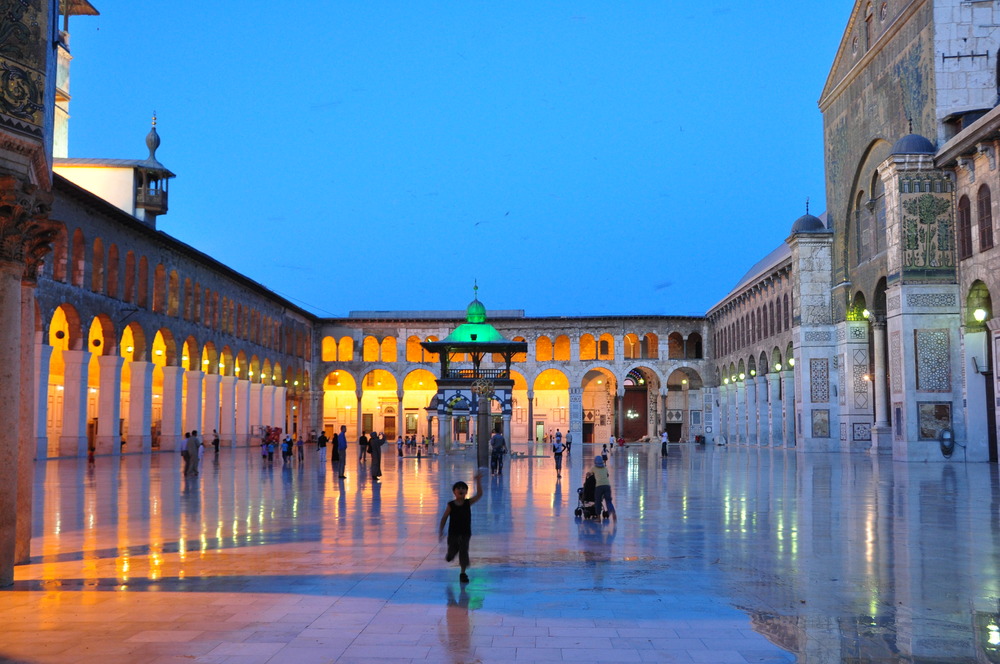
Our last four days in Syria were spent in the ancient city of Damascus, which competes with its sister city of Aleppo for being the oldest city that’s still inhabited in the world. We stayed in the walled Old City, and after being in a bunch of walled old cities in the past 3 months, this is the one that was the most intact. When I say intact I mean untarnished by time and tourism. The locals are still by far the biggest patrons of all things within the souq (covered market). At night the small tables at a tea house are filled by Syrians smoking their nargileh (water pipe) as they listen to a professional storyteller un-weave his tale (as I can’t understand Arabic I imagine it to be The Thousand and One Nights). Women in burkas form line-ups outside Damascene ice cream shops which serve a delicious pistachio covered tapioca concoction. Beautiful courtyard restaurants load tables with Syrian dishes that haven’t been altered to appeal to foreign tongues. Though the mosques open to tourists in other cities are filled with them, we the tourists are overwhelming minorities in the ones here. Pretty much everyone we met in Syria had nothing but praise for this city, and it lived up to the hype. We were living in the Christian quarter of the old city, and every time we walked back to our residence I would notice something new and subtle in the beautiful architecture surrounding us, especially on the second floors of the old houses. It was a charming place, and we really liked it. We’ve heard that this is what the old city in Marrakesh used to be like before tourists took over (kind of like how Vietnam is now sort of what Thailand used to be) and I totally believe that. Fashionable boutique hotels are sprouting up in old Damascene houses, following the Moroccan blueprint of having boutique Riads (guest houses) in old renovated Moroccan houses. I wonder how long it’ll take for Damascus to become as fashionable as Marrakesh to the desirable high-end (ahem big-spending) tourist.
We spent some time in Damascus’ marquee religious building, the Ummayad Mosque which is pictured above. The Shrine of Hussein (Prophet Mohammed’s grandson) is here and is an important site of pilgrimage for Shiite Muslims. Beside the mosque lies the mausoleum of Saladin, a Kurdish-born hero of the Muslim world who kicked the Crusaders out of Jerusalem (also the antagonist to dreamy Orlando Bloom in the movie “Kingdom of Heaven”). The interior of this mosque is lined with stunning golden mosaics which supposedly represent the paradise Prophet Mohammed saw in Damascus. Though it was a religious place, the immense courtyard was filled with children running around laughing and chasing each other. We were enjoying the experience, but many of the eyes were curiously looking at us the whole time we were inside. Though not unwelcoming, we were unsure of how we were supposed to react in this place of worship to all the eyes and whispers. Then finally one woman came up with her young son and camera phone and asked to take a picture with us. After her the floodgates opened, and Di, Jon (a fellow Canadian we were traveling with) and I were smiling for cameras for a good half an hour until darkness descended upon the courtyard. This has happened to Di and I quite consistently on this trip so far (almost daily in fact, I guess Asians aren’t common around these parts) but this mosque was definitely where we were photographed most. People were actually lining up, but they were excited so we were happy to oblige.
One day 6 of us decided to hire a driver to take us to the ’Disengagement Zone’ of the Golan Heights, a region between Israel and Syria that is now under UN control. This was a sobering reminder of the political issues that plague the region. In the 6 day war of 1967, Israel took this area from Syria and expelled almost all of its residents. With UN negotiations, Israel agreed to leave the area as a demilitarized zone administered by the UN, but they bulldozed much of everything remaining before they left. The former town of Quneitra here is now comprised of flattened concrete, twisted steel, mine-filled fields, and a bullet riddled hospital (supposedly used for target practice after all residents left). UN vehicles are the only ones really still using these roads. Visiting here was definitely heavy, similar to how I felt being in the demilitarized zone between the two Koreas. Except here, there was no theatre, museum or tourists like in Korea. It was just us, our driver, and UN soldiers; quite an experience.
It’s quite unfortunate that the western world views Syria as a ‘rogue state’ (George W Bush’s exact words). For a ‘rogue state’, its people are pretty darn friendly. We’ve never heard the word “Welcome” so many times in our life. Children would run up to us to say this, drivers and passengers would yell this out their windows, and fellow pedestrians would always smile and try to shake our hands. Anytime we took out a map someone was eager to help us or walk/guide us, and this always had no strings attached. Syrians were constantly giving us tea or drinks, asking if we liked their country. Though we’ve experienced hospitality everywhere, I would say so far here and Libya take the cake. (Though as an unfortunate aside, Libya and Syria are also the only 2 countries where we’ve gotten a little sick. I had a case of ‘Damascus Belly’, not fun. One day of Cipro though and I was fine).
Syria has been held by Phoenicians, Egyptians, Persians, Greeks, Romans, Arabs, Crusaders, Mongols, Turks…basically a who’s who of the empires of the region. As such they’ve all left their marks: architectural, cultural, culinary, artistic, religious etc. Finding these relics in the everyday life of this ancient land is fascinating, but don’t be fooled by the word ‘ancient’. Syria is modernizing quickly, so if you want to catch it before tourists outnumber locals in the old city walls, now would be the time. It’s an easy country to travel as it’s not large and all sites are within driving distance of Aleppo or Damascus. The travelers that make it here also tend to be very experienced, as Syria is usually not on the top of a newbie’s list like Thailand or Western Europe would be. As a result, there are ample opportunities to discover the country with sociable, adventurous and extremely open-minded explorers who are on the same route as you. What I’m trying to say is that making new friends, both local and foreign, will not be a problem at all. Just don’t try to add them to facebook here, it’s banned.
The Oldest Cities of the World

Right after crossing the land border to Syria, our driver stopped by a gas station to fill up gas. It was a ghetto looking gas station and it had a ghetto looking slurpee machine with three colours – florescent orange, blinding yellow, deadly purple. Just as I was thinking ‘eew gross!’ our nice driver opened up Eug’s door with one of each in his hands and gestured Eug to choose. Eug politely took the two of the less deadly looking ones and our driver gestured us to taste them. We reluctantly took a small sip each and nodded until he gave a satisfying smile and continued driving towards Aleppo. For the rest of the car ride, we were thinking of ways to get rid of these fatal liquids without him noticing. It was only our first day in Syria and neither of us wanted to risk the chance of getting traveler’s diarrhoea. We ended up finishing the small bottle of water we had in our bag so we could pour the slurpees into the empty bottle. But because of the ice, Eug couldn’t pour it directly into the water bottle, so he ended up using the slurpee straw to transfer the slush into the bottle one straw-full at a time using his index finger to retain and release. At the same time he was pretending to be enjoying the border town scenery too. It took a good half an hour but his mad straw skills saved our stomach.
Syria isn’t a big country. Our itinerary was to start with Aleppo in the North, followed by a picturesque train ride to a coast town Lattakia, then the famous water wheel town Hama, next the desert town Palmyra, and we were to end in the capital Damascus. All cities were within 3 hours drive of each other.
Aleppo is one of the oldest inhabited cities in the world. The main sights in the city that we visited were the Citadel, the Old City, and the Christian Quarter. We made the Christian district of Al-Jdeida our base for three days. It’s a much quieter neighbourhood than the hustling and bustling souq of the Old City, and this charming cobbled area has a few age-old townhouses being converted into beautiful boutique hotels. The Citadel sits atop a huge mound east of the Old City, it was quite an enjoyable walk inside the citadel after having a fit and FPH to Eug right before that. We also took a day tour outside Aleppo to visit the Basilica of St. Simeon (Qala’at Samaan). He built a pillar to preach from, and kept making it higher and higher so people couldn’t touch him, and at night he would chain himself to it so that he wouldn’t fall off the pillar in his sleep. Quite a peculiar guy if you ask me. After the Basilica we went to the Dead Cities of Al-Bara and Serjilla. These are ancient deserted ghost towns that still have some remaining ruins. Even though Al-Bara is supposed to be the most extensive of the Dead Cities, we found Serjilla to be more interesting. It has been deserted for about 15 centuries but the buildings’ stone facades are remarkably well preserved. We also met some nice young Syrian guys who were just having a picnic under one of the columns. They immediately invited us to join them for lunch when we walked by and after we gestured ‘we are full’ by patting our stomach, they insisted for us to have something to drink by shoving 2 full cups of Sprite into our hands. Since we didn’t speak Arabic and they didn’t speak English, it was one of the longest Sprite drinking moments ever, until eventually one of them bent down and picked up a dried weed and split it in half and asked Eug to teach him how to use chopsticks. He was quite talented and was able to pick up an olive after 10 seconds of practicing.
After Aleppo, we headed towards the coast to Lattakia. Lonely Planet says it has some fine beaches so we decided to relax there for a few days. It turned out to be a busy port town with high cranes and countless shipping containers so we ended up spending only one night and we took off the next day to Hama.
Besides seeing the water wheels in Hama, many tourists stay in Hama to visit the impressive Roman ruins of Apamea and Crac Des Chevaliers, which TE Lawrence (Lawrence of Arabia) simply called ‘the finest castle of the world’. We enjoyed both very much, especially the castle. It’s a Crusader fortress in Syria. We’ve visited a few castles on this trip already and this one is definitely our favourite so far.
We then went east towards Palmyra (Tadmor in Arabic), the Bride of the Desert (the picture above). In ancient times it was a vital caravan city for travelers crossing Syria. Now the sandstone ruins of the city are one of the premier ancient sites in the Middle East. We started our visit with the temple of Ba’al, and then walked along a colonnaded street which led to the rest of the ancient city. We didn’t get to see the theatre since there was a movie being filmed at the time. It was quite funny to see scrawny teenaged Syrian gladiator extras all lined up on top of a small theatre. We also went up to the citadel to get a panoramic view of the city around sunset. It was quite amazing how we could actually picture the ancient city from its remains.
We’ve been seeing a lot of great sites so far, but starting in Syria, we met a lot of travelers also traveling the same regions. So we ended up visiting the sites with them and traveling to different towns together when our itineraries happened to coincide. It’s been really fun and enjoyable with them!
Our last days in Turkey, Our first encounter with Iraqis

We took a bus from Goreme in Cappadocia to Gaziantep in the south of Turkey, which was to be our final stop before crossing into Syria. The bus ride was supposed to last about 3 hours, but about 90 minutes in our bus overheated with a busted radiator. We were luckily able to pull over at a truck stop which had a mechanic. The mechanic ended up taking over 3 hours to fix the radiator.
During these 3 hours we slowly got to interact with the other passengers. No one could really speak English here in the heart of Turkey, so people just made faces indicating that it was taking forever to fix the bus. One guy finally had the courage to try to strike up a conversation with us, basically asking us where we were from. We told him Hong Kong, which we’ve learned is a lot easier for people to comprehend than saying Canada. The exchange was mostly smiles and shrugs on either side. Eventually people started to take more interest in us, and next thing you know the whole bus was surrounding us. This is not an exaggeration; all of the passengers on this bus were hovered around us (there were about 10 of them).
The other riders went around in a circle saying where they were from; a few were Turks from Gaziantep, one guy was from Lebanon, and the rest were from Iraq! Supposedly the bus went to Northern Iraq (Kurdistan) after Gaziantep. These Kurdish Iraqis could speak Kurdish and Arabic, the Turks could really only communicate in Turkish, and the Lebanese guy (who was named Zaki and was hilarious) could speak Arabic and a little bit of English and Turkish so he ended up being the group translator.
Basically, pictures of wives and children were passed around to everyone, and one of the women there proudly placed her super cute baby on our laps to hold for a while. They asked us where we were going to after Gaziantep and we indicated that we were traveling to Syria, and then Lebanon and Jordan, and all the Iraqis were like “Why no Iraq????” Hilarious laughter ensued as they made bombing sounds and were shooting air pistols at each other. Pretty amazing that they could make light of such a tragic situation. They were all Kurds though, so their region is significantly more stable, and they seemed to be quite happy that Saddam was dead. One guy said “Saddam” and then pretended to hang with his tongue sticking out, which was followed by more laughter.
At one point the engine started and we all went outside to take a look. This is when all of them tried to give me their best Kung Fu stance which usually can get annoying but this time it was pretty funny. The bus was a Mercedes bus, so one guy yelled “Made in Germany no good, Made in China good!” with more laughter. Eventually the problem was fixed and we made it to town where everyone got off to shake our hands and to say goodbye. Before we parted ways everyone made sure they got pictures with Di and I. One Turk getting off told us to follow him and he paid for our transport (he wouldn’t take our money) and took us to the door of our hotel. The Lebanese guy gave us his number and was adamant that we call him when we arrived in Beirut. This was definitely the most fun I’ve had waiting for a vehicle to be fixed. The above picture is with the most outgoing guys on the bus. I am the second oldest guy in this picture (I was shocked to hear their ages, they’re mostly in their late 20s. Please correct me if I’m wrong but I definitely feel as though I look younger than them. Must be the Oil of Olay). The Lebanese guy is the one wearing Di’s hat. I hate to make light of this but check out the epic unibrow on the guy second from the right. The first time I saw that over here I thought it was really funny, but in Turkey it’s almost been an hourly occurrence, seeing a guy with one eyebrow and one eyebrow only.
Anyways Gaziantep was a nice town with a fabulous (yes I’m using the word fabulous) mosaic museum. There really are no tourists in this town so the museum was ours for about 5 minutes. After that, about eighty uniformed 10 year olds showed up on a school field trip. We were definitely way more interesting than the mosaics to them, as they kept running away from their teachers and following us, trying to wave and say Hello! The teachers kept yelling at them to get back in line. At one point we could hear a few sprinting up to us, and as we turned around the guy in the lead quickly screeched to a stop, with the resulting 5 students behind him ploughing into his back, straight out of a cartoon. We took longer than them to check out the exhibit, but a group of them were waiting for us at the exit! They were all yelling and waving “Bye” as we walked through them and I decided to turn around and take a picture. They were more than happy to oblige as all them started to immediately laugh and pose, teacher included. I was also given my first Koran here by a local on the city bus. It was in Turkish though, so no I haven’t read it.
The next day we took a bus to Kilis, the border town, and grabbed a taxi to take us to Aleppo in Syria. Though we heard stories of how tough it was to cross the border from other people, we had no problem and were through relatively quickly. The border was quite disorganized though and I’m glad we took a taxi instead of walking through and finding a ride on the other end like we did at the Libya/Egypt crossing. The taxi driver did take our passports to load up on as many duty free cigs as he could, but we didn’t mind, as long as we got through.
Turkey is truly an incredible country. There is striking and unique natural beauty, an amazing modern metropolis, fantastic food, a beautiful coastline, a rich history, a strong culture, and wonderful, friendly people. In addition the independent travelers trail is pretty standard (Istanbul – Selcuk/Ephesus – Fethiye – Olympos – Cappadocia-Istanbul doing it either clockwise or counter-clockwise) so along the way you are bound to run into people you’ve seen previously in other towns or you’ll meet people who can offer you advice as you keep moving forward. Meeting other travelers who will no doubt have interesting stories and viewpoints always adds to the experience. In short, Turkey is a country that you need to visit. We liked it here so much that we plan to return relatively soon to check out the less traveled Northern and Eastern regions, with another pit stop in Istanbul, a city we fell in love with. Who knows? Maybe by then Iraqi Kurdistan (as of today the safest part of Iraq, and braver tourists are trickling in) will really be open to travelers looking for the next region ripe for exploration and discovery, with friendly Kurds like the ones we met more than willing to host and to share their undoubtedly incredible stories and experiences.
Cappadocia – the Land of Fairy Chimneys, Underground Cities, Hot Air Balloons, and Penis Jokes
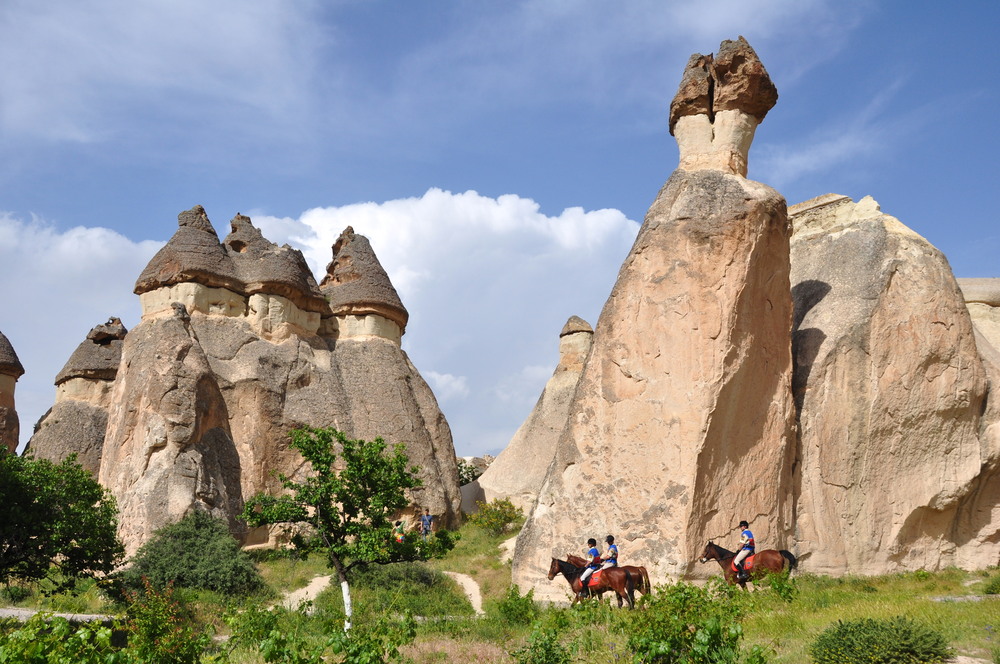
We took our first night bus of this trip to Cappadocia from Fethiye. We pulled into Goreme, the town we used as a base to explore the region, at 4:30 in the morning and made our way to our second cave hotel of this trip (the first was in Matmata, Tunisia). The one here though, named Star Cave, was definitely far nicer. Since we arrived so late at night we didn’t get an appreciation of the landscape that brings tourists to this part of Turkey. That completely changed in the morning.
The terrain, as Di put it, is almost alien-like. It was created by volcanoes and carved by rain, wind, and time to form extremely unique looking valleys and countless pillars named “fairy chimneys” here. Some of these fairy chimneys look like they belong in an elf’s village in a fantasy novel, others are extremely phallic looking and if I was a teenage boy I would have found them really, really amusing. Actually who am I kidding, if my highly educated and respected 30 something year old male friends came here with me I’m positive the penis jokes would still be never-ending.
Back to the landscape, we woke up really early one day (like 4:30 am) to hop on a hot air balloon, a popular but expensive activity out in this region. We considered not doing it due to the price but everyone we met who experienced it vehemently assured us that it was worth it. They were right. We were in the air for about an hour while our pilot deftly controlled something that was basically at the mercy of the winds. At times she would let us hover one meter off the ground, gently grazing the tall grass, and at other times she would launch us 1000 meters up to give us a commanding view of Central Anatolia’s canvas. We would drift through valleys and canyons gliding between fairy chimneys with the silence being occasionally interrupted by the sound of massive flames erupting from the burner. We couldn’t stop taking pictures. It was a surreal experience and definitely one of the highlights of our trip so far.
Another day we rented a POS (that stands for piece of crap, mom) 100 cc Peugeot scooter to check out the immediate region surrounding Goreme. I say POS because the thing totally died on me on a steep downhill section, so we had to ride it out without a functioning engine for about 500 metres before I could finally stop on some level ground and restart it. Also when I had the thing on full throttle at inclines of about 10 degrees, the fastest Di and I could go was about 40 km/h. That day was still fun though, seeing up close what we were seeing from a far in the balloon. The most impressive sight was the Goreme Open Air Museum, which is deservingly the star attraction in this area. Here Christian Monks carved cave churches into this otherworldly landscape between 900 and 1200 AD. Some of the frescoes inside these cave churches are still in remarkable condition. Three theologians known as the Cappadocians (St. Basil, St. Gregory and another St. Gregory) contributed greatly to Christian doctrine and the development of monasticism here. So apart from its natural beauty, there is interesting history in Cappadocia as well.
On the last day we booked a tour to visit the farther areas (where a scooter would not be able to make it) and we checked out the Ihlara valley and an extraordinary underground city named Derinkuyu. The city was made for the purpose of hiding from enemies and was remarkable. The tour was fun as we had a good group of people and an excellent, informative guide. There were a couple younger girls from Hong Kong there, and when I asked them in Cantonese to help us take a picture, they started to freak out and scream and hug each other in excitement. I thought this reaction was due to the fact that I’m ridiculously good looking, but really they were just excited because they hadn’t heard Cantonese in over 3 weeks. I guess their reaction could have been worse (like the “get away from me creep!” response that I’m more accustomed to) so I won’t complain.
The hotel/pension we were staying at was completely filled with Canadians, Australians and a couple of American students studying Arabic in Jordan on an exchange program. We had a great group which resulted in some pretty good conversations about travel and life-experiences. I mostly ended up talking to the Americans, and I found myself envying how impressive they were at the age of 21. They had an amazing grasp on politics and Middle Eastern issues, and a drive to foster their intellectual growth while making the world a better place. Long discussions about health care, foreign policy and economics didn’t phase them at all. And if you’re envisioning a couple geeks you’d be dead wrong; the guy looked and talked like a ski bum out of Whistler with scruffy hair and an 80’s “Idaho potatoes are best” sweatshirt on, the girl (who had the sweet girl-next-door look) was confident and her obvious intelligence commanded your attention as she talked, but she was in no way overbearing. When I was in third year at UBC I’m pretty sure that most of my conversations were still about girls and cars. And it’s not like I wasn’t well travelled as I was able to backpack a region of the world every summer. I’m happy to have met them and curious to see where they’ll be in 10 years.
After Cappadocia, our options were to either keep heading east to Mt Nemrut or to head south into Syria. We finally decided that after being in Turkey for over 3 weeks, we really should head to Syria as we only have about a month and a half left to cover 4 countries before meeting my sister on July 4 in Cairo. So we took a bus to Gaziantep (very interesting ride, will post about it later) and spent the day here. We’ll be heading to Syria tomorrow. I heard the border crossing is not fun, so hopefully we’ll get through in less time than it took to get into Libya. Time to re-enter the Arab world, insha allah.
The Blue Cruise
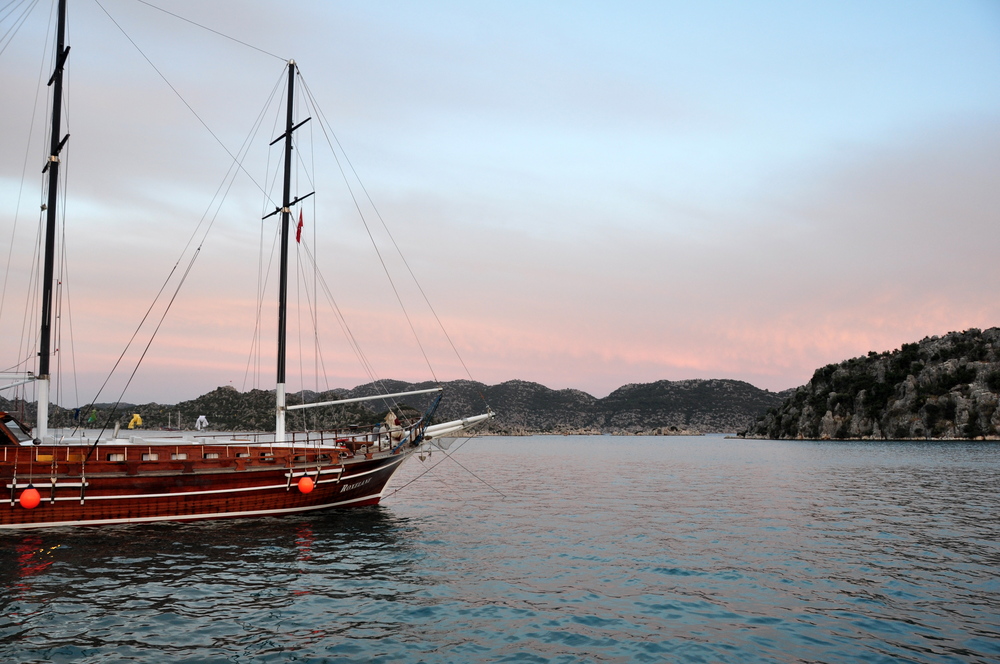
We enjoyed Greece so much we almost didn’t want to leave Rhodes. It was the first time in our trip that we felt we weren’t ready to move on. But we purchased the tickets back to Turkey the day before already so we reluctantly hopped onto the fast ferry from Rhodes to Fethiye. However once we arrived on Turkish soil we were glad to be back as the familiarity was comforting.
As soon as we checked into our guest house in Fethiye, the owner Omar kindly made us cai (delicious Turkish tea which we’re quite accustomed to having) and helped us book a Blue Cruise. The Blue Cruise is a 4-day 3-night cruise on a gullet (traditional wooden yacht) between Fethiye and Olympos. It’s a very popular cruise apparently, as we found out they were all fully booked and the next available one was 4 days later. Since we spent a few extra days in Greece already, we couldn’t wait for that long. Omar was very helpful and suggested for us to join the Olympos to Fethiye (going in the reverse direction) one instead as there was an opening for the cruise starting the next day. We agreed.
The first morning we took a 3 hour bus from Fethiye to Demre (close to Olympos where the boats docked) where we joined 7 other travelers and began our sailing adventure on the Mediterranean Sea. Our captain was a cool looking 25 year old boy, our cook was his childhood best friend, and the other crew member was the captain’s dad. The passengers were a good mix of people from all 6 continents of the world (if Eug and I did double duty of representing Asia and North America); one British couple, one Brazilian couple, one Australian lady, two South African ladies, and us. Our first stop was a small secluded bay where we jumped into the beautiful turquoise waters for a swim. It was our first time ever swimming in the Mediterranean Sea! We then visited a cave and cruised over the Sunken City of Kekova. At the end of the day, we docked by a small fishing village Kalekoy where we stayed for the rest of the night.
Our captain told us there would be a ‘typhoon’ approaching the second day so we wouldn’t be able to sail very far. It did get pretty windy but it was nothing like the typhoons in Asia. He did his best to sail against the winds for an hour towards the next town Kas, but the journey turned into a major rollercoaster ride against the big waves. All of a sudden, the front sail unravelled (though we were on a sailboat the sails were never raised) due to the heavy wind and the boat started to veer towards the rocks. Our captain quickly ran out to grab the cord of the sail but as he was trying to keep it from unravelling anymore he was being thrown around like a rag doll, for a moment it looked like he was going to be blown off the boat. Eug was having a great time and wanted to video tape the ride until that point, when everyone actually started to get nervous. The captain was frantically shouting orders at the 2 other crew (his BFF and dad) while the rest of us didn’t know if we should help, stare, or abandon ship. After about 3 intense minutes (2 guys trying to tie up a sail in strong winds, one deckhand being yelled at to steer the boat between large rocks on either side) the captain grabbed a knife and cut the rope that was holding up the sail and the entire sail came loose, ending the tension. We ended up turning back towards the fishing village and spent another night there. One of the passengers was in tears while another one said she saw her life flash before her eyes. After we docked back in the harbour and people calmed down, our cook made a delicious barbeque dinner which we washed down with Raki. What a day!
I forgot to mention that right before this all happened, I think I got stung by a bee on my upper right lip. Immediately it started to swell. I asked Eug if there was something wrong as I noticed my lip getting numb. At first he said it was nothing and kind of laughed, the usual. However, I knew something was up when about 2 minutes later he took another look and then sprinted down to the cabin in the midst of this windstorm. That’s when I started to get worried. Luckily he was able to get some anti-histamines and it resolved the swelling. He later told me he wished he could have taken a picture as he said my lip was almost swollen to the point of blocking out my right nostril. He didn’t want to worry me though so he kept quiet (and told another passenger to do the same). So while other passengers were having fantasies of the Titanic sinking, I was worried about my asymmetrical face.
We started sailing at 4am the next day to get to Kas before the wind picked up again. The ride started out rather smoothly and but progressively got choppier. What was worrisome was that we were the only boats out on the water. Thankfully we made it to Kas! Kas is a small fishing, yachting, and tourist town that was founded by the Lycians. We walked around this cute little town for a bit and grabbed a real coffee (as opposed to the ever popular Nescafe in Turkey). Our captain showed us a small Roman theatre and the Lycian rock tombs and took us to a small pebble beach. Later that night we all went to a pub where the captain and the chef shared many of their fun cruise stories with us (especially ones relating to fawning female guests). The last day we dropped by Butterfly Valley, a canyon that hosts many different kinds of butterflies and moths when the season is right, and Oludeniz (Blue Lagoon), one of the most photographed beaches on the Mediterranean. The colour of the ocean water here was absolutely breathtaking. It is also regarded as one of the best places in the world for paragliding due to its unique panoramic views. We saw the bay from our boat and it was so beautiful that we decided to stay in town for the night after we docked. We were very disappointed to find out that this incredible beach was completely spoiled by restaurants and pubs blasting Kenny G and Celine Dion (we heard My Heart Will Go On no less than 5 times) at dinnertime. We were hoping for some calm after dinner, but the music then turned into blaring techno (again?!) for all the beach party goers. There were even dudes on the roofs swinging flames. What a shame.
Despite the windstorm that put us behind schedule, we had an incredible time on the cruise. Every meal was delicious and the dishes were never repeated. There was no doubt that our young captain knew exactly what he was doing. Us passengers bonded really well and we all shared an unforgettable 4-day journey together.
“Hey, that’s Greece…Wanna Go?”
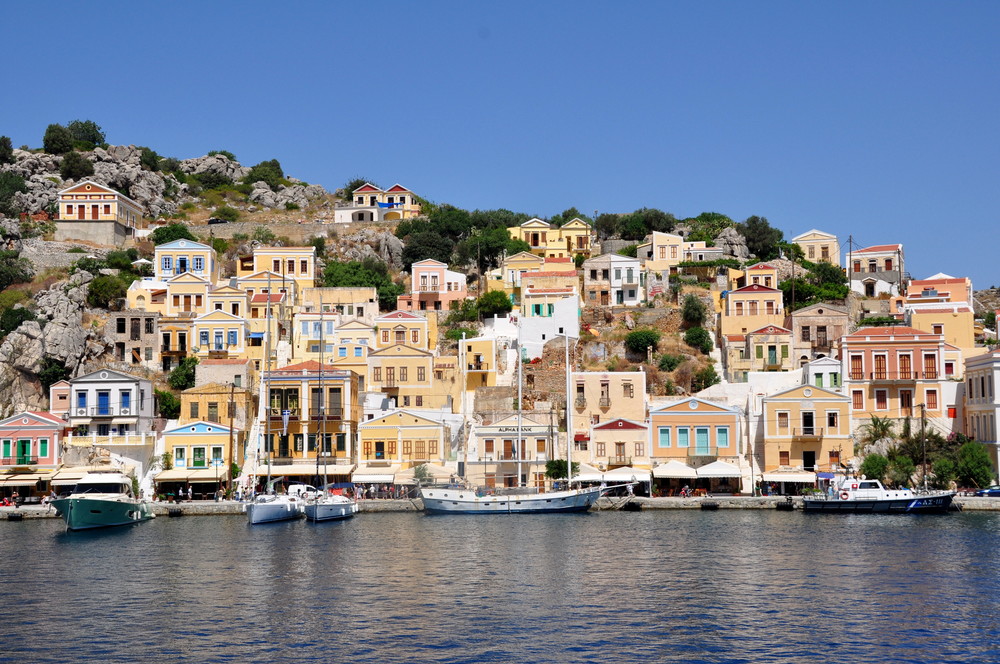
Since Bodrum didn’t turn out to be the type of town we were looking for we decided to check out Kos, the Greek Island visible from Bodrum and an hour ferry ride away. We spent our last few days in Kos and Rhodes with a brief stop in Symi, and these 3 islands alone almost derailed our travel plans. We were close to staying in Greece, heading north to Athens instead of heading South to Syria!
Kos, Symi and Rhodes make up 3 of the 12 Dodecanese islands in Greece which are just off the coast of Turkey. Kos was a pretty nice town though it was pretty dead as it’s still low season and the ferries have just started to run (supposedly the economic crisis in Greece right now is causing it to be a lot slower than it should be). Its claim to fame is that it’s the birthplace of Hippocrates, the father of modern medicine. That was pretty interesting to me since I had to learn about the Hippocratic Oath in university. Embarrassingly, what was more impressive to us was the fact that we got to taste pork for the first time in over 2 months (since Spain we’ve only been in Muslim countries)! We had a pork gyro, and needless to say, we had the best of all pork products, bacon, on our subsequent meal. Mmmmm…bacon. Since I’m back in Turkey I shouldn’t get all riled up about that amazing meat that can go great beside eggs for breakfast, or layered between turkey and tomatoes in a club sandwich for lunch, or wrapped around a filet mignon for dinner, as it’ll be another month and a half before I can taste that crispy awesomeness again.
Ok enough about pork. Kos was a very nice island on the Aegean, but Kos town wasn’t one of those picturesque villages like Santorini and Mykonos that I had always associated with Greece. After spending a day there we took a ferry to Rhodes with a stopover in Symi. Symi, on the other hand, was a town built for postcards. The buildings were all different shades of pastel pink and yellow, with some white ones in between. Tier by tier they were stacked beautifully around the harbour rising up the hills, and with a population of under 3000 I don’t think development will change this place anytime soon. We would have liked to stay longer here, but as usual we were short on time, and the most popular of the Dodecanese Greek Islands, Rhodes, was calling.
Rhodes has an interesting history as it’s been controlled by many different groups. The Persians, Romans, Turks, Saracens, and obviously Greeks have all ruled here at one point in time. Rhodes was also once home to one of the seven wonders of the ancient world, the Colossus of Rhodes (what’s actually pretty cool about our trip so far is we’ve been to 4 of the 7 wonders of the ancient world. What isn’t as cool is that the only one left standing is the pyramids of Giza, so the other 3 have basically just been placards). The group of rulers that left the biggest imprint however were the Knights of Saint John (Knights Hospitaller) in the 14th century. During their rule they built the old city that is still in amazing condition to this day. Approaching Rhodes on the ferry, the first thing you notice are the walls of the old city. Since we’ve seen so many walled cities on our trip already, I was expecting it to be not much different than the others. I was wrong. This place is exactly what I would imagine an old medieval fort-city should be like. There is a huge moat surrounding the city, and though it’s now devoid of water you still can’t help but be impressed by the 30-50 foot high walls on either side of you as you walk on the footpath. As you cross one of the drawbridges late at night and enter the city you are greeted by something truly magical. Its buildings, pebbled streets, squares, fortifications, lighting, courtyards and alleyways all come together to create an enchanting experience. It almost put me in the mood to buy a dragon-slaying sword to save a damsel in distress. I do however have to stress that it feels like this at night only when the shops are closed. In the daytime the endless multitude of shopkeepers, restaurateurs and tourists can leave you feeling a lot less like a knight and a lot more like a tool as your goal becomes finding the nearest ice cream vendor instead of the nearest evil villain.
So instead of being in the city in the daytime, we went to check out the rest of the island with something I haven’t been in control of for over 2 months, a car. I do admit, getting behind the wheel of that tiny Opel was super fun and made me miss driving. As the whole island is only 80 km long and 40 km wide, we were able to cover a lot of it in the one day we had a vehicle. We went to the town of Lindos, where there is an amazing acropolis (aptly named the acropolis of Lindos) built atop a natural citadel. The town was enjoyable and the views from the acropolis were spectacular. We also made it to the beaches, and though they were rocky, the water was beautiful on both the Aegean (north) and Mediterranean (south) side. Plus there were topless women sunbathing. Just saying.
Anyways, we enjoyed it so much here that we were really tempted to take an overnight ferry from Rhodes to Athens and onto Santorini and Mykonos. We were even thinking of going to Italy by ferry to meet up with our friends Lindsay and Ian who are on the Amalfi coast on a romantic holiday. However, as Di can confirm, I’m pretty good at killing romance so I didn’t really want to ruin their vacation. So here we are back in Turkey in a town called Fethiye waiting to hop on a gullet tomorrow to do 4 days of sailing on the Mediterranean. Not too shabby and now that we’re here I’m happy to be back in Turkey.
The city outside the walls of the old town of Rhodes is really nice as well; very modern and cosmopolitan with clubs, restaurants, and shops right out of Soho. We had a great night in a Greek outdoor tavern drinking ouzo, eating seafood and soaking in the atmosphere. The attractions here, both natural and man-made, really make Rhodes island a beautiful place. The addition of eating pork (that sounds ridiculous but it’s true) and the thrill of driving a nimble little 5 speed on windy coastal roads resulted in 4 brilliant days for us. This first taste of Greece has definitely left me wanting to see more, so hopefully we’ll be back very soon. Did I mention topless beaches?
Ruins, Beaches, Religion and Techno
We really liked Istanbul, but it was time to leave as the one week we stayed could have easily turned into two, and we still had so much of Turkey to see. So we took the ferry across the sea of Marmara to Bandirma, and from there we caught a train to Selcuk. If you’re into Christian history, Selcuk provides some interesting sites. The Basilica of St John, just 5 minutes from the heart of town is the supposed resting place of St John the Evangelist. There is also a house where the Virgin Mary lived towards the end of her life. We didn’t visit the Virgin Mary site but the Basilica was pretty interesting. There were a few American Christian tour groups there but the site is quite large so it wasn’t that busy. The main reason people come to Selcuk though is to see Ephesus, the best preserved Roman city in the Eastern Mediterranean.
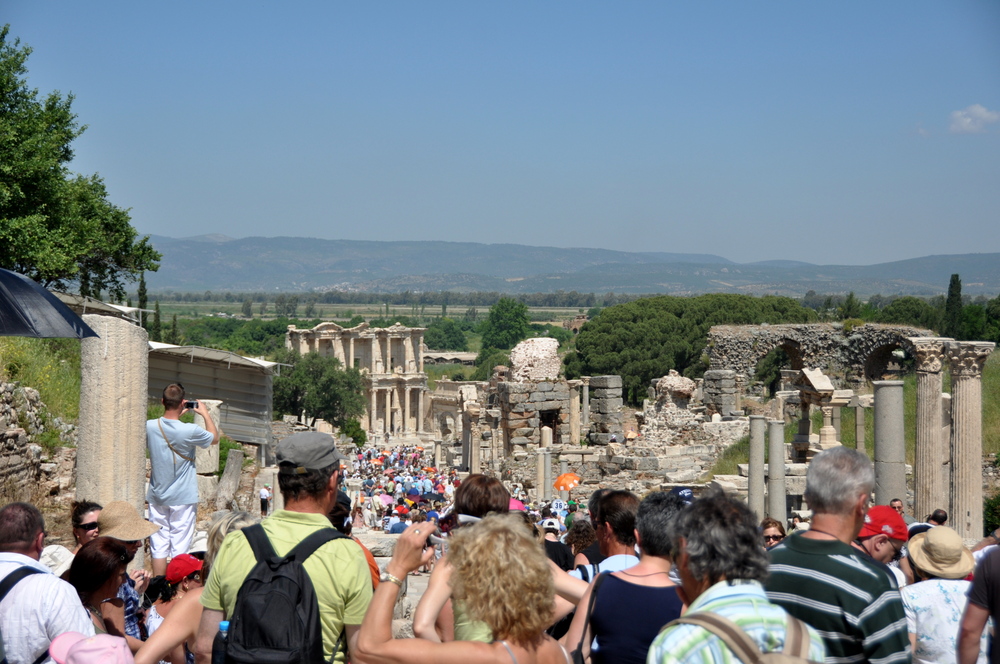
Ephesus is pretty large, with the entrance and the exit approximately 3 kms apart. We, unfortunately, went at the wrong time. 3 cruise ships were in town that day, and we entered Ephesus when the cruisers did. As you can see in the picture above, there were so many people that you couldn’t even move. Definitely frustrating, it made it impossible to enjoy the ruins. So Di and I found a little sanctuary in the shade behind the Library of Celsus (the 2 story building at the centre-left of the picture) and waited there until the crowds dissipated. 2 hours later, we pretty much had Ephesus to ourselves. The ruins are pretty cool, but I think we’ve become ‘Roman ruins snobs’ because the ones in Libya were a lot more impressive to us. All the other tourists found it amazing though, and I’m sure we would have as well if we hadn’t been to so many other ruins in the past 2 months.
After a couple days in Selcuk, we decided to pick a town on the Aegean Sea to chill at for a few days. After reading the books we picked Bodrum since it seemed to be the prettiest and a little more laid-back than the other ones on the coast. The cities’ laws restrict building height, which leaves the town looking pretty picturesque as all the structures are white and uniform. The bay Bodrum is situated around is truly gorgeous as well. However, the positives for us ended there as we were looking for a nice, peaceful place. We got something entirely different instead. We should have known when there were signs for “Halikarnas – The Best night club in the World” posted all over town. The club boasts a capacity of 5000, so not exactly the kind of place you’d typically find in a quiet beach town. A lot of the restaurants were blaring techno, and on the main drag the shop-keepers, most wearing fake Ed hardy shirts, were frankly annoying (and that amazingly had nothing to do with the fake or the Ed hardy!). I hate when you have to walk the long way home because you want to avoid the guys you passed by earlier, but we had to do that here a few times. You have to be in the right mind set to enjoy a place like this, and we just wanted to relax and enjoy the ocean. Techno is not conducive to that for me.
We did have a good conversation with the owner of a sandwich shop where we had lunch. He had been living in Bodrum since 1981, and as we were the only ones in his place he chatted with us about the changes tourism has brought. At the end of the conversation Di asked him if he thought the changes were good or bad, and after a bit of hesitation he said bad. He understands it has brought more money, and he gets to meet people from all over, but apart from that he feels there have only been negatives. He misses the strong community of the quiet, safe, friendly fishing village it once was. So afterwards Di and I tried to compile a list of idyllic beach towns we’ve been to in the past 2 years that haven’t been too affected by tourism yet and we’ll check back on this list in 10 years (if we can remember). Here it is: Playa Guiones in Costa Rica, Mui Ne in Vietnam, The Gili islands in Bali, and El Nido Town, Palawan in the Phillipines.
Anyways, since Bodrum is supposed to be the most laid-back of the Aegean beach towns we’ve decided to not go to any others. It’s low season right now but high season will be starting soon (in a couple weeks), so we can only expect places to get even busier. Because of that we’ve decided to change our itinerary. We’re actually pretty excited about it, and we’ll tell you about how it went in a few days.
The food of Istanbul – a lot more than meat on a stick
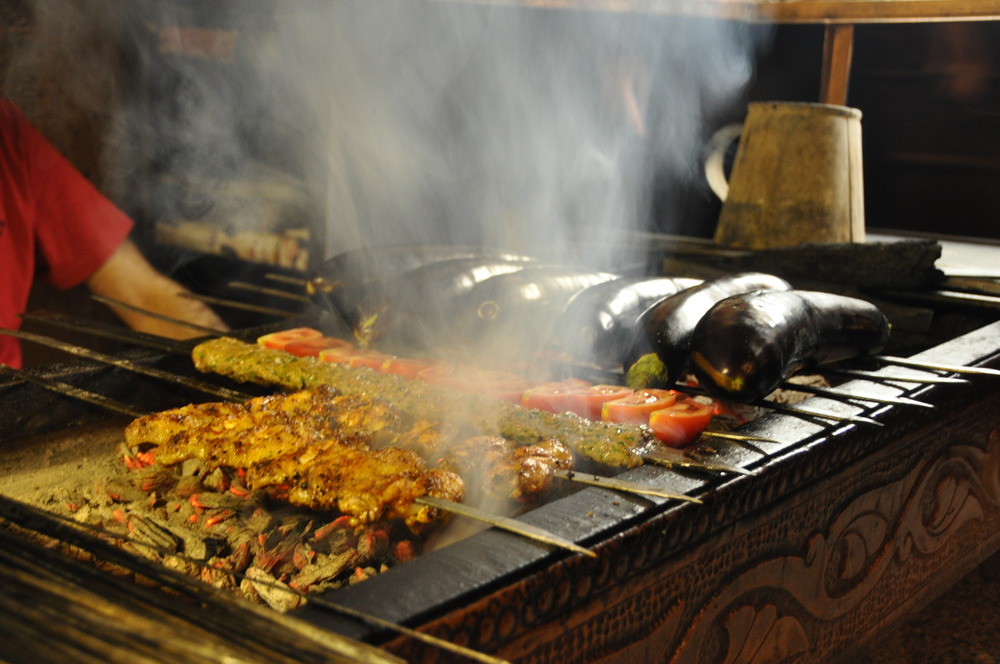
I haven’t written a post about food since Seville, but I think Istanbul really deserves one. The food here has been spectacular. Because we don’t get much Turkish variety back home, I incorrectly assumed that Turkish food was mostly meat on a metal stick over fire (kebaps) or meat on a rotating stick (doner). Thankfully, I was wrong.
We checked the websites www.chowhound.com and www.istanbuleats.com to pick our restaurants, according to whatever area we were going to that day. The best reviewed restaurants ended up being in close proximity to where we were living. Score. I’ll start with my review of the kebaps. After eating the ones here, I realized I’ve been eating a bastardized version back home. The many varieties (chicken, lamb, beef, spicy minced, etc etc) are all amazing. A little crispy on the outside, spiced perfectly with a slight hint of the hot coals they’re cooked over, moist on the inside and full of flavour; basically the best meat on a stick I’ve ever had. Meze appetizers are also a wonderful way to start your meal. They’re small dishes (usually cold) that offer a surprising array of tastes and textures. The salads, yogurts, cheeses, and dips were all great. Their eggplant (or aubergine as they call it here) concoctions though, are something else. Though I like eggplant, I’d never go out of my way to get some. Istanbul has changed that, as we actually returned to a restaurant just to get their roasted eggplant dish again.
All this food goes well with the Turkish drink of choice, Raki. It’s a clear aniseed alcohol that when mixed with water turns milky like calpis. The first restaurant I tried it at (also where I had the best kebaps) was called Zubeyir. Everyone else at this packed joint was drinking Raki so I ordered a small bottle. The waiter looked at me and said in his broken English that it would be too much for me and we would need more people to share it like the other tables. The 16 year old (or more like the 16-29 year old) in me replied “No it should be fine”. 3 happy hours later, I finished that bottle. I felt like high-fiving the waiter and yelling “Beeyaaah” (Dave Chapelle style) immediately after I emptied the last glass, however he, or anyone for that matter, was nowhere to be found. We were the last customers in the joint, but at least I finished my Raki.
The street food on offer is delicious as well. The doners, fish wraps, Turkish pizzas (pides), borek (flaky pastry stuffed with meat or cheese), the list goes on and on. We were basically eating constantly and searching for restaurants became more important than finding the must-see sites (those were easy to find). Oh we also had the Turkish baked potato called kumpir. I used to think a baked potato with sour cream, chives and bacon bits was fully loaded. Fully loaded potato now has a totally different meaning to me. The kumpir here has butter, cheese, and about 10 (not exaggerating) other toppings. Stuff like corn, hotdog, cabbage, peas, olives, durum, ketchup, mayo, I can’t even remember what else. The final size of this potato was bigger than Di’s head (that’s not saying much cuz her head is size mini, we just bought her a hat at a children’s store) and it took us a good hour to eat one between the 2 of us. Amazingly, the locals were inhaling one each in about 8 minutes. We washed the potato down with an equally sized waffle stuffed with fruit, nuts and chocolate sauce. This has been having a detrimental effect on my rippling 8 pack, but I guess I can deal with that later.
I must say I was slightly disappointed by Turkish coffee (even though we supposedly went to the best place called Mandabatmaz), and I reverted back to Starbucks. Their desserts like their ice cream, baklava, and Turkish delight didn’t really do it for me either but I think we’ll be in Turkey for at least another week if not 2 so maybe I’ll change my mind.
Either way, don’t let that last paragraph deter you from coming to Istanbul to eat. The food culture is great here, and I’m glad my ignorance to Turkish cuisine has been put in its place.
Istanbul – where East meets West
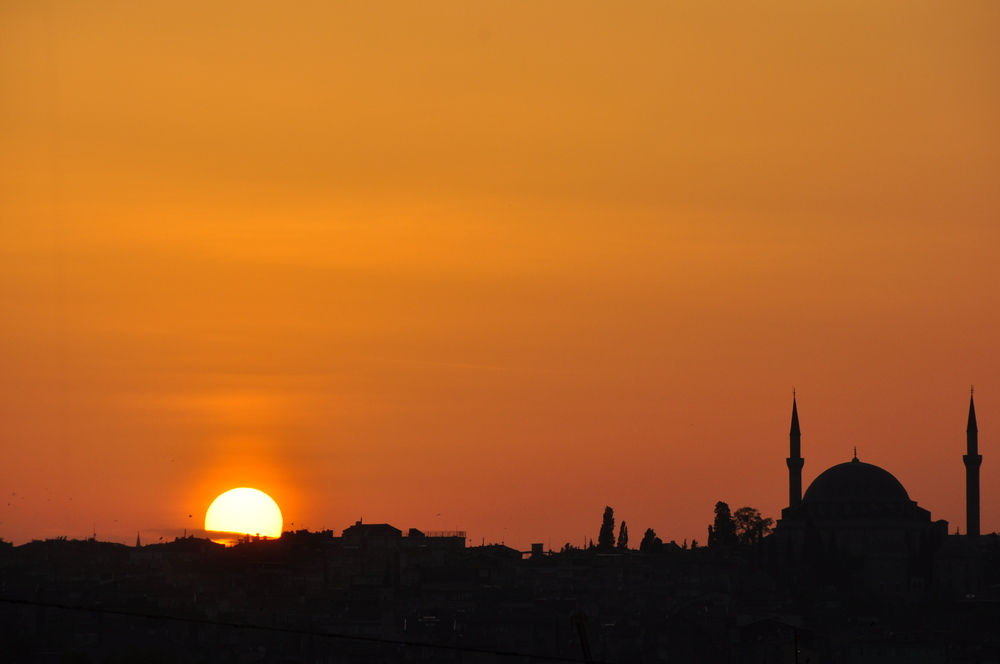
We flew from Cairo to Istanbul via Turkish Air. It was only a 2.5 hour flight but it was awesome. Not only did we get drink service, wine was also free, and we got a full meal (pretty tasty too for airplane food) and snacks at the end too! Air Canada should be ashamed, tsk tsk tsk.
After moving around from place to place for short stays in the past 2 months, we were feeling a bit tired so we decided to stay in Istanbul for one full week in a furnished rental apartment. The last time we stayed in a rental apartment was in Seville, which also means that the last time we had a washer was almost 2 months ago! Yes, we have been hand washing our laundry for almost 2 months and trust me, it is not fun at all. We were so happy to have a washer again we did 3 loads of laundry the first day.
The apartment we stayed at was in a perfect location in an area called Beyoglu (thanks to Brooks for his suggestion). Beyoglu is across the bridge from Sultanahmet where most of the main sights are. We were within walking distance to the attractions without the crowds of tourists. We were close to the Galata tower and less than 50 metres away from the most famous thoroughfare of modern Turkey – Istiklal Caddesi. Eug met a Turkish guy at George before our trip and when he found out we were going to visit Istanbul he told Eug about Istiklal street and that ‘Istiklal is like Robson but way cooler’. He was absolutely right. The street is packed with locals every day and night. It has shops, embassies, churches, movie theatres, restaurants, bars, street food vendors, a fish market, street performers, and a tram that runs up and down the boulevard. There was so much to explore here that we stayed around the area for 2 days before crossing the Galata bridge to visit the main sights. We also had to run around between the Syrian and Canadian embassy a few times to replace our Syria visa the first 2 days and we ended up discovering another nice area Nisantasi where there are more embassies and some upscale stores, it almost felt like Paris. It was really nice just to be in a modern city again.
We went to Sultanahmet the next day and checked out Topkapi Palace first. Ottoman sultans lived in this palace until the 19th century. The guide book said the must sees here are the Harem and the Treasury. Oh I did ‘wow’ at the ridiculously huge 86 carat diamond in one of the Treasury rooms. Eug said he’d buy my one that was 860 times smaller. I’m a lucky girl. And seriously, do you really need a Quran casing made out of gold and covered with emeralds and diamonds? I guess I don’t understand since I’m not a sultan. Though Eug thought the Harem, or maybe more the thought of it, was pretty awesome, we both found the Privy Chamber to be the most interesting. The Privy Chamber houses what are considered to be the most sacred relics of the Muslim world. It had an interesting collection such as a small strand of the prophet Mohammed’s beard, bowl, turban, Moses’ walking stick etc. It also had the Muslim interpretation of the bible stories. Neither one of us is religious, but we have been asked numerous times already if we believe in God on this trip. It’s especially fun for me to hear what Eug has to reply to whoever asks us the question (evil laugh). It definitely raised our curiosity and interest and we both agree we wouldn’t mind reading more about it in the future. We moved onto Aya Sofya after. From the outside, this religious building (church first under the Romans, mosque later under the Muslims) didn’t look as impressive as what the book described – one of the world’s most glorious buildings. But once we walked in, we couldn’t stop staring at the incredible dome hovering above our heads. The architecture was magnificent, as were some of the mosaics. The history of the building was extremely interesting as well. We then went to the Blue Mosque. It was simply breathtaking. There’s something about the Turkish Mosques, especially the Blue Mosque that you can’t really describe. They look much more serene and graceful than the other churches and mosques we’ve seen so far. You just really appreciate looking at it and you can take pictures from every angle and not get tired of it. The last sight we visited was the Hippodrome. It’s an open area in front of the Blue Mosque where chariot races took place. There’s a stolen (er… I mean transported) obelisk from Karnak temple in Egypt here.
We also visited the Basilica Cistern, the Grand Bazaar, and checked out another fish market in the Kumkapi area. The Basilica Cistern is this underground reservoir built in 532 AD to hold up to 80000 cubic metres of water. We walked by it not thinking much of it, but luckily we decided to go in because we really liked it in there. It was like a dark cave supported by Roman columns with eerie lighting. What made it even more memorable was just outside of it I got pooped on by a stupid pigeon! Obviously Eug thought it was hilarious and stood there laughing instead of cleaning it off me. Thankfully it was just a small amount that landed on my shoulder and he wiped it off after he regained his composure. See, I am a lucky girl! On another day we took a cruise up the Bosphorus, a body of water that connects the Black Sea to the Sea of Marmara and is the dividing line between Europe and Asia. The sights are impressive on either side, and we got off at the last stop on the European side and took a bus back to the centre of town stopping at cute suburb Ortakoy on the way back.
There are tons of places to visit in Istanbul. One week may not be enough for those who want to see everything. There is also a lot of food to try; I wish I had an extra stomach to taste them all. We thoroughly enjoyed Istanbul and will definitely come back again. This time of year is perfect as well as it’s been nothing but blue skies and warm weather all week. Life is good.
 fromwonderintowonder
Recent Comments