Taipei 101 Fireworks on New Year’s Eve

Happy New Year!
Kuala Lumpur – Home of The Petronas Twin Towers
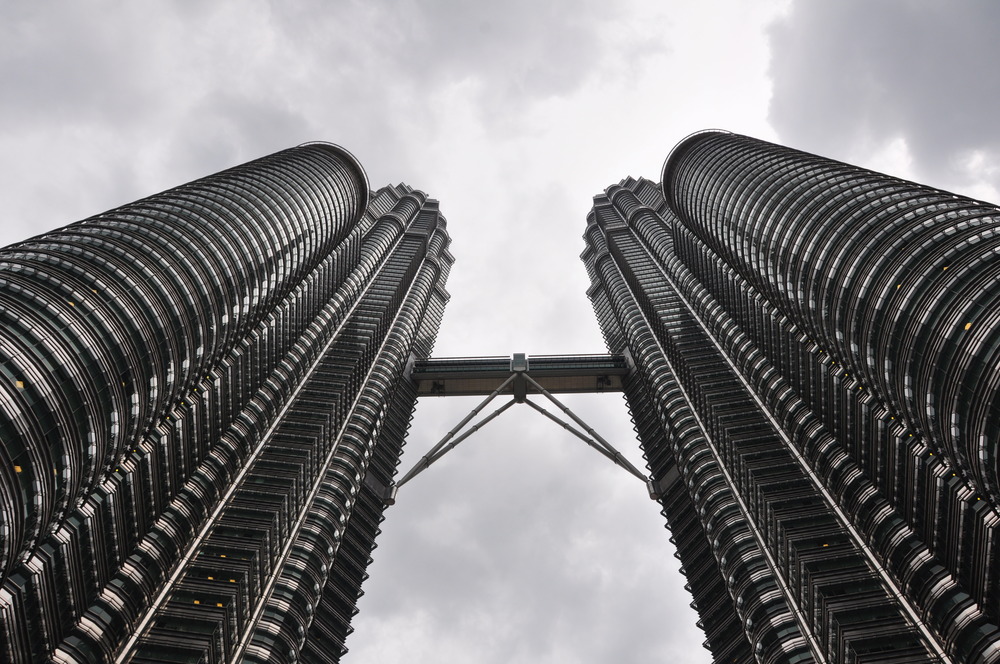
We landed in Kuala Lumpur (KL), Malaysia after a short flight from Phuket. Since we are pretty much finished with tough traveling, I booked a hotel for our 4 day stay in KL. I got a deal from the Starwood Preferred Guest website to stay for 2 nights at the Sheraton and get the 3rd night free, woo! I was looking forward to Starwood’s well-known heavenly bed to get a good night’s sleep. When we arrived in the hotel, I immediately felt a bit out of place carrying our worn out backpacks and looking slightly dishevelled compared to other family tourists with brand new shiny suitcases looking all decked out for the holiday season. But no worries, after we checked in, Eug and I put on our best outfits too, jeans and hoodies, yeah! Our room was awesome, it was probably bigger than our Shangri-la apartment and the bathroom had a view of the city. Thank you Starwood! We came to KL for two reasons. First of all, the flight from KL to Taipei via Air Asia was half the price compared to other major airlines. Secondly, we came to feast on the incredible variety of Malay, Chinese, and South East Asian food KL has to offer.
This was my first time to Malaysia, so I had no idea of what to expect in KL except for the famous Petronas twin towers (picture above). Unlike the Taipei 101, even though the twin towers were once the world’s tallest, they didn’t stick out as if they were the only buildings in the city. KL has many other modern high rises as well whereas Taipei 101 is surrounded by a collection of much shorter buildings. The Petronas Towers were designed by an Argentinian architect named Cesar Pelli and they were first opened in 1998. They stand 88 stories high and are the headquarters of the national oil and gas company Petronas. Upon close inspection, we noticed the Islamic art influence on the buildings which gave them a distinctive aura that captivated our attention. The two towers are connected by a skybridge on the 41st floor, however we didn’t make up it there because there were only about 1000 visitor tickets available a day. We never made it early enough to get the tickets. If you’ve been up there please feel free to share your experience with us. Was it worth lining up early in the morning for?
We made our way to the Twin Towers area which is called Kuala Lumpur City Centre (KLCC) via a free shuttle from the Sheraton. We basically waited 20 minutes for the shuttles to get organized before taking off and the ride to KLCC turned out to be less than 5 minutes, no joke. Getting pampered costs you time and freedom I guess. We decided to get around the city on our own after that. It was very easy to take the skytrain or just to walk around the city on foot. Suria KLCC is a very nice mall where we had some delicious Malay cuisine including Nasi Lemak, Laksa, Char Kway Teow (broad noodles fried in chilli and black bean sauce), and desserts like shaved ice with red bean coconut milk and fried banana fritters with vanilla ice cream. It reminded me of the lunches in Tropika restaurant in Vancouver. KL is also known for excellent street food. Since there are around 50,000 registered hawkers in KL, we decided to venture to the areas where there are food stalls as well. We went to Bukit Bintang area’s Jalan Alor street where supposedly the best Chinese hawker stalls and restaurants in KL are found. There we tried chicken wings, noodle soup with fish balls, fried vermicelli and rice noodles. All were scrumptious. We also walked around Chinatown in the evening when it was the most happening. Numerous restaurants set up extra tables outside the streets because all were running at almost full occupancy. The night market was so packed with people we could barely squeeze through the 5 blocks of street vendors. Here in fact was where we had the best meal in KL. We came across a food stand right outside a convenient store. There were fresh vegetables and meat and seafood all laid out on the stand and behind it was at least 20 tables set up with a hotpot in the middle of each one. We first picked a few items and then the cook either grilled or deep fried the meat and seafood, while we cooked the vegetables in the hotpot. We had really good calamari, chicken and pork skewers, and all kinds of vegetables. The food left our taste buds extremely satisfied. We were on such a food high that we almost tried the infamous stinky durian as well, but we were just way too full.
KL is a fascinating city to visit. It is made up of Chinese, Malay, and Indian communities, and each marks a prominent influence that is reflected throughout the city. It is also the most modern Muslim country we’ve been to so far on this trip. There is an efficient public transport system, world class business and shopping districts, and a bustling nightlife full of trendy bars and restaurants. And due to its multicultural nature, it`s not surprising to find a Malay who can speak fluent Mandarin, Cantonese, Hokkien, and English on top of Malay. This makes KL an easy holiday destination for other Asian country tourists. I, for one, hope to come back to Malaysia again when it’s not the monsoon season to hit the beautiful islands and do some diving.
Groovin…On a Sunday Afternoon

Growing up with a silver spoon meant my family spent a lot of time in the Caribbean when I was a kid. This was the era of Tom Cruise in Cocktail, so I was surrounded by older dudes in Hawaiian shirts with overly tanned wives drinking colourful concoctions that always had a mini umbrella out the top. One of many things I fondly remember about those vacations was the soundtrack of the beach; songs like Groovin (the Young Rascals), Red Red Wine (UB40), and Baby I Love Your Way (Peter Frampton) were constantly playing. When I got older and started heading to the beaches of California a new soundtrack started to form, one that I thought was infinitely cooler since I, as a teenager, was infinitely cooler (or so I thought) than overweight drunk lawyers in the Cayman Islands. Songs by the Dove Shock, Warren G and Sublime were always in my Sony Discman (with 9 second ESP I might add, pretty awesome). The reason I bring up this music is because I’m currently looking out at the turquoise waters of the Andaman sea on Klong Dao beach, a beautiful stretch of sand on the Thai Island of Koh Lanta. Here, the music of Jack Johnson has taken over. I have nothing against Jack Johnson, I used to like him a lot (I still do but less than before, overexposure tends to do that to an artist) but I do find it a little unfortunate that the islands and beaches of SE Asia, which I like more than those of the Caribbean, don’t have their own home-grown sound that matches the vibe of the ocean. I will make the statement that when it comes to music on the beaches all over the world though, there is still one king to rule them all, one king to find them, one king to bring them all and in the music bind them. That king, deservedly, is Bob Marley. He’s still the one voice common to every beach we’ve ever been to. I’m hoping you can tell by my reference to the Lord of the Rings that I no longer think I’m infinitely cooler than anyone else, including overweight drunk lawyers having fun, dancing and singing to Kokomo in the Caymans. However, I do hope that one day I won’t be that drunk, overweight dentist trying to get people to do the Macarena with me. Fingers crossed.
After Myanmar we returned to Bangkok for a night so that we could have my stitches finally removed. Once that was done we headed to Phuket for a night before taking a ferry to the island of Koh Lanta, briefly stopping at Koh Phi Phi. Phuket is kind of the resort hub of the area, with all the big hotel brand names setting up shop. Further south are the islands of Koh Phi Phi, made famous by dreamy Leonardo Di Caprio in the movie The Beach. Phi Phi, like many other Thai Islands, used to be a backpackers haven, but the place has completely changed with overdevelopment and speedboat day trippers from Phuket. Some still think it’s paradise while others, especially those who knew what it once was, are on the verge of tears when they see what has happened. The Thai government had a chance, under horrific circumstances, to redevelop Phi Phi sustainably (supposedly it’s currently an environmental disaster waiting to happen due to its fragile ecosystem) when it was basically wiped out by the tsunami in 2004. However things now, unfortunately, look just like they did immediately pre-tsunami. Di and I decided to head further south to the larger and less-famous Island of Koh Lanta, which has a more groovin (I’m bringing that word back for this post) vibe and extremely long stretches of beach along its coastline. Since we had been moving around a lot, we also decided to spend 5 full nights here without checking out the rest of Krabi province even though it’s considered Thailand’s most beautiful.
The first thing we noticed when we arrived was that most everyone had really blonde hair and blue eyes. Further questioning provided some answers; most of the tourists were from Sweden, with the rest being largely from other Scandinavian countries. We had barely met any Scandinavians over the past 10 months, and now we were surrounded by them. Most of them were families on their Christmas vacation. Supposedly once the infrastructure was set up and direct flights opened up from Stockholm word of mouth got back to Sweden and they all started to come to Koh Lanta. The Swedes, however, don’t sound like the dude in the funny IKEA commercials back home, their English is far better. That was a shame really for me, as I’m a fan of hilarious accents.
Anyways, we went scuba diving with a recommended Swedish company, and the service was amazing compared to our other dive trips so far. We basically didn’t have to do anything but put on our mask, BCD and fins and jump in the water; everything else was done for us. We went diving around the islands of Koh Ha Yai. When we told our German divemaster that our last dives were in Palau, he conceded that here the diving was catered to families who rarely dived anywhere else. He thought we should try diving around Thailand on a liveaboard, which is a boat you live aboard (hence the name) and where all you do is scuba dive, sleep and eat for as many days as you want. He, and other hardcore divers, was of the opinion that the underwater experience would be unparalleled. He was basically implying that though the tourists on the boat would find the diving awesome at Koh Ha Yai, we might not. He was right. The diving was still good and enjoyable though so no complaints. We also did have fun hanging out with a Swedish couple on the boat and we met up with them later on the island for food and drinks. The rest of our days were just basically spent groovin; we scootered around the island checking out other beaches, paddle surfed, got Thai massages, and ate delicious Thai food. Life was good, and we could definitely see ourselves retiring somewhere in the south of Thailand in the future. Being surrounded by Swedes but not knowing their writers, I also decided to read the Stieg Larsson Millenium trilogy which Di recommended and which turned out to be pretty entertaining. I’ve mostly been reading non-fiction on this trip so Swedish mystery novels were a nice change.
We spent Christmas day here yesterday, my first without my large extended family around in a long time. I did miss them a lot but we skyped them to send our xmas greetings. Our xmas dinner was pad thai and curry, nothing like my aunt and uncles’ turkey and stuffing but Di and I were still happy to spend it together and thankful for our amazing year so far. We also decided that though we’ve enjoyed travelling mostly in the developing world, we’re ready to slow things down as our trip is coming to an end and we are starting to get tired of harder travel. So, from here on out, life will be on easy street; no more “tough” countries. We’re going to head to Kuala Lumpur after this just for a couple of days before flying to Taipei for New years with our friends. After that, if all goes well, we’ll finish things off in Australia, HK and Japan where we also have friends. Groovin! (I don’t think that word works here but I’m using it anyway)
So in the immortal words of Trooper (in the lyrics of a song that happily reminds me both of Caribbean beaches and my days at UBC where it was a sort of theme song for the sunny days in our residence house) I’d like to finish off by saying:
We’re here for a good time, not a long time, so have a good time, the sun can’t shine every day.
Merry Xmas everyone
The Temples of Bagan and The Waters of Inle Lake

After Mandalay, we took a very short flight covering 190km south to Bagan. Bagan is officially known as the “Bagan Archaeological Zone” consisting of approximately 2000 temples. The ambitious Bagan kings built about 4400 temples on the riverside plain over a 230 year period in this area, but some were lost to erosion, earthquakes, and neglect over the years. Bagan includes three main areas, Nyaung U, Old Bagan, and New Bagan. Nyaung U is the biggest town housing most guest houses for independent travellers and a supposedly vibrant restaurant street. Old Bagan is within the old city walls in the core of the archaeological zone. There’s no one living in Old Bagan now except for tourists occupying the high end hotels in the area. New Bagan is where the inhabitants of Old Bagan were relocated to in 1990 by the government. It has some restaurants and middle range accommodations. Needless to say, with the way we roll on this trip, we settled in Nyaung U and paid $20 a night for our accommodation. That’s a $20 crisp new bill without Eug commenting on how stupid the banks here are when he paid the owner. There are three ways to experience the multitude of temples scattered throughout Bagan, either by taxi, bicycle, or horse carriage. Because we only had one full day here to cover 30km, a bicycle would be too slow and a taxi wouldn’t be able to get into the less accessible sites, so we settled on the romantic horse carriage option. We shared the horse carriage with a German girl whose boyfriend got sick a few days earlier from eating something that upset his stomach leaving him in the hotel. It was a shame for him but we ended up having an amazing day visiting the sights. The temples themselves were pretty cool, some Indian-ish, one was all white like a castle, one was shaped like the pyramids. But what we couldn’t stop raving about was the landscape of the archaeological zone viewed from atop of the temples. As Lonely Planet put it, “imagine all the medieval cathedrals of Europe sitting on Manhattan island”, but replace the cathedrals with temples or payas, as they call them in Myanmar, all around the archaeological zone. Whenever we could hike to the top of a tall paya, we would take our time to soak up the incredible landscape of endless temples stretching all the way out to the horizon. We were able to catch the sunset from the top of one of them as well. The views were utterly stunning.
The next day we flew to Heho from Bagan. Heho was an hour away from our guest house in Nyaungshwe, a town on the shores of Inle Lake which was our next discovery point. By our guest house we ran into four Singaporean travellers we had seen before in Mandalay and Bagan. It turned out that they were also travelling independently and had planned the exact same itinerary as us for the 9 days in Myanmar. In addition, one of the girls was recently transferred to Hong Kong and she worked together with one of our friends there. Talk about a small world! They were going to bike around Inle that afternoon, and since we didn’t have any plans for the day we decided to join them. Our Asian bicycle entourage biked through the country side roads of Inle passing through many small villages. The narrow cement road we rode on was surrounded by vast plots of farmland on both sides. Almost all the villagers who noticed us going by smiled and waved madly at us to say hi. The children always gave a curious look at first followed by the cutest innocent smile. The playful naughty ones would run up to us while reaching out their small palms to give us high fives as we rode by. The purity of their welcoming gestures left us feeling warm and fuzzy all over. About half way through our ride, we needed to hop on a boat to take us across the lake to continue our journey home. The size of the boat was about half that of a dragon boat we see back at home on false creek. I couldn’t believe our boatman (a 60 year old grandpa) was able fit all 6 of us and our 6 bikes plus himself onto his boat. We meandered through blocks of houses sitting on stilts on the water. It was very interesting to see the local people in these houses washing clothes, eating meals, or just chatting away and hanging out with their neighbours having a good time. By the time we reached the other side of the lake it was already approaching sunset. Since Eug and I were still traumatized from the unpleasant memory of riding bikes in the dark, we tried our best to keep on pedaling so we could get back to Nyaungshwe before night fell. We all made it back just a bit after sunset. What a relief! Our travel companions were saying how fit we were because we didn’t stop cycling, little did they know we just wanted ‘safety first’. The next day the 6 of us hired a boat to go around Inle Lake, one of Myanmar’s treasures. Inle Lake is 22km long and 11km wide. It is home to 17 villages on stilts inhabited by the Intha people. We started off the day with a visit to a market. The boat ride there took about an hour and it was peaceful. We passed by a few fishermen along the way (picture above). The hardworking Intha people are known for propelling their flat bottom boats by standing at the rear of the boat on one leg while wrapping their other leg around the oar to row the boat. I eventually fell asleep for a bit on the comfortable boat ride and Eug just daydreamed. It was one of those perfect quiet moments where you could just relax and enjoy the scenery without having to worry about anything. The market had the usual tourist souvenir stands but also a lot of local produce where the locals go and shop. We spent much of our time wandering around the fruits and vegetable stands to people watch. Too bad there weren’t a lot of tourists there, because we learned that watching the tourists with the locals can be pretty fun and entertaining too. We were taken to several shops on stilts along the way to see how the local lotus and silk scarves were weaved and how tobacco, paper (like the ones in the Papyrus store), silver jewellery, etc were made. It’s incredible to see how everything was fabricated using the most basic tools; there’s definitely no modern machinery involved here. However the highlight of the day long boat trip for us was really the dazzling scenery. Almost every picture we took possessed a post card quality because of the clean black water reflecting everything above it. It’s no wonder that Louis Vuitton did a beautiful advertising campaign with its photo shots all taken on Inle. A simple wooden house on stilts with some grass on the side sitting on the placid clear water reflecting a mirror image of itself against the blue sky was all it took to make the day perfect. It was a photographer’s dream and we were spoiled by seeing tons of that.
I remembered feeling like “ugh, can we get out of here already?” upon arriving in Yangon, eating not-so-good street food and sleeping in smelly bed sheets. It was dirty (though not as dirty as India) and ghetto and I was tired of travelling in developing countries again after having a taste of luxury that a clean and modern city like Bangkok offered. Eug then told me to give it a chance since that was only our first day in Myanmar. I’m glad he gave me that advice because having spent the last few days in Bagan and Inle, I actually wished we had more time in Myanmar! Most travellers we met allocated 3 weeks to a month in Myanmar and we were only able to spend a short 9 days here. It’s a huge country with a lot more to see and we agreed this is somewhere we will definitely return in the future for a more thorough visit. Hopefully by that time the military regime will have changed and the citizens will have a better quality of life. Just in case, we’ll make sure we bring all virgin bills next time.
Burmese Days

The title of this entry is my tribute to George Orwell, who lived in Burma for a while and wrote a book with the same title. I’ve rediscovered his writings on our voyage with a new appreciation.
With the doctor’s OK we took a flight to Yangon to start our time in Myanmar, formally known as Burma. We were originally going to stay here for 2 weeks but had to shorten our trip to 9 days because of our unintended longer stay in Bangkok. In our limited time we decided to visit Myanmar’s ‘Big Four’: Yangon, Mandalay, Bagan, and the Inle Lake area.
Myanmar, nestled between India/Bangladesh on one side and China/Thailand/Laos on the other, is one of those countries that is quite isolated from the international community. It is ruled, quite brutally in many instances, by a repressive military junta. Many western countries have enforced full economic sanctions against Myanmar because of this regime, and there is an active debate among travellers on whether to even visit this country since some of your money will inevitably end up in the governments’ dirty hands. However, everyone we spoke to who had been to Myanmar had nothing but amazing things to say about the land and its people. Their collective advice was to visit the country but to avoid giving as much money as possible to the government, ie don’t stay in government hotels or take government transport etc. So Di and I followed their recommendations to go, and our only regret is that we had too little time here.
Yangon is the capital of this large country (about the size of France) and is home to 5 million people. Yangon’s landmark is the Shwedagon Paya, the most sacred of all Buddhist sites in the country and on the top of every citizen’s pilgrimage list. At the centre of the grounds was a huge golden domed stupa (picture above), purportedly enshrining some hairs of the Buddha. The stupa was surrounded by a myriad of other temples and buildings, all filled with different Buddha statues. Though the site itself from an architectural standpoint was pretty interesting, what made the afternoon we spent here more worthwhile was the people watching. Unlike the famous Buddhist temples in Bangkok where tourists far outnumber the devout, I counted 7 of us foreigners among the hundreds of local worshippers, monks and nuns. Though many were praying and chanting, the atmosphere was very casual with families running around and smiling faces more plentiful than solemn ones. The picture above may make the place look rather ominous with the cloudy weather, but really the mood there was the exact opposite. When Buddha-statue-overload started to kick in, we headed to the Bogyoke Aung Sang Market to check out Myanmar’s famous jewellery stores and their world renowned jade and ruby collections. When we arrived it was actually quite intimidating, as there were hundreds of shops and the jewellery section was overwhelming. We were hoping to learn why Myanmar’s jades and ‘pigeon’s blood’ rubies were so famous but we weren’t willing to listen to the hard sell (which was what this market seemed to be about) so we just walked through and glanced at the gems. Luckily for my wallet Di didn’t buy. As an aside companies like Tiffany & Co, Cartier and Bulgari have stopped buying Myanmar’s gems (though their rubies are supposed to be the best in the world) as profits help fund the suppressive military regime. There are counterpoints by others who say that bans and sanctions only repress economic development which hurts the average Burmese citizen more than the government.
After Yangon we went to Mandalay, Myanmar’s other big city. When we checked in to our hotel I tried to pay with our US 20 dollar bills. We were warned by other travellers that there is a pretty strict policy here where you have to pay in USD and the bills have to be in really good condition, ie no stains, tears, or even creases. This is supposedly because the Myanmar bank only takes good quality bills from locals and if the bank doesn’t want them they’re SOL. Getting bills rejected is a pretty big problem for travellers because there are no banks in this country for you to take out money and no one accepts credit cards. Knowing about this beforehand, I actually performed the ridiculous job of ironing all my American money at our guest house in Bangkok the night before we came to Myanmar. Anyways, the lady at this check in counter was just being ridiculous and she rejected the first four 20s that I gave her. We were trying to convince her that they were fine but she wasn’t having it. I got severely frustrated because if people were going to reject all of our bills for the next week then we would have had to leave Myanmar much earlier than we wanted to. So I looked at Di, shook my head and said “this is soooo stupid”. All of a sudden the lady’s cold and businesslike demeanour (thankfully she was the only one who was like this during our whole time here) turned defensive and aggressive as she yelled back at me “I NO STUPID”. Great, she thought I said she was stupid. For the next 5 minutes Di tried to pacify the situation by trying to explain that I was talking about the Myanmar banks and not about her, much to the amusement of everyone watching in the lobby. Eventually she accepted 2 of our bills, but she gave us change with a stain (if you could call it that, it was about 2mmx2mm) slightly larger than one of the bills she rejected from me. I was kinda pissed at this point, so I took my rejected bill to show her how unfair she was being by giving us ‘dirty’ change. She was also pissed, and just kept saying ‘NO’ and ‘YOU TAKE CHANGE’. Di eventually calmed me down and took the change as she joked she didn’t want to go back to our room later on to see a snake lying in our bed. Thankfully for the rest of our trip owners of other hotels happily took our USD. And you might ask “what about the local currency, is it subjected to the same scrutiny?” Well since you need local currency (called Kyats) to pay for meals and taxis and stuff, I was able to find out. A ton of bills here looked like they were first run over by a stampede of elephants on the filthy streets of India before being handled by Freddy Kreuger, who then left Elm Street to give them to Di’s 18 month old niece to scotch-tape back together. When I was given these as change I tried returning them to the proprietors, but they all said that they would work at other stores and they told me not to worry with a big smile. To my surprise, these Kyat bills were gladly accepted everywhere.
Anyways, in Mandalay we first went to check out the Mahamuni Paya which houses a Buddha where male worshippers apply gold leaf with lacquer to its surface. Currently the 4m tall bronze Buddha has a 15 cm thick golden shell comprised of this gold leaf which has been applied over the years. That stat was amazing to me considering how thin each little square sheet of gold being applied was. We then went to the ancient cities of Sagaing, Inwa, and Amarapura just outside of Mandalay. We climbed a hill in Sagaing that was covered in over 500 Buddhist stupas and which offered great views of the Ayeyarwady river. We took a boat across said river to Inwa where life was quieter and ancient temples were empty and inviting. Our highlight though was hanging out on the U Bein Bridge in Amarapura. The foot bridge, at a length of 1.2 kms, is the world’s longest teakwood bridge, requiring over 1000 teak posts to hold it up. We lingered there for over 2 hours while waiting for the sun to set. During that time we watched fishermen around us and conversed with monks walking by. The exercise in patience awarded us with one of the most spectacular sunsets we have ever seen. Unfortunately we were short on time and had to leave to Bagan the next day, or we would have returned to watch the sunset again.
When we got back to the hotel that night thankfully the woman I had a disagreement with was off (and our bed was snake-free!). I’ve learnt my lesson and have decided to never use the emotionally charged word ‘stupid’ in front of someone with a weak command of the English language again.
Bangkok and Chiang Mai
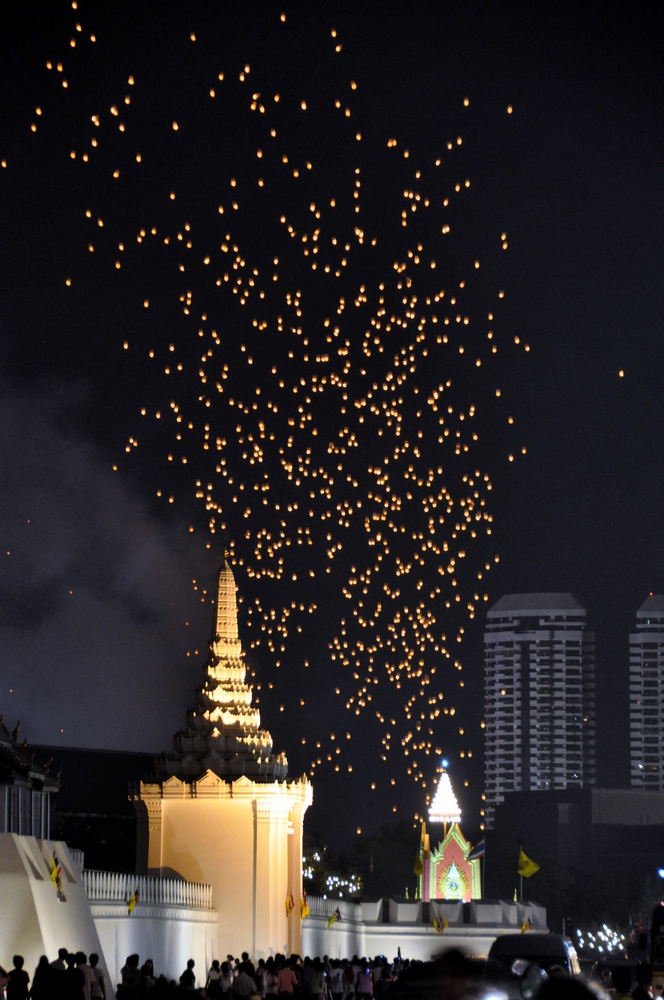
As soon as we arrived at the Bangkok airport, we felt relieved to see modern amenities like soap, toilet paper, and paper towels available in public washrooms again, something we hadn’t seen much of in the past month. As Eug mentioned before, by this time his leg was as swollen as an elephant’s, and we were in desperate need of a comfortable place with four walls to sleep in. Our tent on the island was not bad, but we are city people after all. We were soon reassured by the sight of our spotless b and b. We arrived at 6am and our considerate host Charn made us breakfast and directed us to a private hospital so Eug could get his fat leg looked at as soon as possible. The hospital, complete with valet parking, looked like a five star hotel and the emergency nurses called the doctor right away. The competent general surgeon showed up very quickly and took care of the wound. From that day on, he saw through Eug’s progress with great care and attention. We paid daily visits to the hospital for the 8 days that we were in Bangkok. We didn’t plan to stay that long initially but we had to because of Eug’s infection. That in turn, gave us a different perspective of Bangkok. Usually people just fly into this city to transfer to other beach destinations in Thailand. We were also just planning to transit through to Yangon in Myanmar. However, having spent more time here, this city eventually grew on us.
For the first few days in Bangkok we didn’t do much sight-seeing. We re-organized our itinerary after the doctor confirmed that Eug could not get stitched up so soon. We decided to postpone our Myanmar visit until his leg was healthy enough. Good thing we paid for full fare tickets so we could change the dates without having to pay a fee. Our new itinerary was to head to Chiang Mai for a few days, then back to Bangkok to visit the doctor again before going to Myanmar. We started sight-seeing in Bangkok when Eug felt better. Our first sight was to see the golden Buddha in Wat Trimit. As we were walking there, these 2 nice and talkative Thai moms came up to us and started chatting with us. Long story short, we ended up taking a private boat ride with them on the Chao Phraya River and got scammed! Sigh. In hindsight it was pretty stupid of us not to have asked the price before we hopped on the boat. We both assumed they were locals so they would know or get the local rate. We must have been pretty exhausted mentally to let all our guard down. At the same time, we didn’t want to think that everyone who tries to be friendly is up to no good either. That’s a tough one. We ended up having to pay the boatman (their partner in crime) $100 which was a lot considering the public boat is only $5 and renting the whole boat privately would have cost about $30. We were even too tired to get really pissed at them, we were just really mad at ourselves. We’ve been generally good at gauging locals, and for our 1 year trip this is the first time we got scammed so I guess it’s not that bad, especially since we’ve followed friendly locals many times in many different countries.
The next day we visited the Grand Palace, Wat Phra Kaeo, and Wat Pho where the enormous reclining Buddha lies. It was my first time seeing Thai temples, and I found them impeccably well kept. They looked brand spanking new! Usually when we visit heritage sights we can tell which parts are restored and which have remained untouched since the beginning of time. But all the temples here looked as if they were just built yesterday. The golden blinged out exteriors and the clean and simple interiors of the temples were definitely unique to see. We didn’t plan this but the weekend we were here just happened to be the King’s birthday. There were various celebrations throughout the country and we managed to follow the crowd to the busiest area where people were lighting their own candles while jointly singing the royal anthem. There were many fireworks and innumerable lanterns being released into the sky. It was priceless to see people’s faces as they sent their lanterns floating off (check out the pictures we took in Flickr under Bangkok and Chiang Mai set). We decided to follow suit and it turned out to be the most unforgettable experience. Watching thousands of lanterns drifting across the evening sky above the temples was incredibly magical. We later did walk long enough to see the lanterns burn out and fall to the floor. Some were caught by pedestrians like us and some just landed on the rooftops or the ground. I felt badly for whoever had to clean them up. We also tried to tackle the countless street food vendors in hopes to try at least half of all the different Thai food on offer. I’m glad to declare that we did a pretty decent job. From chicken rice, curries, and pad thai, to wonton noodle soup, grilled pork neck salad, and street meat skewers, we were very satisfied after one week’s time.
Up north In Chiang Mai, we visited the famous Wat Phra That Doi Suthep. Besides the soothing ancient temple and a good view of the city, we really enjoyed the short blessing ritual performed by this elder monk. We knelt in front of him as he dipped a miniature broomstick into a pot of water and flicked the stick so drops of water splashed our way as he chanted along. He was skilled in making sure everyone got plenty of drops of water before he tied a white wrist band around each and everyone’s wrist. Eug liked him a lot. We also did a cooking course in Chiang Mai. That was super fun! We spent a day with Yui from A Lot of Thai cooking school. She’s probably the friendliest person I’ve ever met. She didn’t stop smiling at all the entire day we were with her. She had the cooking school for a few years and among her students was Gordon Ramsey, the British celebrity chef that swears all the time. He did a show with her too. We learned to make pad thai, tom yam kung (hot and sour prawn soup), green and panaeng curry chicken, chicken with cashew, spring rolls, and mango sticky rice. As you all know, I’m not a good cook at all, but I really liked what I made that day. Yui’s class was awesome.
We had an amazing time in Bangkok and Chiang Mai. Chiang Mai is easily liked by most tourists because of its relaxed atmosphere, chill vibe, and cultural sites. Bangkok, on the other hand, is a dynamic metropolis with a new and efficient metro, ancient temples, modern hotels and malls carrying international brands, and delicious food. Bangkok unfortunately has the seedy image of being a sex tourist destination, but if you stay away from those sleazy neon-lit areas offering ping pong shows (if you don’t know, don’t ask), this city has a lot to offer. There’s a vibrant social and arts scene, bustling food and shopping markets, and age-old buddhas in meditative temples. What’s impressed us most so far (apart from those 2 scamming moms) is that Thailand really does live up to its moniker ‘The Land of Smiles’. We’ll be heading to Myanmar for a bit, but after that we’ll return to Bangkok to continue our way to the south of Thailand where tropical beaches beckon. Can’t wait!
I fell off my bike

Yup. And since then I’ve been in a crappy Indian hospital, received 3 crappy stitches, and have had the wound reinfected (not surprisingly). But I’m getting ahead of myself, so let me start from the beginning.
After some relaxing time in Kerala we took a flight out to the Andaman islands, one of those hidden gems that is sure to be overrun by backpackers in the next 5 years, with resorts then running those backpackers out in 10; think the towns on the Turkish Med like Oludeniz or the Thai lsland of Koh Samui. We actually had never heard of the Andamans, but our buddy Dan who we travelled Tibet with (who is on an 18 month around-the-world trip with his wife) said he was gonna be there in the end of November and that we’d like it a lot more than Goa. Di and I did some research, and these islands sounded perfect. The diving was supposed to be spectacular, the water turquoise, the sunsets purple, and the beaches white. There were also plentiful beach huts on offer, what else could you want?
The Andaman and Nicobar islands are in the Andaman sea and are actually much closer to Myanmar and Thailand than to mainland India. The Nicobars are off limits to tourists as there are still indigenous tribes living there who want no contact with the outside world (ie confrontations have been really hostile in some cases). We first flew into the capital of the Islands, Port Blair, and immediately we hopped on a 3 hour ferry to Havelock, the island most popular with travellers. We checked into a dive ‘resort’ which was just a bunch of tents and huts on the beach. We talked to the dive centre and decided to do some scuba a couple of days after we arrived, just to give us some time to check out the island. The next day we rented a bike to do some exploring. The nicest stretch of beach was on the west side of the island, while most of the accommodations were on the east. So we headed the 12 kms through the jungley heart of the island to check out the nicest beach, also called beach 7. The road there was bumpy and full of potholes, some massive, but we made it and hung out there all afternoon. It really was stunning and it felt like we were the only ones around. After watching the romantic sunset we hopped on our bike to go back, and this is where ego/stupidity led to some poor decision making. Since the Andamans are so close to the equator, when the sun sets, it gets dark pretty much instantaneously. So about 5 minutes into the ride home it became super dark, and in case you’re wondering there are no street lights here. Our light that we had was broken, in hindsight we should have tested that before leaving. So instead of hiring a tuk-tuk to take us home I just thought we could make it by moonlight, I mean how hard could it be? About 15 minutes later I blindly hit a deep pothole and my right knee came down hard on the gravel, cutting it open about an inch and a half. Even though it was pitch black out, a bunch of Indians must have heard me fall as I was surrounded by them within about 2 minutes. They pointed me to the nearest (and only) hospital, which was a free government clinic in the heart of town. When I say the heart of town, I mean the only T-intersection around with a couple of T-shirt stores and one or two food stalls. I walked in and found the head nurse, who quickly attended to Di first. Good thing she did since Di had a small bruise developing on her knee, and you know how bruises can be such a huge emergency. I, on the other hand, was only gushing blood to the point of my foot being completely covered in red, but I could wait. She gave us a couple of tetanus shots and wiped Di’s knee clean with a cotton swab and saline. Then it was my turn. She basically doused my open wound with alcohol. That…frickin…hurt. Then she threw in a ton of Iodine for good measure before using her bare hands to stitch me up with what looked like rope. It sucked having no anesthetic but that was the least of my worries at that moment as cleanliness was a bigger concern for me. Thankfully the needle came out of a sterile pack. Anyways, she put in 3 stitches and she tied them as tight as she could. I told her that she was going to make my tissue ischemic, but she said that since it was on my knee where there’s lots of movement she needed to make it as tight as possible or else it wouldn’t stop bleeding. After dressing my wound she gave me some antibiotics and we were on our way. I was not confident at all with the stitching job but there were 5 Belgian doctors staying where we were so I bee lined it to them (they were sitting around talking about their days diving, eating chocolate they brought from Belgium, and smoking cigars; can you be more stereotypical?) Anyways, they had a good laugh with the size of the silk sutures but they said the job was quite adequate and should do the trick; only the scar would be larger than if they did it. That eased my concerns a bit but they said I shouldn’t do any diving for a few days. We were unhappy about not being able to dive, but in hindsight that was a good thing as everyone there basically told us the diving was only mediocre at best. Especially since we were heading to Thailand to dive in places like Ko Lanta people told us not to waste our time diving in Havelock. So Di and I just relaxed on the beach for 5 days, hanging out with other travellers. Most were backpackers (well pretty much everyone except the Belgians) who were there to dive and chillax on a beach, a crowd we definitely got along with. It was good seeing our friends who we travelled Tibet with too. In addition we got in a day of fishing and Di caught a 4 kilo Pocari that was super tasty, not bad for her first time fishing.
The wound seemed to be improving and I changed the dressing at the government clinic twice. Though I kept trying to get the lone doctor to look at it he basically said he couldn’t because he was too busy (which he was) so I just had to go to the dressing room and have the nurses do the work. However, on the day we were to leave, my leg started to hurt, and I knew that was not good. We first caught a ferry to Port Blair before taking the overnight flight to Bangkok. By the time I arrived in Bangkok, my right leg looked like it belonged to an elephant. We quickly checked into our guesthouse, and the owner pointed us to a private modern hospital catered to foreigners. The ER guys took a look and told me what I already knew, the wound was re-infected. The general surgeon came down and froze me up before cutting away the sutures and the dead and infected tissue, re-cleaning everything and irrigating out small bits of remaining gravel. Luckily the hospital here has given me excellent care and the surgeon and nurses have been fantastic. So now my leg looks size normal (and not size elephant) again, but I’ve had to go for a daily debridement and dressing change. He kept it open to make sure everything was drained and it looks like he’ll suture me back up in the next few days. He made a comment about how he’d try to minimize the scar but I’d definitely have one on my knee, and though it wouldn’t interfere with function he joked that I might not look as good in swimming trunks. I responded that I don’t look good in swimming trunks anyways so it’s all good!
India was an extremely intriguing and diverse country. Though it probably was the most difficult place for us to travel, we can now definitely see how many people absolutely love it (and also how others absolutely hate it). The poor infrastructure and city planning, awful train system, and the crushing poverty are certainly negatives that can really frustrate the most seasoned travellers. In fact many of us were quite astounded that India gets compared to China so much; it really still seems light years behind China in many respects. However, it was the amazing heart of the people and their palpable sense of passion and warmth that really left a lasting positive impression for Di and I. Something about their incomparable love of song and dance, something about the sparkling eyes of the average Indian and their ability to convey all their emotions with a glance, something about the addictively amiable head bobble, just something about the soul of this country permanently affects the substance of your heart and the genuineness to your smile.
The Parts of India That We Began to Fancy

Her husband was murdered by his business partner for 40,000RMB (that’s about 1000USD), and because of a bribe the murderer’s sentence was only 1 year in jail. She was left with 2 boys aged 7 and 9. Being in the Brahmin caste, she was not allowed to work and for 45 days after the death of her husband, she had to cover her head up entirely with her sari. There was no money for her and her children so her boys ended up secretly collecting travellers’ laundry from guest houses for her to wash, just so they could afford to eat plain naan with chilli sauce to ease their hunger. By chance, a foreign traveller came upon her cooking and enjoyed it very much; he suggested she teach people how to cook. So she did. She remembered very clearly that her first students were an Australian couple, and since she spoke no English she just used hand gestures to communicate with them. Another traveller offered to help her print her extensive list of recipes in English. Others came along to translate into their own languages and one of them designed a website for her. She eventually learned English from her students and her sons. It’s been 4 years since her first cooking class, and she is now considered wealthy in her community. She helps the poor and she helps travellers buy spices from the market for the “Indian” price since it was Westerners who first helped her. This is the story of Shashi, our cooking class teacher in Udaipur. Her English was not fluent but her usage of simple words, direct and to the point, brought tears in my eyes when she told her compelling story. We spent 5 hours with her in her cozy 25 sq ft kitchen and learned to make almost all of the northern Indian food that we see in restaurant menus: masala chai, pakora, paneer, naan, curries, you name it. We loved every single dish we made. We (mostly Eug since he’s a more talented cook) will make some for you guys when we get home.
After two weeks of experiencing the infamous madness of India that you hear about, we decided to chill for the rest of the trip. What better place to start than the most romantic city in the country, Udaipur. Besides taking Shashi’s cooking class, we did one day of sightseeing to see the City Palace, Rajasthan’s largest palace overlooking Lake Pichola. We spent some time in the City Palace Museum where there were collections of weapons, textiles, mosaics, glass and mirror work, and ornamental tiles. There are two islands on Lake Pichola, on one of which stands the romantic Lake Palace Hotel (picture above). It was a palace built by a maharaja in 1620 and it is said that the Taj Mahal was inspired by this palace. Most of the guest houses in Udaipur are around the old city by the lake, so most of them have rooftop restaurants with a breathtaking view of the floating Lake Palace. We chilled at the rooftop of our guest house a couple of times to soak up the serenity of this view and forgot all about the hectic week before. It was without doubt a relaxing break.
We initially planned to go down to the south Indian states Goa and Kerala for the remainder of our time in India. However, after doing some research we decided to skip Goa since it’s now apparently another overly commercialized tourist location. So we chose Kerala and the Andaman Islands instead to finish off our trip in this country. We wanted to do a yoga ashram in Kerala, but we didn’t want a fixed schedule that started at 5:00am daily. And I bet Eug wouldn’t be able to keep a straight face around a roomful of devoted yogis chanting and singing. So I found a yoga homestay instead. It was in a very small town 4 hours away from Kochi called Kuttikkanam. It wasn’t even on any of our India Lonely Planet maps. The homestay was on top of the hills nestled amongst tea and rubber plantations. It’s a nice big house surrounded by gardens of vegetable and fruit trees. The amazing host and owner, Matthew, is an Indian originally from the area who lived in New Zealand for 15 years. His cook made us a fantastic variety of south Indian meals for all the 6 days we were with them. They were vegetarian but they made chicken for us as well. Matthew taught us how to eat the Indian way, which is to eat with our right hand. It wasn’t hard to eat the naan, roti, or chipati, but it got tougher as we moved onto the rice. It was fun to eat with our hands and it was interesting to feel the texture of the food on the fingertips. Matthew also taught 2 yoga classes daily. We were the only guests staying with him then so we were the only students. I’ve taken many yoga classes before but this was my first time having almost 1-on-1 instruction. Not only did Matthew tailor make the classes just for us, he also corrected our postures. On his own vacations he likes to go to monasteries and ashrams to meditate and see what some self-proclaimed gurus or monks have to offer. For those who want, he has no problem discussing issues of spirituality, meditation, or ways of living your life, without all the weird stuff that sometimes can be associated with those subjects. He also has a nice little library devoted to those topics. We really appreciated our time here so if you want to check him out he’s at www.mundax.com.
One day we took the local buses to Kottayam to take the public boat to Alleppey on the famous Keralan backwaters. We paid 10 Rupees each (that’s about 25 cents) for the 2.5 hour ride. There are tourist boats that you can hire for 1000 Rupees for the same route, or houseboats for 2 days around the same area for 20,000 to 40,000 Rupees depending on how nice the boats are. We were glad we did the 2.5 hour public boat because we got to see the local villagers hopping on and off as we went along. The backwaters were peaceful and really nice, understandably making them the number one tourist attraction in Kerala. The bus rides were amusing and adventurous too. We received countless head bobbles as the locals hopped on and off the bus walking by us. And on the way back, we were pointed to the wrong bus station when making a transfer to get back to Kuttikkanam. Long story short, the helpful locals led us back safely. Two men took us all the way back to our stop. They told us to take the seats right behind them to make sure we were ok. They didn’t speak much English but they tried to make conversation with us every now and then. A few passengers sitting close to us dropped by and told us approximately how far we still needed to ride before they got off the bus themselves. We are really grateful for how helpful and friendly everyone was when we needed help.
Kerala is also famous for its ayurvedic treatments. In Sanskrit, Ayu means life and veda means knowledge. Matthew briefly explained the ayurvedic massage and how people either love it or hate it. Since we were already there, we were obliged to experience it for ourselves. We did it at a famous ayurvedic hospital close-by. A doctor first checked our blood pressure and weight to make sure we were suitable for the one hour ayurvedic massage, then we were led to 2 separate rooms. I had a girl masseuse, and Eug had a smiley little guy masseuse (I’m sure you know where this is going). I was told to change into something that looked like a shoelace with an attached paper-thin piece of cloth down the middle that was about the same length and a third the width of a standard hand towel. I was completely lost as to what to do with it. Turned out that I was supposed to tie the string around my waist with the paper-thin piece in front of me, then loop it back and tuck the end of it to the string on the back my waist. It worked out fine for me but in Eug’s words, it was kind of like a sumo wrestler outfit that doesn’t really cover your package. In this new outfit, I was asked to sit on a stool for the head and face massage. By this point I was really laughing inside just thinking about Eug in the other room experiencing the same thing but with a dude. Then I was asked to lie on the massage table facing down and that’s when she untucked the paper piece on my back. I was on the verge of cracking up very badly thinking about Eug lying face down with his exposed naked butt. She poured warm oil all over my back and started the massage which was really not a massage but more like a rub down. Then she asked me to turn around to lie on my back and that was when I couldn’t control my laughter anymore, prompting my concerned masseuse to ask if I was ok. Finally, after an hour we got to shower the grease off. She told me to sit on a stool, but I almost slipped off because I was so oily. She then showed me 2 buckets, one big and one small. She took the small bucket and scooped warm water from the big bucket and poured it on me. That’s when it clicked. We’ve been seeing the big and small bucket combination in the washrooms of the places we stayed at. I thought they were for cleaning the washrooms, but they are really for showering! Anyway, when I met Eug outside, he had the same look as when he came out of the Hamman in Essaouira, Morocco (if you remember from our Morocco entry). I don’t think he’ll be doing the ayurvedic massage ever again.
We thoroughly enjoyed our stays in Udaipur and Kuttikkanam. Thanks to Shashi and Matthew and the people in the small town in Kerala, we began to fancy India.
The Kama Sutra, The Taj Mahal, The Pink City, and The Indian Head Bobble
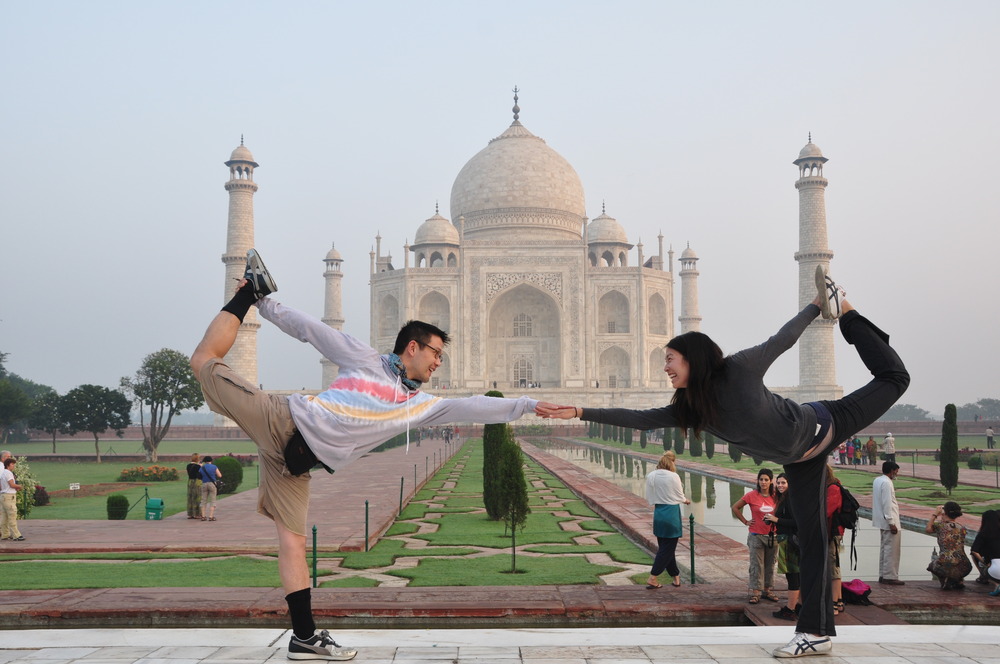
After our time in Varansi (or Verynasty, as Ron so affectionately called It in our previous blog entry’s comments section) we took another quick flight to Khajuraho. Khajuraho is a small town famous for its thousand year old temples. The temples, in turn, are famous for their art, most notably their erotic carvings of the Kama Sutra. After entering the temple grounds I immediately was reminded of Angkor Wat in Cambodia. There were far fewer buildings here, and these temples were Hindu and not Buddhist, but the intricate carvings and the shape of the pillared pavilions were definitely reminiscent. The carvings themselves were really beautiful, and though this place is known for its eroticism, the non-sexual sculptures (gods, warriors, animals, etc.) were far more prevalent. Ok back to the stone-porn. There were a lot of well endowed ladies in sensuous positions all around (so far so good), but the ones with one or more men were what held many peoples’ attention. There were orgy scenes aplenty, with the crazier ones involving people in headstands and/or strength defying positions. Women “helping” each other out was not uncommon, though no homosexual male carvings were to be seen. However, there was one scene involving a man and his unlucky horse. I’m pretty sure that’s not in the Kama Sutra, but if I’m wrong please correct me. The temple complex itself was extremely relaxed compared to Delhi and Varanasi as it was calm, clean, and quite empty inside its walls. It took about 3 hours to check out the whole thing, and even if there was no erotic art on the walls the temples would have still been magnificent (though just not as awesome).
The next day we headed to the town of Agra to see the Jewel of India, the Taj Mahal. We first hired a car to Jhansi before boarding a train in coach class to Agra, which was an interesting and crowded 3 hour experience (before Di’s friends scold me, first class was sold out!). We arrived in the evening after a long day of travelling and crashed early so we could wake up in time for sunrise, supposedly when the Taj Mahal is visually at its best. The Taj, completed in 1653, was erected by Shah Jahan, ruler of the powerful Muslim Mughal empire at the time. He built it in memory of his second wife, Mumtaz Mahal, after she died giving birth to their 14th child. Legend has it that he was so distraught when she passed his hair turned grey pretty much overnight. We woke up at 5 to make it in time for dawn, and when we got there the Taj Mahal not only lived up to the hype, it blew it away. It was the most beautiful building I had ever laid my eyes on, and just looking at it actually invoked an emotional response in me, the first of any edifice to ever do that. Maybe it was its faultless symmetry, or its elegant lines and perfect proportions, or its sparkling white marble with the gentle pink dawn sky as its backdrop. Maybe it was because it was built out of love, or the grieving heartbreak of death. Maybe it was all of that, and something else indescribable. Whatever it was, it was a wonder to behold and something I couldn’t remove my gaze from. It was not only stunning from afar; a view up close revealed the unparalleled skill and mastery of its builders. The carvings, the calligraphy, the domes and arches, they were all amazing. Though obviously biased, when Shah Jahan beheld the finished building he said it made ‘the sun and the moon shed tears from their eyes’. I don’t think he was too far from the truth.
Afterwards we hopped on a bicycle rickshaw for 2 kms to check out the Agra Fort, nicely made of red sandstone and white marble. Much to the rickshaw driver’s delight Ron switched spots with him and pedaled the last bit to see what it was like. The palace/fort actually ended up becoming a prison for Shah Jahan during the last 8 years of his life as his son forced him there after usurping the throne. If we saw that fort anywhere else in India, I would have said it was pretty sweet. The unfortunate truth was that we saw it immediately after the Taj, so it was painfully underwhelming in comparison. Even writing this in hindsight I really don’t have much more to add as I couldn’t hold my attention to the structure while I was there, which is a shame.
Early next morning we parted ways with Ron as we went to Jaipur in the province of Rajasthan while he headed to Egypt. We caught the train (in 1st class this time) and made it in about 6 hours. After we checked into our guesthouse we quickly headed to the Amber Fort just outside of town to fill our afternoon. With a long train ride to compare it to instead of the Taj Mahal, I found the huge hilltop fort to be pretty cool. We actually got lost for a bit inside while checking out its maze of rooms. With a picturesque lake and garden below and defensive battlements all around the fort is definitely a worthy setting for an epic Bollywood story of love and war. The next day we headed to the old part of Jaipur, otherwise known as the Pink City. It was painted “pink” back in 1876 by the then Maharaja to welcome the Prince of Wales and it has remained that colour ever since. I put “pink” in quotation marks because it looked more like an ugly orange with a thick covering of mildew and pollution added in for extra flavour. We first checked out the city palace which also doubled as a museum, housing an impressive collection of art, weapons, and fabrics. We then walked around the corner to Hawa Mahal, Jaipur’s landmark. It’s a 5-story honeycombed structure that was built for the royal ladies so they could people watch in safety. The face of this building was definitely the cleanest and up kept of all the buildings in town, thus giving its viewer a glimpse of what the old city may have looked like at one time if not dirtied by the stains of time and pollution. We did find the unique honeycombed façade to be a lot more impressive than the building’s comparatively plain interior. After sightseeing we walked around the streets of the old city checking out the bazaars and daily Jaipurian activities. The mad traffic, dirty streets, thick smog, aggressive shopkeepers and general craziness prompted us to stop that quickly. Our guidebook recommended that for a break we should experience afternoon tea at Rambagh palace, an ex-residence of the Maharaja now converted to a luxury hotel which costs up to 5000 USD a night. So we walked up to the gates of the massive property looking forward to some cucumber sandwiches and scones. Our eagerness was met with rejection by the gate staff. Ouch, in our face! Supposedly the hotel was fully booked so its courtyard and restaurants were open to guests only. Disappointed, we headed for coffee at a far classier joint, McDonalds. Back in your face Rambagh!
After our sultry coffee in aristocratic red and yellow plastic surroundings we decided to head back to our hotel to call it a day. When we got outside to the waiting rickshaw drivers they surrounded us, vying for our rupees. I showed them our hotel business card, written in Hindi and English, when something very humbling happened. I realized that most (if not all) of them were illiterate as they all asked me to tell them the name of the hotel after blankly looking at the card. I looked up the stats and as of 2008, 40% of India still could not read. I offered 50 rupees to the group to anyone who would take us back, and they all denied, as usual. I turned around to walk away, which usually prompts one to grab me and say OK. I should have known there was something wrong when only a young guy agreed to the price while all the others were shaking their heads. We hopped in, and within 10 minutes we knew he was completely lost. He kept taking our hotel card and showing randoms on the street, asking for directions. These conversations would always attract others, and every time he asked there seemed to be a conglomeration of strangers trying to help us. After about 20 minutes he realized he was in over his head and said in broken English that our hotel was too far and he wanted more money. I could tell by the dejection in his face that he wasn’t lying (plus all the more experienced guys were not willing to take us for that price), but I was still kinda pissed off at the situation as he adamantly said he knew where our lodgings were when we hopped in. So I just gave him his 50 rupees and Di and I got off and started walking away, with both us and him being quite disappointed. We then entered the nearest store and showed the 2 guys there the hotel card and asked for directions. They discussed the issue for maybe a minute before one of them, with a wide smile and decent English, told us to get in his car. He drove us for about a kilometre and dropped us off at the front of our hotel, shaking our hands and wagging his head, grinning as he left. That experience actually sums up a lot of what we’ve felt while in India. At times it can be mind-numbingly frustrating, but then the cheerful help and the warm smile of a stranger inevitably comes, more than balancing out the initial negative experience. Di and I are working on our head-bobble so that hopefully before we move on to the next country we can respond to all the random acts of kindness here with that uniquely Indian gesture we are starting to love.
Bustling Delhi and Holy Varanasi

Eug and I are very lucky people. Right after we parted with our dear friends in Bhutan, we met up with one of my best friends Ron in Delhi, India. Ron had one week in India with us and one week in Egypt on his own before heading home to Seattle. He really wanted to see the Taj Mahal and the rest was up to us. Our one week itinerary with him was to visit the sights in Delhi, Varanasi, Khajuraho, and saving the best for last, the Taj Mahal in Agra.
Eug and I were in Delhi a day before Ron arrived, and we were running errands like there was no tomorrow. I felt more like a local who just moved to a new city than a tourist. It was a bit frustrating having to run around everywhere, especially when we ended up not being able to get anything done. We wanted to mail our wedding outfits back home, get Myanmar visas, and fix the most essential gadget of our trip, our SONY netbook. Unfortunately our netbook was dropped by the cleaning lady in Bhutan, and it turned very slow ever since. We need it to upload pictures, research places to stay, and most importantly keep up with our blog! We were sent to a few places and given a few telephone numbers, but they all led to dead ends. The netbook is useable still but it’s slowly dying day by day. For example, Didi gave us some of the wedding pictures he took for us but they all disappeared from our hard drive. Thanks Susan for uploading them on Facebook for us! I hope our netbook can survive 3 more months before it completely dies. And yes, only 3 more months left for our around the world trip, crazy hey? Due to the Diwali holiday (the Festival of Lights, India’s most widely celebrated Hindu event) we weren’t able to get visas, and the post office was not helpful either. So big thanks to Ron for offering to take our wedding outfits back home with him.
I was very excited to see Ron in Delhi. The last time I saw him was in March in Portugal which seemed like a decade ago. And I was looking forward to doing some sightseeing again like worry-free tourists and not having to run more errands. We first visited the Red Fort, a massive 2 km long structure. The Mughal Emperor, Shah Jahan completed this fort in 1648 but never moved his capital from Agra because he ended up being imprisoned in Agra Fort by his own son Aurangzeb. The fort was pretty cool and we walked across the street to the market in Old Delhi after to see Jama Masjid, India’s largest mosque. To our dismay the mosque was closed to tourists that day. We weren’t sure why but a scrawny uniformed man with a bamboo stick came out of nowhere and shooed us away without providing an explanation. Even though we didn’t see the mosque, we had quite an eye opening experience just walking through the market (Chandni Chowk). We certainly had never seen such poor hygiene and stunning poverty in the countries we visited so far and Ron had never seen anything like that, period. Eug and I walked through numerous busy Middle Eastern medinas and souqs, so we thought were used to the sensory overload. But we definitely weren’t prepared to witness something like ‘Slum Dog Millionaire’ right before our own eyes. It served as another reminder of how lucky and blessed we all are. Afterwards we checked out Humayun’s tomb which was very pleasant and peaceful to walk through in comparison. The city of Delhi itself was beautifully covered in lights and flowers due to the Diwali festival. The lights were meant to guide the Hindu god Lord Rama home from exile, and at night there was a constant barrage of festive fireworks.
We then took a short flight (instead of a long overnight train ride, thanks to Ron since he only had a limited amount of time with us) to Varanasi. Varanasi (picture above) is one of the holiest places in India. Hindus believe that they can wash away a lifetime of sins in the sacred waters of the Ganges River, so a lot of them come to bathe in this water. They also come here to cremate their loved ones so their ashes can become one with the holy river. Lastly, many Hindus come here to die with the belief that it offers liberation from the reincarnation cycle of birth and death. As soon as we checked into our guest house on the riverbank, we quickly got ready, eager to take a stroll down the Ganges to see some action. Our eagerness soon dissipated after walking no more than 20 minutes down the river. First of all, the street was covered in cow and goat and who-knows-what droppings left and right. If you only looked up for a second, you could easily step on one of the dangerous fresh poopie-traps. There were a ton of stray cows walking around aimlessly, as they are holy to Hindus and this is their holiest city. Lots of locals (both adults and kids) were just walking around barefoot, not caring if they stepped on crap. What I found to be the most disturbing was seeing a street dog eating a pile of faeces. I was seriously grossed out. Secondly, everyone who passes by you seems to want to shake your hand and talk you into visiting their stores or accepting their massage or shaving service. No thank you! I was lucky that they didn’t try to shake my hands because I am a girl. Poor Eug and Ron had to stick their hands in their pockets to avoid the constant physical contact because once they grabbed your hand, they wouldn’t let go. Thirdly, witnessing 4 visibly clear corpses being publicly burnt on top of 4 separate stacks of wood didn’t exactly make us feel particularly pleasant. The sight and smell of everything foul combined together was just unbearable. It was not an easy stroll I tell ya. Finally, the Ganges River from up close was very obviously dirty. There was garbage floating around everywhere and the water was dark greyish brown in colour. All 116 cities on the Ganges dump raw sewage into it. Water safe for swimming is supposed to have less than 500 faecal bacteria per litre; the Ganges has 1.5 million/L! Even with all that, the river was full of people bathing, swimming, drinking, and submerging themselves in its waters repetitively. We turned back after walking across the cremation site and found refuge in the rooftop restaurant of our guest house. It had an amazing view of the Ganges minus the distractions from the street. That evening, Eug and I got a sore throat and Ron got a severe bug bite on his cheek that didn’t stop draining pus for the rest of the night. We should’ve done what the Japanese tourists did and wear those SARS masks. We recovered shortly but oh boy, what an introduction to the city.
We woke up very early the next day and hopped on a boat ride down the Ganges to catch the sunrise and the dawn prayer ceremony from the water. The boat ride was much more comfortable than being on foot. The devout prayers and washings of the pilgrims were fascinating to see but the most memorable part of the river trip was seeing a dead corpse floating face-down on the river. When I saw it, I quickly looked away and asked Eug and Ron in Cantonese if it was what I thought it was. Eug was like “no, it’s a mannequin”. Then there was a long pause before Eug and Ron both agreed it was indeed a body. We learned that there were dead bodies in the Ganges from other travellers and our research, however, I didn’t think we’d really see one. Supposedly some poor families can’t afford to buy firewood so their relatives’ bodies would just be placed in the water. Others would buy wood but not enough due to lack of funds, so partially cremated bodies would also be placed in the water. Our boat driver was considerate enough to row away from it, but not another boat that was just 5 feet away from us. There were 3 western tourists on that boat, and their boat actually rowed into the corpse as it got knocked away. One of the girls covered her mouth immediately, she looked like she was about to throw up; I felt so bad for her. At this point, Ron was trying to hold in his laughter so badly that his body was vehemently shaking. He didn’t laugh because it was funny, but because the whole thing was just so far-fetched that you couldn’t help but to react in some way. I just had a very grossed out face. Needless to say, for the rest of the day we chilled in our guest house to recuperate both mentally and physically. We did manage to find a nice restaurant with an excellent view of the river to have dinner. In the evening, the river was beautifully lit with lotus flower candles set adrift from the shore, and there were fireworks on land because of the Diwali festival. We also checked out an evening ceremony which attracted a huge friendly crowd. In contrast with the day, it was a rather delightful evening.
That was quite an experience for our first 3 days in India. I am not sure if I’ve digested all that myself yet, but I know our eyes have definitely been widely opened. Ron, Eug, and I talked about some of the living conditions we’ve observed and if there could be any feasible solutions to improve these conditions. Hopefully with the massive economic growth in India we all hear about the government will be able to increase funding in education, infrastructure and housing, thus putting India’s poor on the first rung of the ladder of economic development, lifting them out of abject poverty.
 fromwonderintowonder
Recent Comments