Bhutan – Land of The Thunder Dragon

In an age where most countries measure their achievement by their Gross Domestic Product, Bhutan’s fourth King, Jigme Singye Wangchuck, decided to measure his countries’ success by the overall wellbeing of his people. He thus created his now famous Gross National Happiness (GNH) index. He believed that “unless an inward change in human consciousness and perception occurs, the mere creation of wealth and economic growth alone cannot guarantee collective human happiness”. This approach was quite easily implemented in his kingdom for a few reasons. Firstly, his subjects absolutely admire him and truly believe he is an enlightened and selfless ruler. There is no other country we’ve been to so far where everyone so universally loves their leader. They all call him wise, farsighted, and passionate about their wellbeing, and from what I can see that does actually seem to be the case. Secondly, Bhutan is a deeply Buddhist nation, and Buddhist ideology stresses the impermanence of material things. The notion that happiness comes from within is deeply rooted in its teachings. We, on the other hand, are constantly bombarded by commercials that tell us happiness is measured by how big our house is or how many cars are sitting in our garage or how many Apple gadgets we have. Though I’m not saying one approach is right and another is wrong, I think it’s great that Bhutan has a different (and arguably better) take than the rest of us. If you want to learn more about GNH, I suggest you check out www.grossnationalhappiness.com. It’s pretty cool stuff and a completely different perspective on nation development than any other county on Earth.
I forgot to mention that the King recently did one thing that was quite unpopular with his adoring citizens. He abdicated his throne back in 2006 at the age of 51 after ruling for 34 years. Was it because of some scandal or some ridiculously unsuccessful war effort? Nope. It was because research has shown that citizens are generally happier in democracies than in Kingdoms, and he wanted to do what he thought was beneficial to the welfare of his people (from a happiness and a democratic governing standpoint). Have you ever heard of an all-powerful King doing something like that? Ya, me neither.
We visited the Western part of the country, staying in towns like Paro, Thimpu, and Punakha. We hiked high up to the mystical Tigers nest monastery (pictured above) that literally clings to the side of a steep cliff, straight out of the pages of some epic movie. Punakha has a beautiful dzong (fortress/monastery) that looks like it’s built from what mythical Himalayan legends are made of. Bhutan even has a unique animal called the Takin. Legend says it was created by a magical saint/monk who combined a goat with a cow (which is exactly what it looks like) when asked to perform a miracle. Eat that Napoleon Dynamite, your Liger has nothing on a Takin. But even with all those spectacular sights, it truly was the spiritual, humble, and peaceful aura of the people that touched us the most.
Bhutan is by no means a wealthy country; you’re not going to be seeing a Porsche dealership opening here anytime soon. However, it also doesn’t seem like a poor country either. The roads are all paved, infrastructure is good, cities are quite clean, and there are no signs of homelessness or extreme poverty. Its citizens are definitely not rich, but they do seem very happy. In fact, I don’t think we’ve seen more genuine smiles from people of all ages in any other country. It also helps that the Bhutanese valley is strikingly gorgeous. Add to that the beautiful, well-preserved and busy monasteries, temples, and dzongs with hundreds of red-robed monks and you’ve got an amazing place. Driving on the road you’ll have no problems seeing archery contests (where dudes hit small targets 145 m away!) among farmers harvesting rice, you’ll see big penises painted onto the sides of houses as a sign of fertility (awesome), and you’ll see groups of children in traditional Bhutanese wear running to school. Since it’s so isolated, the almighty tourist dollar doesn’t seem to have seriously affected the monastic way of life or the peoples view of tourists. English is spoken amazingly well by the average citizen and they had no problem, be it monk or student or waiter, engaging us in friendly conversation. Bhutan’s strict tourism laws, which everyone groans about, actually seem to be a very good thing now that I’ve seen the results. For those who don’t know, in order for you to visit Bhutan, you must spend a minimum of 200USD a day per person and be on a personalized tour. You basically have to wire the money over first to them before you can get a visa. Though this does include hotel and food, it is still extremely pricey. This part of our trip has hands down been the most expensive portion. However, by forcing people to spend that much, the Bhutanese have been able to attract the type of tourist they want. They’re typically getting the traveller that is very interested in their culture and less interested in drinking as much alcohol as they can at a hotel’s open bar (which very quickly creates a jaded general population). Also by making it that expensive, it really limits the number of visitors coming into this tiny nation of 700 000 people so the locals really don’t get overwhelmed.
So what do we think of Bhutan? We love it. A lot. It’s a truly, truly amazing place unlike anywhere else on Earth. Much of the world believes happiness is the physiological response to a favourable stimulus, like a new big-screen TV. Governments have thus created policies and economies which have the ultimate goal of making more money for its citizens. Bhutan’s more humanistic (as opposed to materialistic), holistic, and spiritual approach to happiness gives it an unrivalled uniqueness among its peers. You can definitely feel the positive effects this has had on its populace. But as with everything, things can change. Bhutan is still investing in economic growth as well as it does want to increase its level of development. The younger people (who really are the future) are wearing traditional clothes less and less, and with easy access to the internet they have a larger understanding of the outside world and its many luxuries. Bhutan has made huge investments into the education of its youth and the promotion of its culture internally. Only time will tell if they will modernize and progress into the 21st century while maintaining their distinctive view on what constitutes a happy society. I’m really hoping that they can achieve their goal of socio-economic development paired with the preservation of their Buddhist and Bhutanese cultural values. It’s a fine line to walk, but I’m highly optimistic that they can do it.
Bye-Bye Bachelorhood

He Said:
Up here in the extraordinary land of Bhutan, nestled in the Himalayas, Diana Chen married me with the blessings of the head monk at the Dechen Phodrang monastery in Thimpu. Yes, a real-life beautiful girl married me! Even I’m having a tough time believing that.
After learning more about Bhutan, Di and I made the decision to get married there a few weeks before we went. We asked the tour company to organize a small ceremony for us, which they graciously did. Though Bhutan doesn’t have much of a wedding industry (none in fact, catered to foreigners) they were able to provide a wedding bouquet freshly cut from someone’s yard that morning. We could tell it was fresh because there were still small caterpillars crawling inside the flower petals. They also took us to a shop the night before to get us fitted in traditional Bhutanese wear. The ladies all got a Kira each and Didi and I bought a Goh. Susan and Lorea decided to buy identical outfits to fill the bridesmaid role, while Didi looked pretty sweet in his Goh combined with my Converse kicks. I had to borrow the dress shoes he brought instead, since the Bhutanese guys wear a Goh with black leather shoes at formal events. Di looked graceful, elegant and absolutely beautiful in her Bhutanese Kira. After we got all prettied up, we headed around town to visit a couple of auspicious sites for good luck before our ceremony. One was a large stupa that we had to walk around 3 times in a clockwise direction, and another was an old monastery on top of the hill overlooking Thimpu where we were to ask for blessings. We then made it to the monastery where we got married amid monks chanting and playing music. The chanting was monotonous and the music was quite basic but put altogether with the monastery and monks it was a surreal experience and I don’t think we could have picked a better place to do it on this trip.
After letting everything settle in we took a few pics with the monks and our guests (who included the people from the tour company). Didi then got us to change into the western clothes that he brought for us. Di was stunningly gorgeous in her white dress! Seeing her was breathtaking, and no I’m not exaggerating. We took pics around the monastery with the young monks all running around. Some of the teenage monks were playing volleyball so I decided to join in with them. Even Di came to serve a couple of times in her wedding dress. Pretty soon we had the whole place surrounding us watching the game and laughing. I never thought I’d be playing volleyball in a suit with a team of monks in a Bhutanese monastery, but I’m super happy I did. After that we headed to the centre of Thimpu to take a few pictures as well. It was quite a sight, for all the Bhutanese! Our guide told us that everyone watching on the street had probably never seen a girl in a white wedding dress before. A large crowd of onlookers quickly amassed around us, taking pictures with their cell phone cameras. When we wanted to take shots on the road, the traffic cops helped us out. When we wanted to take shots in people’s cars or from peoples windows, they quickly let us in. Everyone was extremely accommodating. As I’ve said before in this blog, I’m no model; uncomfortable is an understatement of how I felt with the crowds watching us and Didi shooting. But the pics turned out great, especially if you focus more on Di’s face and less on mine. Thanks Didi (and his assistants for the day Susan, Lorea, and our guide Dhendup)!
I’m extremely grateful to Bhutan, its monks, and its people for giving us the wonderful opportunity to get married in a place that felt perfect for us. The people at Blue Poppy travel and our guide Dhendup (dhendupnill84@hotmail.com) did a remarkable job. We were originally planning to do a wedding with just the 2 of us somewhere on this trip, but having Didi, Susan and Lorea join was a fantastic surprise.
Di and I have had an incredible journey for the past 8 months, and now we’ll have the rest of our live to continue the fun. Rock On!
Oh I forgot to add that technically we aren’t married yet by Canadian law as they don’t really recognize the marriage certificate given by the Bhutanese monastery. We’ll still have to register back home, so you know what that means? Bachelor paaarrrttaay!
The Happiest Moment in the Happiest Country

She said:
“Are we married yet?” I whispered, Eug replied “I have no idea.” I looked back at the monks chanting in unison and one of them gestured us to walk up to the head monk. We shuffled along (alright, it was mainly me because I was in the traditional Bhutanese kira and I kept on stepping on it) and came to a stop when we reached the head monk sitting higher up on a raised platform. He had looked very serious when he was chanting earlier but he instantaneously broke into a warm smile and gave us his blessings. He then handed us a certificate (only our names were legible to us, the rest was in Bhutanese) and sent us back to our seats. “We are married?!” I asked Eug while trying hard to refrain from jumping up and down since the monks continued on chanting. “Yeah, I guess so.” Eug replied quietly. He looked like he was about to let out some tears of joy, or was it tears of sadness parting with his bachelor-hood? Then we decided to do a quick ring exchange on the side to say the magical “I Do’s” to each other before a cup of hot milk tea was brought to us. We were told to take turns feeding each other some tea to signify that we were one together (or something like that). I was too excited to remember the details but I did remember the tea being very good and the biscuits that came with the tea were delicious too. I couldn’t stop eating because I was famished by then. And I couldn’t stop smiling because I was ecstatic. We got married!!!
That all took place in the Dechen Phodrang monastery in Thimpu, Bhutan. We took a short flight from Kathmandu to Bhutan and the time change was a difference of 15 minutes. I thought that was strange. Bhutan is supposedly the happiest place in the world. It measures neither GDP nor GNP but GNH – Gross National Happiness. Since then 90% of the people have been ‘happy’, so we were told by our passionate and enthusiastic guide Dhendup. Dhendup also pointed out that there aren’t any traffic lights in the entire country. They aren’t necessary because the drivers tend to let others go first. I might also add that there aren’t any Stop signs either. The Bhutanese people lead simple lives and their beloved King encourages the people to strive for true happiness derived from within and not from materialism. McDonald’s and almost any stores we are used to seeing don’t exist in this country. In such a place, you might question how did Eug get a suit and how did I get my wedding gown and makeup? Especially since you can probably count out all the times I’ve actually worn makeup, which is not much at all. Thanks to our dear friends, Didi, Susan, and Lorea, everything worked out perfectly. Eug looked like a rock star (yeahhhhh! That’s my husband!) and I was able to get the most gorgeous wedding dress, ample makeup supplies, and even a curling iron! They brought everything necessary. Didi is also an excellent photographer and a professional model himself, so the pictures he took were absolutely amazing. I really can’t thank them enough. When we booked our Bhutan trip, we only expected to be in some Bhutanese traditional wear with our jeans and our guide would help to snap a few pictures here and there for us during the ceremony. Initially, Susan and Lorea were going to join us in India, but they couldn’t make it in November so they decided to join us earlier instead in Bhutan. And Didi offered to shoot some pictures for us in Bhutan around the same time too. It all worked out incredibly well somehow. Thanks for everything guys!
We will have a celebration back at home with everyone next year. Stay tuned! 🙂
Krazy Kathmandu

Once we crossed the border from Tibet into Nepal the group of us hired a car to take us to the travellers district of Thamel in the heart of Kathmandu where we were all staying. I had stayed there 5 years earlier, also in the high season of October, but back then Nepal was in civil war. As a result there were not many travellers and Thamel felt almost like a ghost town. This time around was the complete opposite. The streets were crowded with cars, bikes and a wide assortment of travellers, from the older tour bus crowd to the new-age hippy to the hardcore mountaineer. There were a ton of busy restaurants, cafes, bars, hotels, and shady dance clubs. It was like a Nepali version of Khao San Road in Bangkok.
Our original plan way back when was to stay for 2 weeks in Nepal so that we could hike the Annapurna circuit. We had booked our flight to leave to Bhutan on the 28th (which had to be planned way before) and had allocated about 6 weeks for China/HK. We ended up staying a lot longer in Hong Kong than we expected, therefore cutting our time to only 4 days in Nepal. With such little time we didn’t have many options for trekking. We therefore decided to spend a few days exploring Kathmandu city and its surrounding valley, and another day doing some white water-rafting on one of Nepal’s famous rivers. After checking in to our hotel we went to a café with wifi where we were able to log in to facebook for the first time in over a month. What was crazy was that through facebook status updates we were able to find out that our Australian buddy Kent, who we travelled all of Syria with a few months earlier, was also in town at the exact same time. After Syria we parted ways as we continued heading south while he made his way to Europe. We immediately met up with him as he was also staying in Thamel and we had a great night catching up. Ahh the magic of facebook.
We spent one afternoon in Kathmandu’s Durbar square, about 15 minutes away from Thamel. This square is the heart of old Kathmandu and has a pretty cool collection of ancient architecture. The last time I was here the only foreigners were my buddy Adrian and I, and a bunch of Hare Krishna dudes. This time the place was deservedly packed with tourists. We spent the next day in the old town of Bhaktapur and at the Changu Narayan temple, about 25 km out from the heart of Kathmandu. Changu Narayan had a nice little temple on top of a hill and an excellent collection of Hindu stone sculptures dating back to the 5th century. Bhaktapur was the place we liked the most of Kathmandu’s sights though. Its Durbar square (pictured above) is a lot less busy than Kathmandu’s and the area is refreshingly traffic free. The town seems a lot more intact, physically and culturally, than Kathmandu’s old town. The Newari style architecture with its intricate wood carvings was a pleasure to admire, and the laid back atmosphere of its streets and residents was a far cry from Thamel’s hustle. In fact, if you’re not into air pollution and loud music I think Bhaktapur is a fantastic place to make as a base in the Kathmandu valley instead of Thamel as it’s still very close but it’s a lot nicer and quieter.
The next day we went white water rafting in the Trisuli river. The bus left early in the morning, only to be delayed by 3 hours due to really heavy traffic before reaching the drop off point. Not fun. The river itself was decent with some Class II and III rapids. Not exciting enough to write home about, but still enjoyable. The better rafting trips were farther out with camping on the riverbanks mandatory for at least one night, an extra night we didn’t have. Thus we stuck with this one day trip and completed our journey about 4 hours after getting in the water. The rafting company assured us a ride back on a bus to Kathmandu when the trip was over. What they didn’t say was that meant waiting by the side of the road for a random bus to Kathmandu to stop for us. Since the morning bus ride to the rafting point took so long, by the time we were ready to go back to the city it was late and not many buses were passing by. When we finally got one, it was already pretty full. This meant the ladies got to sit inside, and 2 Korean guys and I had to get on the roof where a luggage rack also doubled as “extra seating”. The luggage-less luggage rack was just a series of one-inch thick metal rods running front to back and a guardrail about 6 inches high all around. You know how when you travel to a foreign country you want to live life like the locals to maximize your experience and understanding? This was not one of those times. I sat down with a nice hemorrhoid-inducing rod right in between my butt cheeks, just like the rest of the Nepali dudes who were chilling up on the roof. Things only went downhill from there. When the ancient bus started up I quickly grabbed some metal bars on either side of me for stability. The highway was windy and the driver was driving damn fast, and with each pitch and roll I could feel myself holding on for dear life as I tried to lean into each turn so I wouldn’t tumble over the edge. The driver was passing cars, motorbikes, and trucks like he was driving the Daytona 500. I tried to think positive the whole time to make myself feel better. For example, I was like “my shorts were soaking wet after finishing rafting, but they’ve become dry super quickly up here with all the wind in my trunks”. However as our bus came around a blind corner another oncoming bus approached in our lane as it was trying to pass a truck. Both vehicles slammed on their brakes to come a complete halt. As I saw the other bus come around the corner I heard the 2 Koreans yell in unison “WHOOAAAAAAAA”. I, on the other hand, was far cruder as I heard the words “HOLEEEE SH*******T!!” coming out of my mouth while I held onto the bars as hard as I could in case we hit each other. Have you ever thought about what you want your last words to be? I have now, and I’m 100% positive I don’t want them to be “Holy Sh*t”. Thankfully both busses were able to just miss crashing into each other head-on. My recently dried swimming trunks I was trying make myself feel better about almost became soaked again, only this time with my own urine instead of river water. After about an hour of this the bus driver stopped at a rest stop and I quickly got down from the rooftop, grateful for being alive as I touched solid ground. Di and the other ladies were laughing at us as they waited for us to climb down from the top. Di said with much amusement that with every sharp turn or bump in the road she would look out the window, expecting to see my body rolling off the roof. Though I’m down with the jokes, that wasn’t too comical to me at the time as I just endured an hour long ride from hell with the sensitive part of my ass on a cold metal rod. When the bus started up again, the 2 Koreans and I forced ourselves inside as we refused to get back up on the roof. They ended up sitting in the aisle, and I cozied up beside the driver. I took a look at his speedometer for the rest of the 2 hour ride back to town, and he was consistently between 50-80 km/h the whole time. That might not sound like much, but when you’re on the roof of a bus it feels damn fast. And what were the rest of the Nepali dudes doing up there as the 3 of us newbies were having the crap scared out of us? They were enjoying the scenery or listening to their mp3 players, calm as Hindu cows. Though I’m sure experience has a lot to do with that, I’m not willing to build up my hours on the roof of a bus to find out. So yes you Nepalis out there who have no problem bus surfing, I commend your bravery and concede that I am a wimp compared to you.
Nepal, being wedged between Tibet and India, has been influenced heavily by both of those countries and their respective religions. Thus a lot of their architecture and culture has aspects of Indian Hinduism and Tibetan Buddhism, which is a pretty cool combination. In addition, its outdoor activities of biking, rafting, canyoning, and especially trekking are obviously world famous. Kathmandu is far from a picturesque town nestled in the shadow of the Himalayas. There is enough for you to see here for a few days (like what we did) before heading into the mountains to really enjoy what Nepal has to offer. It’s too bad we didn’t have enough time, as we heard the Annapurna trek is gorgeous. With Everest Base Camp or Langtang as other amazing trekking options in Nepal you could easily spend well over 3 weeks here. I know I’ve said this about other countries on this blog, but Nepal is definitely one we’ll need to come back to. The next time around though I’ll just hire a driver.
7 Days in Tibet – The Rooftop of the World

After that ridiculous bus ride to Songpan we decided instead to fly back to Chengdu from Jiuzhaigou. The flight wasn’t cheap, but 40 minutes on a plane beats 15 hours on a bus by a longshot. We spent another couple days in Chengdu enjoying its awesome food and laidback (relatively, compared to other massive Chinese cities) atmosphere before grabbing another flight, this time to Tibet.
China has special rules for travelling to Tibet, with the main one being you have to be on a tour with a guide and a pre-ordained itinerary. Our group consisted of an American/Russian couple who were travelling for a year and a half, a couple from New Zealand who were travelling for about 6 months on their way home from a long work stint in the UK, and a guy from Wales who was also on the road for a few months. It was a good group and we got along well. Some took the 44 hour train ride from Chengdu; luckily, we didn’t. Our route was to be overland from Lhasa to Kathmandu, Nepal via the Friendship Highway, the highest highway in the world. I actually had done the trip 5 years ago with my buddy Adrian but in reverse, pretty much swearing to never do it again after it was completed. The road back then was not really a road, it was a series of gravel tracks over the Tibetan plateau. And driving at an altitude above 4500 metres on a bumpy “highway” with the crappiest accommodations you’ve ever seen along the way didn’t turn out to be as fun and adventurous as we thought it would be (though I’m glad I still did it). So why was I back? Well for one the road was now completely paved. And Di had never been to Tibet, a place that really should be included on a round-the-world journey. Lastly I really wanted to see how Tibet had changed since I was there, as a railway connecting Lhasa with Beijing had since been completed supposedly bringing in a flood of new Han Chinese immigrants.
The first thing I noticed when I got to Lhasa was that there were far more Tibetans around than previously, but this was due to the fact that it was the Dalai Lama’s birthday and tons had come in from the countryside. Because of this the Jokhang, Tibet’s holiest temple, was packed full of spiritual pilgrims praying and chanting. This combined with the smell of incense, the flickering light of yak butter candles and the solemn stare of Buddhist statues resulted in a pretty amazing experience. Outside there was a sea of Tibetans circling the temple in the customary clockwise direction, while others were prostrating themselves continually at the Jokhang entrance. It was pretty moving to watch the devotion of these Buddhists and I found it to be by far the most “authentic” of the Tibetan spiritual experiences. We also visited the Sera monastery, which once housed over 5000 monks but now has only a few hundred. At 3 pm the monks went to a courtyard to debate over the scriptures. Though it was enjoyable to watch for a bit, the fact that there were easily over a hundred tourists taking pictures of the maybe 50 monks debating made it feel a lot more like a show than a serious Buddhist discussion. Lastly we went to the Potala palace (pictured above), Tibet’s colossal world-famous landmark. It’s a little sad that this palace generates a massive amount of tourist revenue for the Chinese government while its rightful inhabitant, the Dalai Lama, resides in exile unable to return. The rules for visiting this place were far more stringent than 5 years ago, as we were now given only one hour inside and there was a set route that all of the tourists had to follow. There was definitely some cool stuff inside, especially the tombs of previous Dalai Lamas, but I couldn’t help but feel slightly disappointed in what this spiritual treasure trove had become.
After 3 days in Lhasa we started to head west towards Gyantse, a town with a temple famous for its awesome frescoes and statues. Though some in our group were a little templed-out by then, I really enjoyed checking out the ancient Buddhist paintings on the walls here. From there we drove to Shigatse, Tibet’s second largest town to spend the night and to catch some nightlife. A few of us, including the driver and guide, went to grab some beers at a club that had a sort of variety show. The lip synching and dancing was entertaining enough, and the show was catered to locals who would go up on stage to give a white scarf to performers who they enjoyed watching. It got a little weird though when one singer went up with candles in his hand, dripping hot wax on his bare chest while singing a sorrowful song. We kind of left after that. Except Di, who was dying to give him a white scarf. Just kidding…sorta.
On the next day I was pretty excited as we were driving up to Everest Base Camp on the Tibetan side, which is actually at a higher altitude than the Nepali E.B.C. My previous tour didn’t include this excursion off the highway. Unfortunately on our way up there the altitude started to get pretty high (like around 5000 m) which resulted in one of the girls in the car getting some pretty significant high altitude sickness symptoms. She was doing alright until her fingers started to get numb, which immediately induced a pretty big panic attack. Right away we did a U-turn and headed back to the nearest town to check her into a hospital where her and her fiancée stayed the night in a higher oxygen environment. 5 years ago we were also at the same hospital where we dropped off 2 of the people in our tour for the same reason. So my advice for those reading who want to do this trip is to bring some supplemental oxygen. You can buy cans everywhere in Tibet for about 3 USD, totally worth it if you need it. Anyways, after the doctor assured us she’d be fine we made our way back to Everest Base Camp, finally arriving close to midnight due to the over 3 hour delay. We caught some horrible sleep in a freezing cold dorm before waking up at about 7 to drive the final 15 minutes to the base of Everest. Though I couldn’t feel my fingers about 1 minute after getting out of the car, watching the sun’s rays light up Everest right in front of my eyes was an unbelievable experience. It is such a majestic and awe-inspiring mountain, no wonder so many try to climb it every year. From there we went back to town to pick up the couple at the hospital before spending the next 2 days driving to Kathmandu to finish our tour.
Tibet to me is a little bit like Israel; it’s often talked about but most don’t know the full story or what to believe due to the many different viewpoints, including myself. The misunderstandings seem to be widespread among the West, the Chinese, and maybe even the Tibetans themselves. I think the West wants to think of Tibet as that unchanged mystical and magical Shangri-La Brad Pitt went to for 7 years. I think the Chinese like to think of themselves as those who brought modernization, electricity and roads to the benefit of the Tibetan people. The Dalai Lama is always encouraging people to visit his original homeland to discover the Tibetan reality and to make their own informed decisions, and I would agree that this would be the best route to follow. As for me, I can say that Tibet is a truly beautiful place with a strong, unique spiritual culture. The striking Tibetan plateau is dotted with streams of prayer flags flapping in the winds beside gorgeous high-altitude turquoise lakes. And with the spectacular Himalayas to the west, the landscape, from a visual standpoint, is hard to beat. However, if you’re looking for a truly authentic religious monastic experience, then I would say head to Western China, where tons of Tibetans still live and where tourism and propaganda have not touched or tainted many people yet. The famous monasteries and temples in Tibet, though still beautiful, feel more and more like empty museums devoid of the once numerous chanting monks aiming for enlightenment. Many now sit and talk on their cell phones while collecting admission fees in their red robes. The common populace still seems to be extremely pious and devoted though, which can still give you that sense of peace and serenity easily found in deeply Buddhist nations.
As for the political situation, I’m still unsure of what to completely think. It’s obvious China will never give up Tibet, but hopefully in the future with increased independent travel and thought from the Chinese tourist there will be more sympathy for the Tibetan people and culture within China itself. Then maybe one day, the Dalai Lama will be welcomed by China to return to lead his people in cooperating and collaborating with their Chinese brothers in harmony.
Northern Sichuan – Breathtaking beauty

From Chengdu we took the bus to Songpan. What was supposed to be a 7-8 hour ride turned out to be 13 hours because of roadwork. That sucked. So we pulled into town at about 8 at night and we immediately tried to organize our next day’s activity, horse trekking. Very few tour groups come through here so this town has much more of an independent traveller’s vibe, and almost all of them come here to get on a horse for a few days. We talked to the trekking company and we decided, due to limited time and the slightly cold weather, to do a one day trek instead of the most common 3 day one to Ice Mountain (which sounds like a place where some evil storybook witch would live). The next morning we hopped on our horses and headed into the valleys. It was pleasant ride on a sturdy horse, ending at an authentic Tibetan monastery. I say authentic because this one was not catered to travellers, nor did it charge an admission fee to enter. The young monks there were eager to show Di and me around and were hoping we would want to learn about Tibetan Buddhism. It was a truly genuine exchange and we really enjoyed it.
The next day we hired a driver to take us a couple hours away to Huanglong national park. I had been before and I remembered it as being one of the most beautiful and unique places I had ever seen so I really wanted to return with Di. What makes Huanglong special is its travertine landscape, similar to Pamukkale in Turkey. Unlike Pamukkale however, China has done a fantastic job in conserving Huanglong’s natural beauty by not allowing people into the travertine pools. These naturally-formed terraced limestone pools fill with water which overflows into the next pool, and this continues all the way down for 3.6 km’s. This connected collection of yellow limestone pools is supposed to look like a golden dragon weaving through the valley, hence the name Huanglong (which means yellow dragon in Chinese). Each of the many pools is a different shade of crystal clear water, from deep blues to pale yellows to bright turquoises. As I reread the words I have just written, I realize that I the writer can’t even form a mental image of Huanglong with my lousy description, so it really is best if you just check out the flickr pictures so you understand what I’m talking about. To be honest even the pictures don’t do it justice. Anyways, from the park entrance to the top is 3.6 kms, so Di and I hiked the full 7.2 km loop. As we were hiking up the brilliantly maintained boardwalk (and I mean immaculately maintained as workers clear fallen leaves about 2 seconds after they’ve hit the walkway) I realized that we were the only ones going up, even though we saw a lot of people at the entrance gate. I clearly remembered the last time I was in Huanglong there were a lot of unlucky Chinese workers who had the job of carrying tourists up in sedan chairs on their backs for a minimal fee, but this time there were none. I found out the reason why when we got near the top; there is now a brand new gondola that takes tourists who are willing to pay (which evidently was everyone except us) almost to the summit. So most opt for the ride up and then they walk all the way down, and since we got there early in the morning most tourists hadn’t started to walk down yet. It’s a shame really as the hike is not too difficult and it’s stunningly gorgeous, but I’m not complaining as it’s practically impossible to find some quiet time in popular Chinese tourist destinations. As Huanglong’s location is about 3500m above sea level, some people start to feel the effects of altitude sickness. What the park has done to help people with this issue is provide free oxygen huts all along the trail which is pretty impressive if you ask me.
After Huanglong we reunited with our waiting driver who then drove another couple hours to get us to the jewel of the Northern Sichaunese crown, Jiuzhaigou, where we stayed the night. Jiuzhaigou literally means “Nine Village Valley” in Chinese as the valley contains nine Tibetan villages. Obviously the guy who named this place was full of creative genius. Like Huanglong, Jiuzhaigou is a UNESCO World heritage site. Lame name aside, it’s a nature reserve that has the finest collection of multi-coloured lakes, streams and waterfalls that I’ve ever seen. Admittedly it’s super expensive, at 310 yuan which is approximately 50 USD (far more than it was 6 years ago) but that doesn’t seem to limit the number of Chinese tourists who come. Supposedly there were over 12000 in the park the day we were there, a far cry from the 5000 they received in the whole of 1984, the year the park opened for tourism. The park road is shaped like a Y, so our game plan was to take a bus up to the very height of the left arm early in the morning, make our way back to where the road forks, and then bus up to the top of the right arm before walking all the way back down to the bottom. At the height of both arms of the Y are big lakes, and water flows down from them into a series of lower lakes, all connected by waterfalls, streams and rivers. The Chinese government has done an amazing job with providing an army of shuttle buses that runs the circuit between the lakes, and a fantastic boardwalk that connects the lakes as well. The Chinese tourists love to ride the buses to a lake, hop out and take a picture, and then get back on the next bus to go to a lower lake where they can repeat the exact same process. This makes for very crowded buses and lakeside bus stops, but a virtually empty boardwalk. Again, no complaints here as we basically were hiking alone on said boardwalk, occasionally running into the odd Israeli or French couple. The lakes are all different shades of turquoise, blue and green. A fight scene in the famous movie “Hero” starring Jet Li and Tony Leung was filmed on the water here at Jiuzhaigou. Though some are quite deep, you can still see to the bottom of the lakes most of the time as the waters have the clarity of Di’s dream diamond (I stress the word ‘dream’). The connecting waterfalls and rivers have the power, grace, and beauty of a dancer with skills the exact opposite of mine. A lot of the time the boardwalk is set directly above these streams, which makes for really enjoyable hiking. In addition our timing was impeccable as much of the valley was covered in different hues of red and yellow due to the leaves changing colour. We were able to stick to most of our game plan, which resulted in us hiking for over 30 kms. It was a long and tiring day but definitely worth every sore muscle.
Though Jiuzhaigou’s landscape does look a lot like the Rocky Mountains back home, it’s its collection of multi-coloured lakes and waterfalls all in close proximity to one another that sets this place apart from anywhere else. And Huanglong really doesn’t have an equal on Earth for its unique karst landscape and vivid limestone pools. We’ve been travelling for about 8 months and have seen an innumerable collection of beautiful places, but this part of Northern Sichuan has to be near or at the top of the list for me. It’s probably second on Di’s list for things of beauty, losing out only to the ridiculously good-looking face of the writer of this blog entry.
Giant Pandas, a Giant Buddha, and a Giant Fight

We arrived in Chengdu, Sichuan at one o’clock in the morning. Needless to say we were both really tired. When you are tired, you tend to be less patient and you get annoyed easily. That’s not a good state to be in, especially in a single file taxi queue that’s about 2 push carts wide. In this part of the world where some people have the tendency to budge in line, the wide open space is an invitation to do so. Sure enough, in less than 3 minutes time, everyone seemed to want to budge by walking through the wide open space. People in the line with us saw but no one said anything. I was half asleep when I heard a familiar voice saying ‘you have to line up’ in Mandarin. I turned around and realized Eug was telling 2 local Chinese men who tried to sneak by us to line up. I was surprised because Eug would usually just shake his head and give a ‘you are stupid’ kind of look, this was one of the rare times that he actually told off someone directly. One guy replied ‘what? I was just looking’ and walked to the back of the line with his partner in crime. Immediately after, a Chinese mom pushed a cart full of luggage right up behind Eug. By this time, Eug was already standing next to me in attempt to block the wide open space to stop the upcoming budgers so she couldn’t get through. She yelled out loud that she needed to park the cart at the front. Eug told her to line up like everyone else. She got mad and shouted ‘let me through!‘. Eug firmly replied ‘I won’t let you through’ and held his stance. Then this woman got furious and actually tried to push the cart right against him! That made me TWC (Taiwan Crazy) and I told her to back off. He must have been the hero of those who were silently watching and waiting in line because they started to show support too by telling the woman to go to the back of the line. Good job Eug! Luckily before a riot was about to start, we got into our taxi. We sat in the taxi in silence for about 3 minutes before we both started cracking up. It’s funny now but at the time we got pretty worked up. In hindsight, it’s just another TIC (This Is China) situation, as our expat friends in China would say.
Early next morning we went to see the cutest animals in the world – Giant Pandas! They are so adorable. There are about 50 giant and red pandas at Chengdu’s Giant Panda Breeding Research Base. We left at 7 am to the research zoo because pandas are usually the most active in the morning around their feeding time. Once the feeding is over, they don’t do much besides sleep. Even though we only had a few hours of sleep, it was all worth it. Pandas are cute because they are very chill and very clumsy at the same time. We noticed that everyone looking at the pandas has a benevolent smile on their face. I am not sure if there’s any other animal that has that same effect as these adorable bears. The funniest was seeing a giant panda lying lazily against a log with its arms and legs all stretched out. Then he grabbed one of his feet and started chewing on it. Another winning moment was when this other panda was resting on a tree and decided to get down. You’d think it was his first time trying to climb off a tree. He was so slow and awkward that we really thought he was going to pk any moment. How can you not love them? I really wanted to jump over the fence to give them a big bear hug. Even Eug said he wanted a pet panda! The only part where we were asked to show our tickets was at the nursery room where the newborn pandas were. They were so petite (like fist size) that you could hardly imagine one day they’d be eating 100lbs of bamboo daily when they reached adult size. They had pictures of when the babies were first born, to be honest I didn’t think they were that cute then. They looked like hairless rats. At the end they showed a somewhat cheesy video of how this centre helps the new panda moms to breed and take care of the naturally premature panda babies when they don’t seem to know how to care for their new broods. It was just by coincidence that we were listening to an episode of HowStuffWorks.com podcast talking about if zoos are good or bad for the animals. I think in this case, it is a good thing because pandas are dying out on their own in the wild. The Chinese zoos have a reputation of being horrific in their treatment of animals but thankfully this one seems to be different.
The next day we took our time to visit the tallest Buddha in the world. The Grand Buddha in Leshan is 71m high carved into a cliff by the water. Its big toes are 8.5m long and fingernails taller than the average human. In other words, it is really big. The construction of the Grand Buddha was initiated by this monk named Haitong in hopes to stop the lethal currents of the water from taking innocent fishermen’s lives. It worked. Some believe that it was the blessing of the Buddha that calmed the waters, and some believe that during the 90 year construction, the rock and silt from carving the Buddha filled up the water and unintentionally controlled the currents. Besides the Giant Buddha statue, there were gardens, caves, and temples in Leshan as well. We got lost walking around the trail and a Buddhist monk appeared out of nowhere and offered us directions. That was pretty neat because it was my first encounter with a monk. Like the ones you see in olden day Chinese Kung Fu movies.
We also tried a few original Sichuan dishes: Mapo tofu, Dan Dan noodles, Twice-cooked pork, and Fish flavoured eggplant. They were rather on the extreme spicy side for my taste buds but they were delicious. The spice they use here is something I’ve never tasted before. It’s a kind of spicy that doesn’t hit you until 10 minutes after you’ve already swallowed the food. It’s silent but deadly, and a full body experience. However, there are far more layers to Sichuanese flavours than just spicy, and we’ve really enjoyed the food here.
Sichuan is the last province we are visiting in China in this trip, and we’re off to a very fine start. There are tons more sights to see and food to taste, I can hardly wait.
Shangri-La – Our home away from home
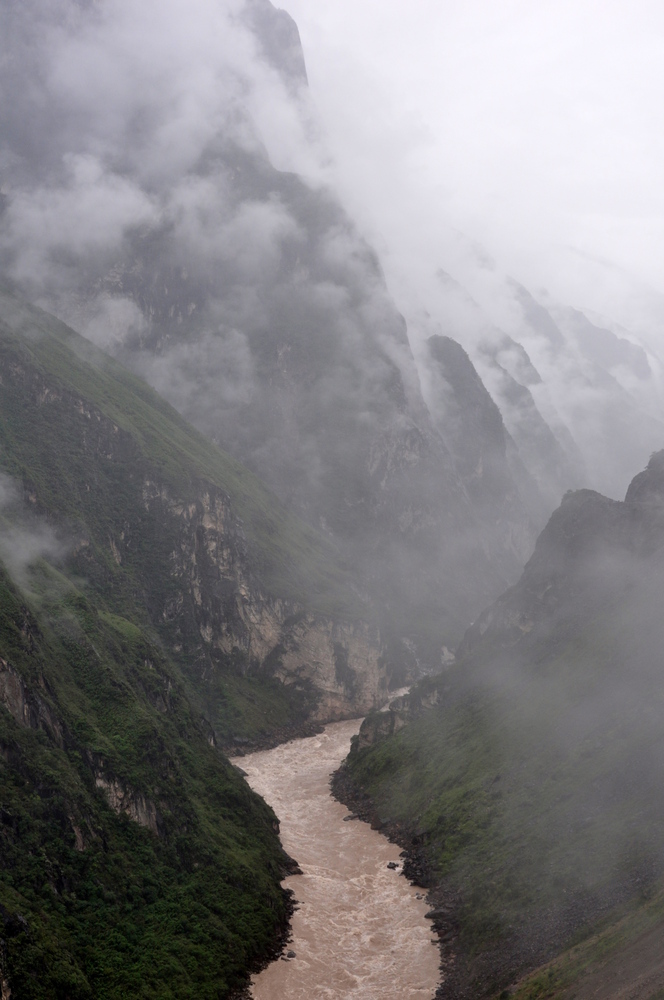
The legend goes a tiger leaped across the gorge, still 25m wide at its narrowest part, when a hunter was trying to capture him. Hence the name Tiger Leaping Gorge. A three hour bus ride from Lijiang took us to Tiger Leaping Gorge. It is one of the deepest gorges in the world measuring 3900m in height and 16km in length (pictured above). At its depth snakes the Yangzi river, and at its height are the Haba and Jade Dragon Snow Mountains. The gorge trek is the most famous in South western China and is popular with both Chinese and foreign hikers. We were quite excited when our bus driver stopped by the first bend of the gorge to let us snap some pictures. It had been raining so the colour of the Yangzi River was muddy brown. Witnessing the power of the water rushing through the first bend of the steep soaring mountains leaves you in awe of its majestic splendour. We hopped back into the bus to head further up towards our guest house in Walnut Garden. The drive got a little scary as we drove higher up on the unpaved narrow roads half flooded with rain water. Looking out the window, the Yangzi River was just an inch away from the edge of the road. Luckily our tough female driver manoeuvred the bus skilfully over all the bumps and turns and took us safely to the guest house. We quickly settled down on the second floor patio of the guest house facing the opposite side of the gorge, overlooking the Yangzi. Most travellers come here to hike for 2-3 days. Since it was raining nonstop, our plan was to do short hikes around the Walnut Garden area which was supposedly the prettiest of all. However, after talking to our guide, we found out that hiking was not an option in this bummy rainy weather. The hike would be too slippery and dangerous in the rain as it’s extremely steep. We did have a good time hanging out on the patio underneath an umbrella sipping some coffee, researching our next destinations (Eug), and reading True Blood (me)! The view of the canyons combined with the sounds of the roaring river from the patio was amazing. The constant movement of the clouds in the gorge made it seem like it was a different scene every single minute. It would’ve been really nice to do some hiking but we were pretty content with enjoying the panorama from where we were.
The next day rained too so we left for our next destination – Shangri-La. Shangri-La used to be called Zhongdian, until the officials here declared that this was the location of the famed Shangri-la described in the British writer James Hilton’s book The Lost Horizon. There’s been arguments as to whether Hilton’s Shangri-La was fictional or not, but using the descriptions in his book authorities here are adamant that this is where Hilton was talking about. True or not, I say our Vancouver home is our real Shangri-La. Anyways, it was a lot colder here than in Lijiang due to the higher altitude. I had to bust out my LJ’s (long johns) from our Kilimanjaro hike. Thanks Auntie for the warm wear! Again Shangri-La was wet and rainy so we couldn’t get out to the mountains, lakes, and the valleys surrounding the town. The muddy roads were flooded so the buses and cars couldn’t get around. It was too bad but we stayed in the old city and enjoyed the serenity of the old town without the interference of large groups of China tourists like in Lijiang and Dali. This was probably due to the fact that the 7 day National holiday was over, and most Chinese tourists wouldn’t bother to get out here to hike anyways. The town looked and felt quite different than the others we’ve visited so far in China because it was Tibetan, as opposed to Chinese or other minorities. We visited the small, somewhat new Tibetan monastery on top of the old city. We could really feel the high altitude here by just walking up about 50 steps. This familiar feeling (from the Kilimanjaro hike) was somewhat refreshing since we’ve had way too much polluted air from other cities in China. Gasping for cold crisp air wasn’t that bad after all. There was a giant prayer wheel at the back of the monastery. It was my first time seeing a prayer wheel. Eug and I and maybe about 5 other Chinese tourists walked around the wheel 3 times together to pray for goodness overall. That was pretty exciting for me already but Eug said we’d be seeing tons of that in Tibet, woo can’t wait! We also tried to go to the Ganden Sumpseling Gompa, a 300 year old Tibetan monastery complex. But the admission went from 10RMB a couple of years ago to 85RMB today. It was too steep for our budget. And we’d be visiting tons of monasteries in Tibet, so we decided to not go. Eug was tempted to go around the back to hike up 2kms (like other travelers did) to sneak in but it was raining and the shuttle that takes you up was right there, so we wouldn’t have made it far before someone stopped us. The local bus ride there and back was pretty fun though. It was only 1RMB and we saw a few lamas on the bus too heading into town from the monastery.
The weather didn’t cooperate for the past 4 days but regardless we had a good time soaking up nature’s beauty on the sidelines. And we had time to chill at coffee shops with wifi, to talk to local restaurant owners, and to catch up with fellow travellers. There were plenty of independent western and Chinese backpackers in these parts, and thankfully no tour groups. In fact we were the only visitors in the Tiger Leaping Gorge village of Walnut Garden. That was a very nice change from the previous national holiday week. It was a relaxing and pleasant 4 rainy days.
Minority Report

The Lonely Planet guidebook states that if you only have time to visit one province in China, it should be Yunnan. Those are strong words, considering the number of attractive and famous provinces there are in this country. So Di and I made it our next stop after Guangxi to see what all the fuss was about. As China’s most south-westerly province, Yunnan borders Myanmar, Laos and Vietnam. The terrain by those countries is therefore more Southeast Asian-like; it’s mainly tropical rainforests and jungle. In contrast Yunnan’s northern border is shared with Tibet, giving this part of the province snowy mountains and emerald coloured lakes which is a far cry from its southern parts. However what draws most people to this province is not its varied landscapes, it’s its varied people. Of China’s 55 registered minorities (non-Han Chinese, as the Han are by far the largest ethnic group in China), 25 live in Yunnan.
We took a flight from Guilin to Kunming, as Di wasn’t too keen on taking another overnight train. We were planning to go visit Shilin (which literally means stone forest) about 90 mins out of town but after doing some research we decided not to. The reason being it was their big national holiday in China, with everyone having time off between Oct 1- 7. The tourist sites here are already overcrowded, and travellers put Shilin as one of the places that was insanely so. We could only imagine how bad it would be with the whole country being on holiday, so we just hung around the modern city of Kunming for a couple of uneventful yet relaxing days instead.
Afterwards, we took a bus to Dali, which lies on the western edge of Erhai lake. Dali is an old walled city whose inhabitants are mostly of the Bai minority ethnic group. They don’t have a written language but their spoken one is alive and strong. Dali’s layout sort of reminded us of a lot of the Middle Eastern cities we visited, with an old walled city surrounded by a new town. The old city here though was extremely navigable with wide, clean cobblestone roads in a grid pattern and nicely restored buildings, unlike the maze of dusty alleyways in the Arab medinas. Though done nicely, it was quite touristy here, with all the shops and restaurants completely catering to visitors, especially with it being the national holiday. So the next day we hired a driver to take us village to village around Erhai lake instead to get away from the chaos. He told us the beautiful lake had a 45 km circumference, and on it he took us to 4 Bai villages: Xizhou, Shaping, Shuanglang and Wase. Both Xizhou and Shaping had very lively morning markets taking place, with all the buyers being locals and virtually no tourists around, which was a nice change from Dali’s scene. It was cool to see the Bai ladies wearing traditional clothing, each with a straw basket strapped onto their backs and colourful wraps on their heads, buying food for the week. They would buy their vegetables or whatever, and then turn their back toward the vendor who would then fill their basket; kinda neat. Shuanglang was near the northern end of the lake and you could tell that it’s poised to become a more touristy destination. The first few backpacker cafes serving lattes have opened up with French dudes manning them, and the town is starting to slowly renovate its properties on the water to be more traveller friendly (ie make them souvenir shops). The above picture is from this region of the lake.
The next day we took another bus to the town of Lijiang, a UNESCO world heritage site just a few hours north of Dali. Lijiang is home to the Naxi people, descendants of Tibetan nomads who decided to settle in this region of Yunnan. They, like the Yao peoples we met in Guangxi, are also matrilineal with children living with their mothers and all property being inherited by women. The man in the relationship would spend nights at the woman’s house, but in the daytime he would return home to his mother’s to live and work. The Naxi are also the last people on Earth to use a hieroglyphic writing system. The pictographs they use are pretty wild; you can check them out on our flickr site to see what I mean. It would take years for me to write anything with their system of pictographs, especially a love letter, since the ones I write Di are so long and poetic and heartfelt and sweet and sensitive and emotional. Anyways, back to Lijiang, it also has a very pretty and picturesque old-town like Dali, surrounded by a new and modern city. In fact, it might be a little too pretty and look a little too perfect to feel really authentic. However I can’t really blame the town for this as an earthquake in 1996 measuring over 7 on the Richter scale knocked down much of the Lijiang, killing more than 300 and injuring over 16000 in the process. Thus the rebuilt structures are no more than 14 years old instead of a few hundred. However the rows of stores selling tourist kitsch don’t help the overly commercial atmosphere, especially during holiday season. So what Di and I did instead was wake up really early one morning to wander around town before the first tour bus arrived or many travellers awoke. What we found was a beautiful scene, full of inviting alleyways, clean canals, stone bridges and pretty parks. It’s nice to see some attempts of preserving ‘old China’. However once the shopkeepers opened their doors, the alleyways began to fill with hungry consumers, not unlike the old cities of Rhodes in Greece or Marrakesh in Morocco. That was our cue to head out of town, so we went north about 10 km to a village called Baisha, where the famous Dr. Ho of The Clinic of Chinese Herbs in the Jade Dragon Mountains of Lijiang was still practicing. We actually went to check out the village, only realizing later that this 87 year old Taoist physician was here, complete with the white Fu Man Chu beard and all. He’s actually pretty famous, with documentaries on the BBC and National Geographic being done about him, and authors like Bruce Chatwin writing about him. His office is lined with newspaper articles from all over the world about him and his knowledge of curative herbs, many of which he grows in his own clinic. Others he actually handpicks from the slopes of the Jade Dragon Mountains. What’s even more awesome is that he practices for free, only accepting donations if you are so inclined. Oh and he speaks perfect English as well. There were stacks of guestbooks full of appreciative and thankful comments from his many international patients, and even American and European doctors who thanked him for curing their patients’ leukemias and such. We were going to ask for some of his practitioner advice, but I was sure he didn’t have any herbs to cure ugly so I really had nothing to ask for myself. Di also was in good health so she just asked to take a quick picture with him and we left, leaving him to mix some herbs for a village woman who was complaining of a cough. Supposedly Di had heard of Dr. Ho’s teacher, as he wrote the definitive book on Chinese herbal medicine. In hindsight I really should have asked him a question, like if he had a herb mix that could help me grow some facial hair, specifically a goatee. Dammit, next time.
桂林山水甲天下 Guilin scenery, finest under heaven
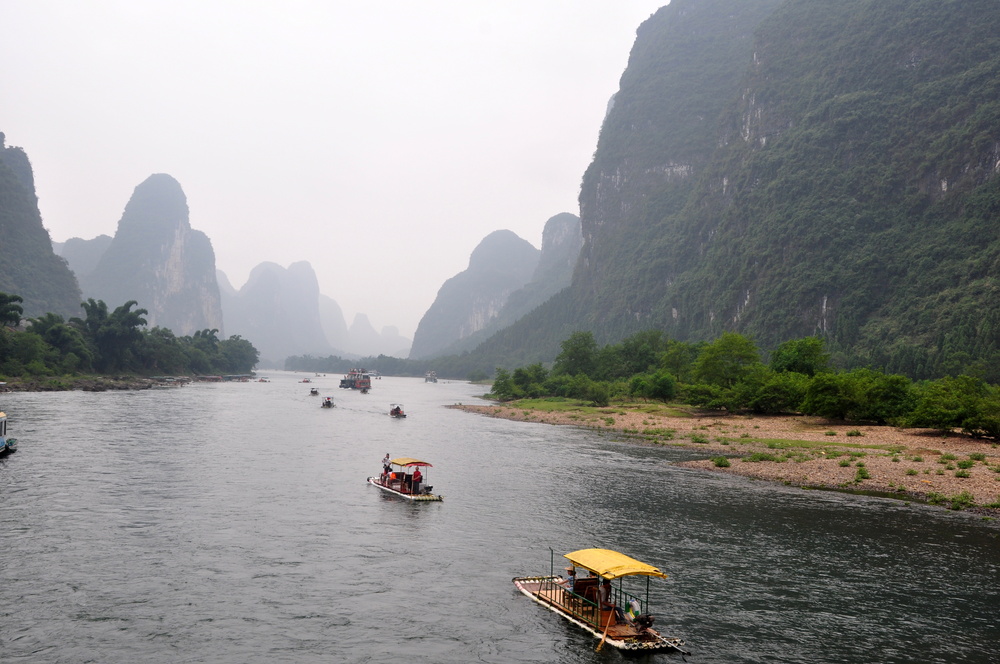
We spent our last four days of luxury in Hong Kong with Phil and Ta before going on the road again for the remainder of our trip. We rested so well in Taiwan and Hong Kong in August that we got soft. Our backpacks became heavier all of a sudden and the idea of staying at hostels again was quite unwelcoming. Luckily our first stop from Hong Kong after Phil and Ta went back to Vancouver was to visit our dear friend Didi in Guangzhou, Guangdong province. He was gracious enough to let us crash at his place and took us out to two amazing Cantonese meals before we moved further west to Guilin. Thanks Didi! 🙂 There wasn’t much sightseeing in Guangzhou but Didi said if we stayed longer, he would have taken us to Donguan, a factory-filled city that’s becoming a Taiwan town due to the numerous Taiwanese-owned factories. There’s good bubble tea and Taiwanese food too, nice! Guangdong province is where most of our Hong Kong friends’ predecessors were from originally. Eug was no exception. He remembered Guangzhou was a dump (quoting Eug’s exact word) when he visited with his grandparents about 20 years ago. Now it’s certainly a modern city.
Remember I said I was not a fan of overnight traveling? This time I really did not like it. Unfortunately the train system in the interior isn’t as new as the coastal cities, so in our 12 hour train ride from Guangzhou to Guilin, Eug and I ended up stuck in the middle bunks of a 6 person hard-bunk room, whereas we had the comfortable 4 person soft-bunk room from Shanghai to Beijing before. There was no room to put our backpacks let alone room for us to sit up straight, and the bunk beds were as hard as the Sahara sand we slept on. We ended up having to lie horizontally for the whole 12 hours every sleeping and waking moment. To top it off, a local Chinese guy snuck in and slept on the free bunk on top of Eug’s and started talking on the cell phone really loudly and then snored up a storm in our tiny cabin. Fortunately for us, he was caught sometime during the night by the train attendant and got kicked out, phew…
After the tiring commute, I was glad to find the hostel we booked comfortable and clean. And the girl working there was extremely helpful and accommodating. Our room wasn’t ready yet when we arrived but she let us take the bigger room which was empty and ready at no extra charge. After an energizing nap, we took a gondola up to Yaoshan (Yao hill), the biggest and the highest hill of Guilin to get the bird’s eye view of the city. On the way back we visited Jingjiang King’s Palace and hiked up the Solitary Beauty Peak at the back of the palace. Guilin is in the Guangxi province and of course there’s a Chinese saying about Guilin – 桂林山水甲天下 (Guilin scenery, finest under heaven). The landscape of Guilin is like Halong Bay in North Vietnam. There are countless limestone hills but instead of being surrounded by water, they are surrounded by the city itself. The top of these hills covered in the clouds look like the scenery in Chinese paintings. Eug and I actually weren’t that impressed by the end of our first day; we thought it was overrated, maybe because of all the high praise we’ve heard about Guilin. However, we were soon proven wrong. The next day, we took a boat cruise down the Li River to the town of Yangshuo. The scenery nearly took our breath away. It was as if we were inside one of those Chinese paintings I talked about earlier. One section of the river we passed by is what’s printed on the 20 RMB bill. The town of Yangshuo is like the Chinese version of Banff, beautiful and nestled in the mountains. A few years ago, it was backpackers’ heaven but now it may be a little over-developed for those independent travelers as it has slowly been overrun by herds of China tourists from other provinces. Here we went to another Zhang Yimou show called “Impression Liu Sanjie”. The setting on the water was similar to that of the “Impression West Lake” show that we saw in Hangzhou, but this one was on a river and set against the hills in the background. This show casts about 600 dancers and singers to reflect the different minority groups of southwest China. Visually it was also pretty amazing (as can be expected by Zhang Yimou) but we liked the Hangzhou show a little better.
We hired a personal guide for a baffling 50 RMB(8 USD) for the day who took us around on a bicycle tour around the country side of Yangshuo. She was a Yao girl; the Yao are one of the minorities that live in this region. She said before the year 2000, she had mostly ‘Lao Wai’ (Western foreigners) clients. After 2000 when people in China started to get wealthier, they became the major visitors. It is very good to hear that China’s citizens are traveling around more and more in their own country, though unfortunately being surrounded by throngs of China tour groups can really test your patience. Pushy and loud would be understatements, but we just try to understand that for many this is their first vacation in their own country and they really don’t want to miss anything, and I mean anything. The bike ride around the countryside was the highlight of our time in this region. Seeing the local farmers working on their neat, small plots of land nestled between lush, green limestone hills is unbelievably soothing. In addition, the tour groups don’t go biking on farming paths, so we really were able to find our own little slice of heaven, just like that old Chinese saying. We also took a 2 person bamboo raft down the Yu Long River. It would’ve been perfect if our boatman would have stopped bugging us to buy pictures or food from the numerous floating stalls in the middle of the river. Oh well. Some things are just out of your control. He did finally keep his mouth shut after Eug got mad at him in Mandarin. Eug’s Mandarin is improving a lot by the way. People are starting to think he’s from Singapore instead of Korea.
On our last day in Yangshuo, we went on a day trip to the Longji (Dragon’s Backbone) Rice Terraces. The hills in this region were reshaped into terraces in order to farm rice and other vegetables. The result is a visually stunning feat of farm engineering. It’s jaw dropping to even try to fathom how people made this in the first place. The minorities that live in this region are mostly Yao and Zhuang. The Yao girls in this region cut their hair only once in their lives at the age of 18. Their different hairstyles can distinguish if they’re married or if they have children. In addition the men marry into the wife’s family and thus adopt the woman’s family name, as do the children. For the women, if they are interested in a man, they can openly pinch the guy’s butt. I was joking to Eug that no girls would be able to find his butt but to his delight the girls definitely did. We hiked up to the top (where again there were less tourists) of the terraces to take a look at the view, and it blew us away. I took about a million pictures of the same vista. Eug had to stop me as I was getting just slightly carried away and turning a little TWC (Taiwanese crazy) with the pictures.
I thought the interior of China would be tough to travel in due to under-development, but I was proven wrong yet again. All I can say is China can surprise you in every aspect, most of the time in a good way. The toilets (squatters), the constant horking sound close-by before people spit, and the pushy grandmas at tourist destinations can get to you, but the positives of visiting this country have far outweighed those negatives. I really enjoyed visiting Guilin and Yangshuo. Nature’s beauty really hit the spot for us here.
 fromwonderintowonder
Recent Comments