Northern Sichuan – Breathtaking beauty

From Chengdu we took the bus to Songpan. What was supposed to be a 7-8 hour ride turned out to be 13 hours because of roadwork. That sucked. So we pulled into town at about 8 at night and we immediately tried to organize our next day’s activity, horse trekking. Very few tour groups come through here so this town has much more of an independent traveller’s vibe, and almost all of them come here to get on a horse for a few days. We talked to the trekking company and we decided, due to limited time and the slightly cold weather, to do a one day trek instead of the most common 3 day one to Ice Mountain (which sounds like a place where some evil storybook witch would live). The next morning we hopped on our horses and headed into the valleys. It was pleasant ride on a sturdy horse, ending at an authentic Tibetan monastery. I say authentic because this one was not catered to travellers, nor did it charge an admission fee to enter. The young monks there were eager to show Di and me around and were hoping we would want to learn about Tibetan Buddhism. It was a truly genuine exchange and we really enjoyed it.
The next day we hired a driver to take us a couple hours away to Huanglong national park. I had been before and I remembered it as being one of the most beautiful and unique places I had ever seen so I really wanted to return with Di. What makes Huanglong special is its travertine landscape, similar to Pamukkale in Turkey. Unlike Pamukkale however, China has done a fantastic job in conserving Huanglong’s natural beauty by not allowing people into the travertine pools. These naturally-formed terraced limestone pools fill with water which overflows into the next pool, and this continues all the way down for 3.6 km’s. This connected collection of yellow limestone pools is supposed to look like a golden dragon weaving through the valley, hence the name Huanglong (which means yellow dragon in Chinese). Each of the many pools is a different shade of crystal clear water, from deep blues to pale yellows to bright turquoises. As I reread the words I have just written, I realize that I the writer can’t even form a mental image of Huanglong with my lousy description, so it really is best if you just check out the flickr pictures so you understand what I’m talking about. To be honest even the pictures don’t do it justice. Anyways, from the park entrance to the top is 3.6 kms, so Di and I hiked the full 7.2 km loop. As we were hiking up the brilliantly maintained boardwalk (and I mean immaculately maintained as workers clear fallen leaves about 2 seconds after they’ve hit the walkway) I realized that we were the only ones going up, even though we saw a lot of people at the entrance gate. I clearly remembered the last time I was in Huanglong there were a lot of unlucky Chinese workers who had the job of carrying tourists up in sedan chairs on their backs for a minimal fee, but this time there were none. I found out the reason why when we got near the top; there is now a brand new gondola that takes tourists who are willing to pay (which evidently was everyone except us) almost to the summit. So most opt for the ride up and then they walk all the way down, and since we got there early in the morning most tourists hadn’t started to walk down yet. It’s a shame really as the hike is not too difficult and it’s stunningly gorgeous, but I’m not complaining as it’s practically impossible to find some quiet time in popular Chinese tourist destinations. As Huanglong’s location is about 3500m above sea level, some people start to feel the effects of altitude sickness. What the park has done to help people with this issue is provide free oxygen huts all along the trail which is pretty impressive if you ask me.
After Huanglong we reunited with our waiting driver who then drove another couple hours to get us to the jewel of the Northern Sichaunese crown, Jiuzhaigou, where we stayed the night. Jiuzhaigou literally means “Nine Village Valley” in Chinese as the valley contains nine Tibetan villages. Obviously the guy who named this place was full of creative genius. Like Huanglong, Jiuzhaigou is a UNESCO World heritage site. Lame name aside, it’s a nature reserve that has the finest collection of multi-coloured lakes, streams and waterfalls that I’ve ever seen. Admittedly it’s super expensive, at 310 yuan which is approximately 50 USD (far more than it was 6 years ago) but that doesn’t seem to limit the number of Chinese tourists who come. Supposedly there were over 12000 in the park the day we were there, a far cry from the 5000 they received in the whole of 1984, the year the park opened for tourism. The park road is shaped like a Y, so our game plan was to take a bus up to the very height of the left arm early in the morning, make our way back to where the road forks, and then bus up to the top of the right arm before walking all the way back down to the bottom. At the height of both arms of the Y are big lakes, and water flows down from them into a series of lower lakes, all connected by waterfalls, streams and rivers. The Chinese government has done an amazing job with providing an army of shuttle buses that runs the circuit between the lakes, and a fantastic boardwalk that connects the lakes as well. The Chinese tourists love to ride the buses to a lake, hop out and take a picture, and then get back on the next bus to go to a lower lake where they can repeat the exact same process. This makes for very crowded buses and lakeside bus stops, but a virtually empty boardwalk. Again, no complaints here as we basically were hiking alone on said boardwalk, occasionally running into the odd Israeli or French couple. The lakes are all different shades of turquoise, blue and green. A fight scene in the famous movie “Hero” starring Jet Li and Tony Leung was filmed on the water here at Jiuzhaigou. Though some are quite deep, you can still see to the bottom of the lakes most of the time as the waters have the clarity of Di’s dream diamond (I stress the word ‘dream’). The connecting waterfalls and rivers have the power, grace, and beauty of a dancer with skills the exact opposite of mine. A lot of the time the boardwalk is set directly above these streams, which makes for really enjoyable hiking. In addition our timing was impeccable as much of the valley was covered in different hues of red and yellow due to the leaves changing colour. We were able to stick to most of our game plan, which resulted in us hiking for over 30 kms. It was a long and tiring day but definitely worth every sore muscle.
Though Jiuzhaigou’s landscape does look a lot like the Rocky Mountains back home, it’s its collection of multi-coloured lakes and waterfalls all in close proximity to one another that sets this place apart from anywhere else. And Huanglong really doesn’t have an equal on Earth for its unique karst landscape and vivid limestone pools. We’ve been travelling for about 8 months and have seen an innumerable collection of beautiful places, but this part of Northern Sichuan has to be near or at the top of the list for me. It’s probably second on Di’s list for things of beauty, losing out only to the ridiculously good-looking face of the writer of this blog entry.
Giant Pandas, a Giant Buddha, and a Giant Fight

We arrived in Chengdu, Sichuan at one o’clock in the morning. Needless to say we were both really tired. When you are tired, you tend to be less patient and you get annoyed easily. That’s not a good state to be in, especially in a single file taxi queue that’s about 2 push carts wide. In this part of the world where some people have the tendency to budge in line, the wide open space is an invitation to do so. Sure enough, in less than 3 minutes time, everyone seemed to want to budge by walking through the wide open space. People in the line with us saw but no one said anything. I was half asleep when I heard a familiar voice saying ‘you have to line up’ in Mandarin. I turned around and realized Eug was telling 2 local Chinese men who tried to sneak by us to line up. I was surprised because Eug would usually just shake his head and give a ‘you are stupid’ kind of look, this was one of the rare times that he actually told off someone directly. One guy replied ‘what? I was just looking’ and walked to the back of the line with his partner in crime. Immediately after, a Chinese mom pushed a cart full of luggage right up behind Eug. By this time, Eug was already standing next to me in attempt to block the wide open space to stop the upcoming budgers so she couldn’t get through. She yelled out loud that she needed to park the cart at the front. Eug told her to line up like everyone else. She got mad and shouted ‘let me through!‘. Eug firmly replied ‘I won’t let you through’ and held his stance. Then this woman got furious and actually tried to push the cart right against him! That made me TWC (Taiwan Crazy) and I told her to back off. He must have been the hero of those who were silently watching and waiting in line because they started to show support too by telling the woman to go to the back of the line. Good job Eug! Luckily before a riot was about to start, we got into our taxi. We sat in the taxi in silence for about 3 minutes before we both started cracking up. It’s funny now but at the time we got pretty worked up. In hindsight, it’s just another TIC (This Is China) situation, as our expat friends in China would say.
Early next morning we went to see the cutest animals in the world – Giant Pandas! They are so adorable. There are about 50 giant and red pandas at Chengdu’s Giant Panda Breeding Research Base. We left at 7 am to the research zoo because pandas are usually the most active in the morning around their feeding time. Once the feeding is over, they don’t do much besides sleep. Even though we only had a few hours of sleep, it was all worth it. Pandas are cute because they are very chill and very clumsy at the same time. We noticed that everyone looking at the pandas has a benevolent smile on their face. I am not sure if there’s any other animal that has that same effect as these adorable bears. The funniest was seeing a giant panda lying lazily against a log with its arms and legs all stretched out. Then he grabbed one of his feet and started chewing on it. Another winning moment was when this other panda was resting on a tree and decided to get down. You’d think it was his first time trying to climb off a tree. He was so slow and awkward that we really thought he was going to pk any moment. How can you not love them? I really wanted to jump over the fence to give them a big bear hug. Even Eug said he wanted a pet panda! The only part where we were asked to show our tickets was at the nursery room where the newborn pandas were. They were so petite (like fist size) that you could hardly imagine one day they’d be eating 100lbs of bamboo daily when they reached adult size. They had pictures of when the babies were first born, to be honest I didn’t think they were that cute then. They looked like hairless rats. At the end they showed a somewhat cheesy video of how this centre helps the new panda moms to breed and take care of the naturally premature panda babies when they don’t seem to know how to care for their new broods. It was just by coincidence that we were listening to an episode of HowStuffWorks.com podcast talking about if zoos are good or bad for the animals. I think in this case, it is a good thing because pandas are dying out on their own in the wild. The Chinese zoos have a reputation of being horrific in their treatment of animals but thankfully this one seems to be different.
The next day we took our time to visit the tallest Buddha in the world. The Grand Buddha in Leshan is 71m high carved into a cliff by the water. Its big toes are 8.5m long and fingernails taller than the average human. In other words, it is really big. The construction of the Grand Buddha was initiated by this monk named Haitong in hopes to stop the lethal currents of the water from taking innocent fishermen’s lives. It worked. Some believe that it was the blessing of the Buddha that calmed the waters, and some believe that during the 90 year construction, the rock and silt from carving the Buddha filled up the water and unintentionally controlled the currents. Besides the Giant Buddha statue, there were gardens, caves, and temples in Leshan as well. We got lost walking around the trail and a Buddhist monk appeared out of nowhere and offered us directions. That was pretty neat because it was my first encounter with a monk. Like the ones you see in olden day Chinese Kung Fu movies.
We also tried a few original Sichuan dishes: Mapo tofu, Dan Dan noodles, Twice-cooked pork, and Fish flavoured eggplant. They were rather on the extreme spicy side for my taste buds but they were delicious. The spice they use here is something I’ve never tasted before. It’s a kind of spicy that doesn’t hit you until 10 minutes after you’ve already swallowed the food. It’s silent but deadly, and a full body experience. However, there are far more layers to Sichuanese flavours than just spicy, and we’ve really enjoyed the food here.
Sichuan is the last province we are visiting in China in this trip, and we’re off to a very fine start. There are tons more sights to see and food to taste, I can hardly wait.
Shangri-La – Our home away from home
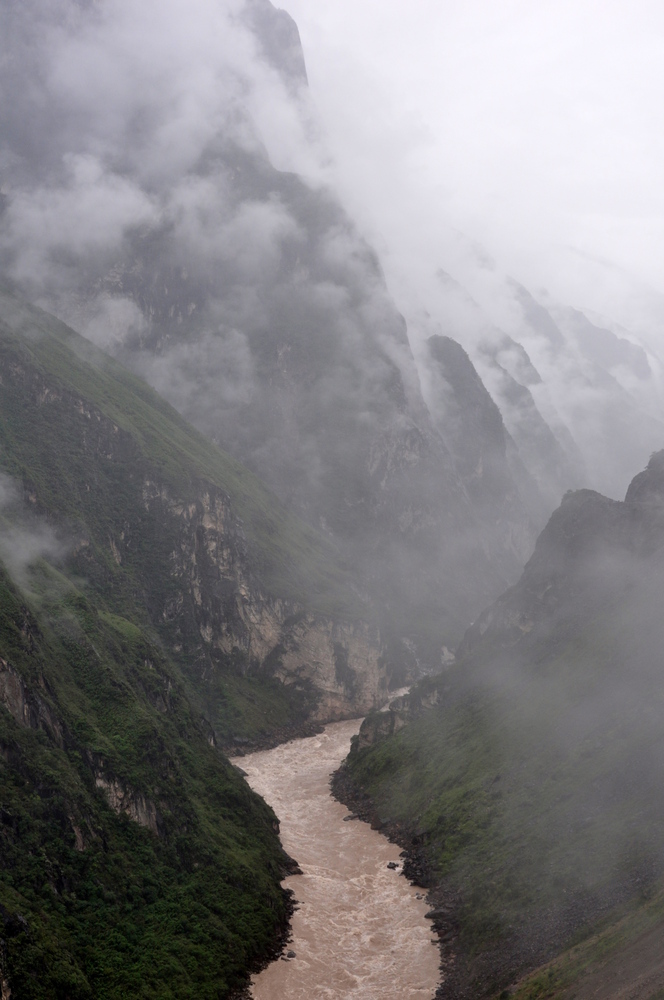
The legend goes a tiger leaped across the gorge, still 25m wide at its narrowest part, when a hunter was trying to capture him. Hence the name Tiger Leaping Gorge. A three hour bus ride from Lijiang took us to Tiger Leaping Gorge. It is one of the deepest gorges in the world measuring 3900m in height and 16km in length (pictured above). At its depth snakes the Yangzi river, and at its height are the Haba and Jade Dragon Snow Mountains. The gorge trek is the most famous in South western China and is popular with both Chinese and foreign hikers. We were quite excited when our bus driver stopped by the first bend of the gorge to let us snap some pictures. It had been raining so the colour of the Yangzi River was muddy brown. Witnessing the power of the water rushing through the first bend of the steep soaring mountains leaves you in awe of its majestic splendour. We hopped back into the bus to head further up towards our guest house in Walnut Garden. The drive got a little scary as we drove higher up on the unpaved narrow roads half flooded with rain water. Looking out the window, the Yangzi River was just an inch away from the edge of the road. Luckily our tough female driver manoeuvred the bus skilfully over all the bumps and turns and took us safely to the guest house. We quickly settled down on the second floor patio of the guest house facing the opposite side of the gorge, overlooking the Yangzi. Most travellers come here to hike for 2-3 days. Since it was raining nonstop, our plan was to do short hikes around the Walnut Garden area which was supposedly the prettiest of all. However, after talking to our guide, we found out that hiking was not an option in this bummy rainy weather. The hike would be too slippery and dangerous in the rain as it’s extremely steep. We did have a good time hanging out on the patio underneath an umbrella sipping some coffee, researching our next destinations (Eug), and reading True Blood (me)! The view of the canyons combined with the sounds of the roaring river from the patio was amazing. The constant movement of the clouds in the gorge made it seem like it was a different scene every single minute. It would’ve been really nice to do some hiking but we were pretty content with enjoying the panorama from where we were.
The next day rained too so we left for our next destination – Shangri-La. Shangri-La used to be called Zhongdian, until the officials here declared that this was the location of the famed Shangri-la described in the British writer James Hilton’s book The Lost Horizon. There’s been arguments as to whether Hilton’s Shangri-La was fictional or not, but using the descriptions in his book authorities here are adamant that this is where Hilton was talking about. True or not, I say our Vancouver home is our real Shangri-La. Anyways, it was a lot colder here than in Lijiang due to the higher altitude. I had to bust out my LJ’s (long johns) from our Kilimanjaro hike. Thanks Auntie for the warm wear! Again Shangri-La was wet and rainy so we couldn’t get out to the mountains, lakes, and the valleys surrounding the town. The muddy roads were flooded so the buses and cars couldn’t get around. It was too bad but we stayed in the old city and enjoyed the serenity of the old town without the interference of large groups of China tourists like in Lijiang and Dali. This was probably due to the fact that the 7 day National holiday was over, and most Chinese tourists wouldn’t bother to get out here to hike anyways. The town looked and felt quite different than the others we’ve visited so far in China because it was Tibetan, as opposed to Chinese or other minorities. We visited the small, somewhat new Tibetan monastery on top of the old city. We could really feel the high altitude here by just walking up about 50 steps. This familiar feeling (from the Kilimanjaro hike) was somewhat refreshing since we’ve had way too much polluted air from other cities in China. Gasping for cold crisp air wasn’t that bad after all. There was a giant prayer wheel at the back of the monastery. It was my first time seeing a prayer wheel. Eug and I and maybe about 5 other Chinese tourists walked around the wheel 3 times together to pray for goodness overall. That was pretty exciting for me already but Eug said we’d be seeing tons of that in Tibet, woo can’t wait! We also tried to go to the Ganden Sumpseling Gompa, a 300 year old Tibetan monastery complex. But the admission went from 10RMB a couple of years ago to 85RMB today. It was too steep for our budget. And we’d be visiting tons of monasteries in Tibet, so we decided to not go. Eug was tempted to go around the back to hike up 2kms (like other travelers did) to sneak in but it was raining and the shuttle that takes you up was right there, so we wouldn’t have made it far before someone stopped us. The local bus ride there and back was pretty fun though. It was only 1RMB and we saw a few lamas on the bus too heading into town from the monastery.
The weather didn’t cooperate for the past 4 days but regardless we had a good time soaking up nature’s beauty on the sidelines. And we had time to chill at coffee shops with wifi, to talk to local restaurant owners, and to catch up with fellow travellers. There were plenty of independent western and Chinese backpackers in these parts, and thankfully no tour groups. In fact we were the only visitors in the Tiger Leaping Gorge village of Walnut Garden. That was a very nice change from the previous national holiday week. It was a relaxing and pleasant 4 rainy days.
Minority Report

The Lonely Planet guidebook states that if you only have time to visit one province in China, it should be Yunnan. Those are strong words, considering the number of attractive and famous provinces there are in this country. So Di and I made it our next stop after Guangxi to see what all the fuss was about. As China’s most south-westerly province, Yunnan borders Myanmar, Laos and Vietnam. The terrain by those countries is therefore more Southeast Asian-like; it’s mainly tropical rainforests and jungle. In contrast Yunnan’s northern border is shared with Tibet, giving this part of the province snowy mountains and emerald coloured lakes which is a far cry from its southern parts. However what draws most people to this province is not its varied landscapes, it’s its varied people. Of China’s 55 registered minorities (non-Han Chinese, as the Han are by far the largest ethnic group in China), 25 live in Yunnan.
We took a flight from Guilin to Kunming, as Di wasn’t too keen on taking another overnight train. We were planning to go visit Shilin (which literally means stone forest) about 90 mins out of town but after doing some research we decided not to. The reason being it was their big national holiday in China, with everyone having time off between Oct 1- 7. The tourist sites here are already overcrowded, and travellers put Shilin as one of the places that was insanely so. We could only imagine how bad it would be with the whole country being on holiday, so we just hung around the modern city of Kunming for a couple of uneventful yet relaxing days instead.
Afterwards, we took a bus to Dali, which lies on the western edge of Erhai lake. Dali is an old walled city whose inhabitants are mostly of the Bai minority ethnic group. They don’t have a written language but their spoken one is alive and strong. Dali’s layout sort of reminded us of a lot of the Middle Eastern cities we visited, with an old walled city surrounded by a new town. The old city here though was extremely navigable with wide, clean cobblestone roads in a grid pattern and nicely restored buildings, unlike the maze of dusty alleyways in the Arab medinas. Though done nicely, it was quite touristy here, with all the shops and restaurants completely catering to visitors, especially with it being the national holiday. So the next day we hired a driver to take us village to village around Erhai lake instead to get away from the chaos. He told us the beautiful lake had a 45 km circumference, and on it he took us to 4 Bai villages: Xizhou, Shaping, Shuanglang and Wase. Both Xizhou and Shaping had very lively morning markets taking place, with all the buyers being locals and virtually no tourists around, which was a nice change from Dali’s scene. It was cool to see the Bai ladies wearing traditional clothing, each with a straw basket strapped onto their backs and colourful wraps on their heads, buying food for the week. They would buy their vegetables or whatever, and then turn their back toward the vendor who would then fill their basket; kinda neat. Shuanglang was near the northern end of the lake and you could tell that it’s poised to become a more touristy destination. The first few backpacker cafes serving lattes have opened up with French dudes manning them, and the town is starting to slowly renovate its properties on the water to be more traveller friendly (ie make them souvenir shops). The above picture is from this region of the lake.
The next day we took another bus to the town of Lijiang, a UNESCO world heritage site just a few hours north of Dali. Lijiang is home to the Naxi people, descendants of Tibetan nomads who decided to settle in this region of Yunnan. They, like the Yao peoples we met in Guangxi, are also matrilineal with children living with their mothers and all property being inherited by women. The man in the relationship would spend nights at the woman’s house, but in the daytime he would return home to his mother’s to live and work. The Naxi are also the last people on Earth to use a hieroglyphic writing system. The pictographs they use are pretty wild; you can check them out on our flickr site to see what I mean. It would take years for me to write anything with their system of pictographs, especially a love letter, since the ones I write Di are so long and poetic and heartfelt and sweet and sensitive and emotional. Anyways, back to Lijiang, it also has a very pretty and picturesque old-town like Dali, surrounded by a new and modern city. In fact, it might be a little too pretty and look a little too perfect to feel really authentic. However I can’t really blame the town for this as an earthquake in 1996 measuring over 7 on the Richter scale knocked down much of the Lijiang, killing more than 300 and injuring over 16000 in the process. Thus the rebuilt structures are no more than 14 years old instead of a few hundred. However the rows of stores selling tourist kitsch don’t help the overly commercial atmosphere, especially during holiday season. So what Di and I did instead was wake up really early one morning to wander around town before the first tour bus arrived or many travellers awoke. What we found was a beautiful scene, full of inviting alleyways, clean canals, stone bridges and pretty parks. It’s nice to see some attempts of preserving ‘old China’. However once the shopkeepers opened their doors, the alleyways began to fill with hungry consumers, not unlike the old cities of Rhodes in Greece or Marrakesh in Morocco. That was our cue to head out of town, so we went north about 10 km to a village called Baisha, where the famous Dr. Ho of The Clinic of Chinese Herbs in the Jade Dragon Mountains of Lijiang was still practicing. We actually went to check out the village, only realizing later that this 87 year old Taoist physician was here, complete with the white Fu Man Chu beard and all. He’s actually pretty famous, with documentaries on the BBC and National Geographic being done about him, and authors like Bruce Chatwin writing about him. His office is lined with newspaper articles from all over the world about him and his knowledge of curative herbs, many of which he grows in his own clinic. Others he actually handpicks from the slopes of the Jade Dragon Mountains. What’s even more awesome is that he practices for free, only accepting donations if you are so inclined. Oh and he speaks perfect English as well. There were stacks of guestbooks full of appreciative and thankful comments from his many international patients, and even American and European doctors who thanked him for curing their patients’ leukemias and such. We were going to ask for some of his practitioner advice, but I was sure he didn’t have any herbs to cure ugly so I really had nothing to ask for myself. Di also was in good health so she just asked to take a quick picture with him and we left, leaving him to mix some herbs for a village woman who was complaining of a cough. Supposedly Di had heard of Dr. Ho’s teacher, as he wrote the definitive book on Chinese herbal medicine. In hindsight I really should have asked him a question, like if he had a herb mix that could help me grow some facial hair, specifically a goatee. Dammit, next time.
桂林山水甲天下 Guilin scenery, finest under heaven
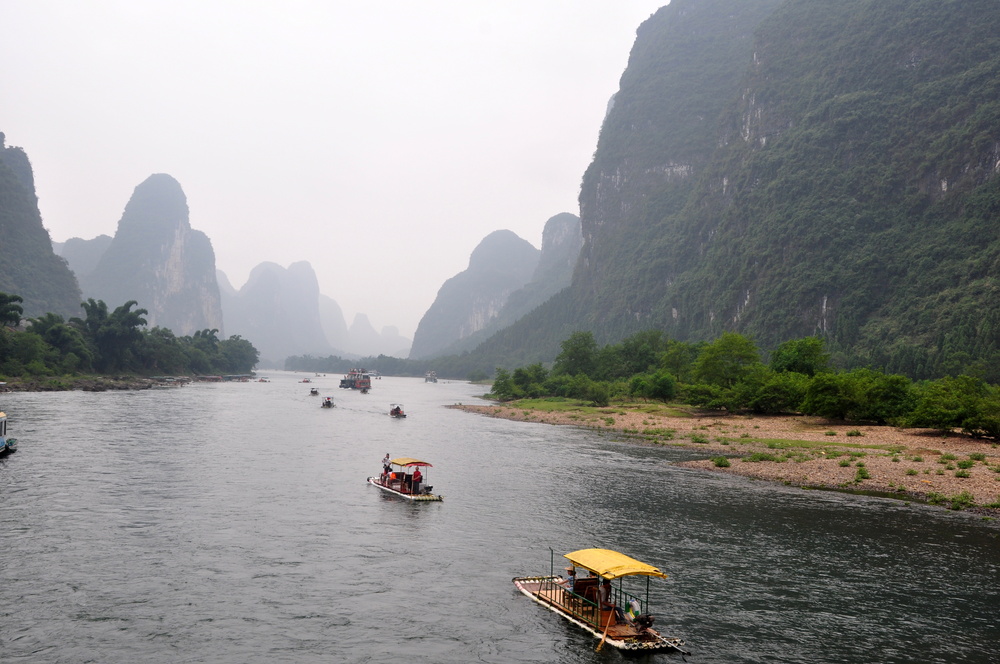
We spent our last four days of luxury in Hong Kong with Phil and Ta before going on the road again for the remainder of our trip. We rested so well in Taiwan and Hong Kong in August that we got soft. Our backpacks became heavier all of a sudden and the idea of staying at hostels again was quite unwelcoming. Luckily our first stop from Hong Kong after Phil and Ta went back to Vancouver was to visit our dear friend Didi in Guangzhou, Guangdong province. He was gracious enough to let us crash at his place and took us out to two amazing Cantonese meals before we moved further west to Guilin. Thanks Didi! 🙂 There wasn’t much sightseeing in Guangzhou but Didi said if we stayed longer, he would have taken us to Donguan, a factory-filled city that’s becoming a Taiwan town due to the numerous Taiwanese-owned factories. There’s good bubble tea and Taiwanese food too, nice! Guangdong province is where most of our Hong Kong friends’ predecessors were from originally. Eug was no exception. He remembered Guangzhou was a dump (quoting Eug’s exact word) when he visited with his grandparents about 20 years ago. Now it’s certainly a modern city.
Remember I said I was not a fan of overnight traveling? This time I really did not like it. Unfortunately the train system in the interior isn’t as new as the coastal cities, so in our 12 hour train ride from Guangzhou to Guilin, Eug and I ended up stuck in the middle bunks of a 6 person hard-bunk room, whereas we had the comfortable 4 person soft-bunk room from Shanghai to Beijing before. There was no room to put our backpacks let alone room for us to sit up straight, and the bunk beds were as hard as the Sahara sand we slept on. We ended up having to lie horizontally for the whole 12 hours every sleeping and waking moment. To top it off, a local Chinese guy snuck in and slept on the free bunk on top of Eug’s and started talking on the cell phone really loudly and then snored up a storm in our tiny cabin. Fortunately for us, he was caught sometime during the night by the train attendant and got kicked out, phew…
After the tiring commute, I was glad to find the hostel we booked comfortable and clean. And the girl working there was extremely helpful and accommodating. Our room wasn’t ready yet when we arrived but she let us take the bigger room which was empty and ready at no extra charge. After an energizing nap, we took a gondola up to Yaoshan (Yao hill), the biggest and the highest hill of Guilin to get the bird’s eye view of the city. On the way back we visited Jingjiang King’s Palace and hiked up the Solitary Beauty Peak at the back of the palace. Guilin is in the Guangxi province and of course there’s a Chinese saying about Guilin – 桂林山水甲天下 (Guilin scenery, finest under heaven). The landscape of Guilin is like Halong Bay in North Vietnam. There are countless limestone hills but instead of being surrounded by water, they are surrounded by the city itself. The top of these hills covered in the clouds look like the scenery in Chinese paintings. Eug and I actually weren’t that impressed by the end of our first day; we thought it was overrated, maybe because of all the high praise we’ve heard about Guilin. However, we were soon proven wrong. The next day, we took a boat cruise down the Li River to the town of Yangshuo. The scenery nearly took our breath away. It was as if we were inside one of those Chinese paintings I talked about earlier. One section of the river we passed by is what’s printed on the 20 RMB bill. The town of Yangshuo is like the Chinese version of Banff, beautiful and nestled in the mountains. A few years ago, it was backpackers’ heaven but now it may be a little over-developed for those independent travelers as it has slowly been overrun by herds of China tourists from other provinces. Here we went to another Zhang Yimou show called “Impression Liu Sanjie”. The setting on the water was similar to that of the “Impression West Lake” show that we saw in Hangzhou, but this one was on a river and set against the hills in the background. This show casts about 600 dancers and singers to reflect the different minority groups of southwest China. Visually it was also pretty amazing (as can be expected by Zhang Yimou) but we liked the Hangzhou show a little better.
We hired a personal guide for a baffling 50 RMB(8 USD) for the day who took us around on a bicycle tour around the country side of Yangshuo. She was a Yao girl; the Yao are one of the minorities that live in this region. She said before the year 2000, she had mostly ‘Lao Wai’ (Western foreigners) clients. After 2000 when people in China started to get wealthier, they became the major visitors. It is very good to hear that China’s citizens are traveling around more and more in their own country, though unfortunately being surrounded by throngs of China tour groups can really test your patience. Pushy and loud would be understatements, but we just try to understand that for many this is their first vacation in their own country and they really don’t want to miss anything, and I mean anything. The bike ride around the countryside was the highlight of our time in this region. Seeing the local farmers working on their neat, small plots of land nestled between lush, green limestone hills is unbelievably soothing. In addition, the tour groups don’t go biking on farming paths, so we really were able to find our own little slice of heaven, just like that old Chinese saying. We also took a 2 person bamboo raft down the Yu Long River. It would’ve been perfect if our boatman would have stopped bugging us to buy pictures or food from the numerous floating stalls in the middle of the river. Oh well. Some things are just out of your control. He did finally keep his mouth shut after Eug got mad at him in Mandarin. Eug’s Mandarin is improving a lot by the way. People are starting to think he’s from Singapore instead of Korea.
On our last day in Yangshuo, we went on a day trip to the Longji (Dragon’s Backbone) Rice Terraces. The hills in this region were reshaped into terraces in order to farm rice and other vegetables. The result is a visually stunning feat of farm engineering. It’s jaw dropping to even try to fathom how people made this in the first place. The minorities that live in this region are mostly Yao and Zhuang. The Yao girls in this region cut their hair only once in their lives at the age of 18. Their different hairstyles can distinguish if they’re married or if they have children. In addition the men marry into the wife’s family and thus adopt the woman’s family name, as do the children. For the women, if they are interested in a man, they can openly pinch the guy’s butt. I was joking to Eug that no girls would be able to find his butt but to his delight the girls definitely did. We hiked up to the top (where again there were less tourists) of the terraces to take a look at the view, and it blew us away. I took about a million pictures of the same vista. Eug had to stop me as I was getting just slightly carried away and turning a little TWC (Taiwanese crazy) with the pictures.
I thought the interior of China would be tough to travel in due to under-development, but I was proven wrong yet again. All I can say is China can surprise you in every aspect, most of the time in a good way. The toilets (squatters), the constant horking sound close-by before people spit, and the pushy grandmas at tourist destinations can get to you, but the positives of visiting this country have far outweighed those negatives. I really enjoyed visiting Guilin and Yangshuo. Nature’s beauty really hit the spot for us here.
Bowstaff skills, Nunchuck skills, and now I got Sword skills too

We took another overnight train to get from Beijing to Xi’an, the next stop on our China trip. At one point Xi’an was called Chang’an, and it was home to the first Emperor of China. This first Emperor, Qin Shi Huang, unified China by defeating the 6 other Warring States at the time. He standardized its currency, measurements and writing. He also completed huge infrastructure projects, laying miles and miles of canals, roads, and the first version of the great wall. Unfortunately he was also quite a tyrant who liked to burn books on good days and bury scholars alive on bad ones. Before he died he had an army of terracotta soldiers built for him to accompany him into the afterlife. This subterranean army is the main reason we came to Xi’an.
The Army of Terracotta Warriors is about an hour out of Xi’an so we caught a minibus from the city to get there. The site itself is pretty big and split into 3 different pits. The first one is the most impressive with over 6000 horses and soldiers in battle formation. Other parts of the museum let you see bronze chariots, chrome-plated weapons, and different types of soldiers (a kneeling archer, a standing archer, a cavalryman, an officer, and a general) up close. The detail is absolutely incredible, especially considering that they are all well over 2000 years old. What’s also remarkable is that no two faces of the soldiers are alike. We’ve seen some pretty amazing tombs over this year of traveling, including the ones in Egypt in the Valley of the Kings, but to have a full standing army built to go with you into the afterlife is pretty badass. Say what you will about the ruler, his influences on Chinese culture as we know it are still felt today.
When we got back to Xi’an that night we walked around the Muslim quarter. There is a sizable Muslim population which has been around for hundreds of years here. Maybe it has to do with the fact that Xi’an is the beginning of the Silk Road, though I’m unsure if that’s the reason. Either way, the Muslim quarter is a pretty cool part of town and that’s where we ended up having a massive dinner of cumin-doused street-meat-on-a-stick and beer. Pretty good combination if you ask Phil.
The next day we decided to go to Hua Shan (Mount Hua, pictured above). I climbed this mountain 6 years ago and liked it so I thought I’d take everyone there to do it again. For those who don’t know, Hua Shan is the most sacred of the top 5 Taoist mountains in China. It’s one of those legendary, mythical places where immortal Taoists hang out and meditate, dispensing the truth for those who are willing to be disciples. It also holds an allure for those of us who are into Kung-Fu movies and stories. Supposedly, the Hua Shan sect’s style of swordplay was invincible as they knew the Nine Swords of Dugu style (I know, awesome, right?). A great movie illustrating what I mean is Swordsman II starring Jet Li and Brigitte Lin. The Chinese believe in this thing called Chi (or Qi) like in Tai Chi. It’s kind of like a life energy, sorta thing. Anyways, Hua Shan is supposed to have a lot of sword Chi. So seeing as I’ve been up the mountain twice, my sword skills must be pretty killer due to the absorption of the sword Chi. We took the gondola up to the North Peak and from there we hiked another 45 minutes to get to Golden Lock Gate. The views were stunning, and Hua Shan is truly a granite beauty with striking vertical rock faces. Poetry and Taoist proverbs are also skilfully carved into the mountainside. It’s regrettable that we didn’t have enough time or it would have been nice to do the whole 6 hour hike from the very bottom without taking the cable car. Unfortunately the bus ride to and from XI’an was a gong show and took way longer than expected, so maybe next time we’ll bite the bullet and hire a private driver. If I went up another time though my sword skills would probably be outta this world. I dunno if I could handle that much power.
On our final morning in XI’an before heading back to Hong Kong we rented bikes and cycled the old city walls which took about an hour. Xi’an is one of the few cities in China whose ancient walls are still left standing. They are over 500 years old and from the Ming Dynasty. The bikes we were able to rent also looked like they were 500 years old and from the Ming Dynasty. While Phil was cycling the pedal completely came off his bike. Luckily he didn’t crash and fall so the historic wall wasn’t damaged.
After Xi’an we hopped on a flight back to HK for a few days before Phil and Talica went back to Vancouver. There really isn’t much to say about that except that we partied like it was 1998 (the first of many years that Phil and I went back together to HK). A lot of his friends from Halifax were in town, and a lot of my friends from Vancouver were also there. This conglomeration resulted in a pretty powerful combination which then resulted in Talica and Di doing the robot for about 4 hours in this club called Volar. Supposedly I was belting out Justin Bieber (that’s Steve Jue and Christine Pang’s fault for introducing him to me) as well. Good thing I didn’t have a sword in my hand while I was dancing Bieber styles, I don’t think Volar or any of its patrons would have survived that.
Beijing – The Capital of China
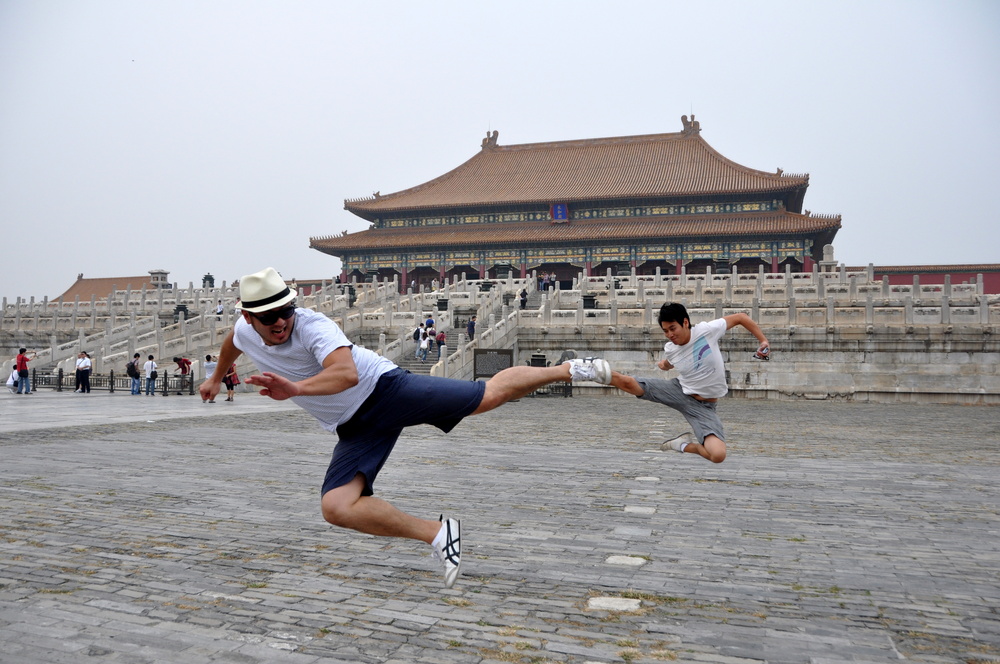
I’m not a big fan of overnight traveling, but taking a new fast overnight sleeping train doesn’t seem bad at all. And that’s what Phil, Ta, Eug, and I did to get to Beijing from Shanghai. The sucky thing was that we couldn’t all be in the same cabin but the good thing was that we all got top bunks in the 4 bunk rooms. And it was Ta’s first time taking the overnight train too! I was super stoked to be in Beijing because I’ve always wanted to see the Great Wall, the Forbidden City, and Tiananmen Square. The last image of Tiananmen Square that was embedded in my brain was a line of military tanks driving slowly towards a student protestor who was blocking its way. That was 1989 before we moved to Canada. Like a curious but shy kid, I anticipated the visit to Beijing with mixed feelings. On one hand, I couldn’t wait to see the sites; on the other hand, I wasn’t sure if I’d like what I was going to see. It turned out that my worries were absolutely unnecessary. Beijing was far from what I thought it was as a child and the sites we managed to cram in during these short 4 days were incredible, and we had some really good meals too.
We wasted no time to try the yummy Peking duck after checking into our serviced apartment. Finally, Peking duck in Beijing! We went to Da Dong Peking Duck and it was really the best Peking duck I’ve ever had. The skin was crispy and the meat was lean yet full of flavour. The wrap itself was almost paper thin. So good! The squab was probably the best one I’ve had as well and every other dish we ordered was delicious too. The price wasn’t cheap by China standards but it was definitely worth it for the quality we got. Having satisfied our appetite, we headed towards the Forbidden City. We took the subway to the Tiananmen East station and walked to the palace. The palace was huge and seemed never ending, gate after gate, and each got grander and grander. There were other exhibits on the sides as well. By the time we wanted to check out the clock tower and the treasury, they were already closed. That was a bummer but what we saw was tons already.
Right across the street in front of the big picture of Mao by the entrance of the Forbidden City is Tiananmen Square. As we were walking towards it, my heart sank a bit recalling the image of the tank. Even though it was just across the street from the visitor packed Forbidden City, there seemed to be only a few groups of tourists on the square side. Tianamen, which is actually the world’s largest public square, was surrounded by big boxy gray and imposing communist style buildings. It was such a great contrast between the posh, new capitalistic steel and glass buildings in Pudong that I almost forgot we were just in Shanghai the day before.
The next morning we visited the Great Wall. Eug was here about 6 years ago and he snuck into the Great Wall at 5 in the morning with some friends when it wasn’t opened yet to catch the sunrise. He raved about the experience so we did the same this time. Our driver picked us up at 4am and we were dropped off at the Mutianyu section of the wall. Eug previously snuck in at the Badaling section so we thought we’d try another area that many actually consider more beautiful. We hiked up to the wall in half an hour in the dark and the drizzling rain with flashlights. It wasn’t exactly clear and sunny but the misty surroundings gave a different feel to the place. As the sun came up it didn’t take long for us to start appreciating the mysterious and majestic look of the Great Wall, especially wrapped in clouds and with no other tourists in sight. We couldn’t see the sunrise though, next time! We also visited the Summer Palace and the Temple of Heaven. Both were equally extraordinary. We were told Beijing has a more cultural aura compared to the modern and posh Shanghai, and we did find that to be true. Our Shanghai friend Heidi told us we must visit the Hohai area so we hung out there one night despite the rain. It’s a long strip of pubs and bars surrounding a lake. At night time the outside is well lit by a neat row of red lanterns. You’ll hear live bands performing different songs from every single bar, Chinese oldies, pop, western hip hop and rock and oldies as well. All were sung by talented local singers and bands. We had a really good time there. We also checked out the famous Wangfujing shopping area. There’s a night market that has all these weird creatures for you to consume and it’s in almost all the travel shows you see. Things like star fish, silk worms and scorpions are all on the menu. NO THANKS! And even though I love stinky tofu and pig’s blood and other crazy stuff that Taiwanese people like, it was pretty gross to see people actually eating live scorpions. We double dared Phil to eat the scorpions but he chickened out. Plus Talica wasn’t going to kiss him afterwards if he ate them. But mostly it was because he chickened out.
Though we liked it here there were a couple of negatives. The air isn’t exactly of the best quality as the cities’ constantly covered in thick smog (thicker than in LA). The traffic is also insane, and we were almost never able to hail taxi in less than half an hour. The Mandarin spoken here is completely incomprehensible to my Taiwan Mandarin ears. But there’s something about Beijing that lures you in and you somehow can’t get enough of it. Being here made me realize that the image I had was from a long time ago and China is definitely a different place now. Word on the street from those in the know say Beijing is more fun than Shanghai, and we can see why. Beijing is kind of like Shanghai’s older, cooler, and more confident sibling. It doesn’t try to shove the “I’m popular and people want to be like me” vibe down your throat like Shanghai does with its brash parties, big lights and flashy architecture. Beijing knows it’s cool, and it has no problem letting Shanghai take the spotlight. I wish we had more time here to ride out the rainy days and see more sites as we still missed quite a few. And if the epic partying in Shanghai didn’t leave us in such a tired state we would have liked to have taken in more of the Beijing nightlife. Luckily we have a few friends living here, which gives us an excuse to come back to visit soon!
Shanghai – The Future New Centre of the World?

We had an awesome time in Shanghai. First we came to visit one of my closest friends Shingo, who has been living here for a couple of years. In addition, Di’s parents showed up with their Taiwanese friends for a short 5 day tour of Shanghai that coincided with the days that we were there. And to top it off, my BFF Phil and his girlfriend Talica came from Vancouver to spend the next 2 weeks with us. Sweet!
Shanghai doesn’t have as much of a dignified history as cities like Beijing and Xi’an. In fact, there was a time when corruption was rife, gangsters ruled, and many different European countries controlled large sections of the city unhindered by Chinese law. Opium dens and gambling joints were ubiquitous with this extremely busy port town. I’m actually not sure if the Shanghainese are proud or ashamed of this past, but I’m quite positive that they think extremely highly of their current position in China and the hopes they have for their future on the world wide stage.
It’s because of this sense that Shanghai is the next “It” city for business and development that so many of our friends are here. As I mentioned, Shingo is here from Japan. When he came to pick us up from our hotel, in the car was Mits (a friend I hung out with in New York way back when) and Jeff (a Taiwanese guy who went on an exchange program with Di in Japan 13 years ago)! It was crazy to see those 2 with Shingo, having lost touch with them and not knowing they all knew each other; such a small world. In addition to that, sitting at the table next to ours at the club was our buddy Areef, who lives in Jakarta but was also in town for business. What are the chances? Oh, and our French friend Martin who we met on Kilimanjaro was also in town and partook in the festivities of the night. What I’m trying to say is that people are gravitating here. I met many others throughout the nights here, and they were from all over the world. When I asked them why they were here, pretty much the universal answer was “to get rich”. Most of the Asian guys had family business from other parts of Asia to expand into the China market, but pretty much all the European and American guys were here to seek new opportunities and make new contacts. I haven’t witnessed that kind of energy in any other city we’ve hit so far on our travels.
It was also good to grab dinner with Di’s parents and their friends. Since there was so many of them they split everyone up into 2 tables, with dudes on one side and women on the other. So I got to chill with Di’s dad and 10 of his Taiwanese speaking buddies. These guys were all from the South of the Island, which typically has a more pro-Taiwan/anti-China sentiment. However, at dinner it seemed as though the sentiment was more towards cooperation on the business front (I didn’t get into the political front as that would have opened up a can of worms). They were talking about how in their youth when they had to do military service, China was their enemy, but now those times are past and the future is about teamwork and mutually beneficial relationships. I for one was ecstatic to hear these guys say that, as I’m all about building bridges and I’ve been hearing the negativity in China/Taiwan issues for way too long.
We were able to visit most of the areas of the city we wanted to see, such as the Yu Yuan gardens, Nanjing Road, Xin Tian Di and the Bund. We lived in the French concession too which was a nice part of town. In addition we went to the world Expo for a day, which was immense, though not in a good way. We basically only entered 2 pavilions, which was enough for us as we had no interest in lining up over 2 hours to check out another one. In addition our friend Heidi hooked us up with river cruise tickets as her friend owned the nicest boat on the water. The views at night on both sides of the river were quite stunning, with one side the historic European waterfront of old Shanghai (the Bund) contrasting with the other side, the modern steel and glass financial powerhouse district of new Shanghai (Pudong). For those who visit I definitely recommend this cruise to get a glimpse of the new architecture (a lot of it nice, some like the TV tower, not so nice) that is being built at breakneck speed.
One quick note about food. Shanghai’s most famous dish is probably xiao long bao, a small steamed dumpling that’s ridiculously good when done right. Well, there’s been the argument that Taipei’s are better, so Di and I went out all over town to the most famous joints to give them a try. I’m sorry to disappoint the Taiwanese readers out there, but Jia Jia Tang Bao in Shanghai was tastier for us than Din Tai Fung in Taipei. And yes we know Din Tai Fung well, Di lives across the street from them and we eat there almost every 2nd day we’re in Taipei. When you’re in Shanghai you have to give Jia Jia a try.
5 days here gave us a pretty good feel for Shanghai, especially with so many local friends. I was here 5 years ago, and though it was developing a lot already there were still a lot of visible social issues, especially begging. This time around, I didn’t see even one panhandler on the street. And though the odd person still budges in line, it’s definitely rarer than my first time here. This city is evolving, and fast at that. The infrastructure is first rate, and the new buildings rival those of any built in the rest of the world. Though China is still a developing country, Shanghai is confidently leading the charge for its transition into a first world powerhouse. Being here, in the front line of change, almost made me want to grab a suit, a cell, and a notebook to join the army of entrepreneurs looking for excitement and their piece of the pie. Then I remembered I was travelling the world with Di, and Phil and Ta were along for this part of the ride, so I emerged from my stay-here-and-get-rich daydream and happily we moved on to Beijing to let the adventure continue. Shanghai definitely impressed us though, and I’m sure all of us will be back. Maybe by then it will fully attain that international city status the Chinese government so wants it to have.
Heaven on Earth – Hangzhou

Having never been to China, I felt like I was the last Chinese person who hasn’t visited my heritage yet. Needless to say, I was very excited about going. Our plan was to fly to Hangzhou from Taipei, then train to Shanghai, Beijing, and Xi’an. I’ve seen pictures and images of Shanghai, Beijing, and Xi’an before, so I knew what to expect for those cities. However, that was not the case for Hangzhou. I only knew that there were numerous beautiful poems written by many famous Chinese poets back in the day about the beauty of West Lake in Hangzhou, but that was the extent of it. And there’s this Chinese saying about how Hangzhou and Suzhou are heaven on Earth – "Heaven Above, Suzhou and Hangzhou below" (上有天堂,下有苏杭). Marco Polo also described this city in his book as “beyond dispute the finest and noblest in the world”. I was looking forward to seeing this with my own eyes, and this might sound strange coming from the princess me but it was nice to be on the road again after having been stagnant for the past 3 weeks. If I stayed in Taipei any longer, I probably wouldn’t have wanted to move again because it was so comfortable staying at home and it was heartbreaking to leave my adorable niece.
We arrived in Hangzhou after a short 1.5 hour plane ride from the Taipei airport. Hangzhou is the capital city of Zhejiang province and is well known for its beautiful natural scenery, the most famous being West Lake (Xi Hu). After arriving at the brand new Hangzhou Xiaoshan International airport, we took two nice air-conditioned buses to the Hangzhou zoo near the southern part of the West Lake where our hostel was, and walked around for about half an hour in the unbearable humidity before finding our hostel. By the time we got to the hostel, our t-shirts were completely soaking wet. It was not the most pleasant feeling. And there was an old friend from our Libya hotel in our room, hi again cockroach! Ugh… But as soon as we sorted out our itinerary for the day and took the bicycles out to see the West Lake, all these annoyances were gone with the wind.
West Lake is in the city and has a lot of scenic points: pagodas, temples, gardens, paved walkways, and you can hop on boats to go around the lake as well. I admit the colour of lake itself isn’t the clearest or the prettiest, but the scenery around it is picturesque and calming. I thought I was looking at a Chinese painting when looking out to the lake and its surroundings. Eug almost wanted to recite Chinese poetry right there like his ancestor Tao Yuan Ming. The centre of town is also very close to the lake too. We biked all the way around the lake and to the centre of town and tried a few delicious meals. One of them was at Grandma’s House – a local favourite for some tasty Hangzhou food. Tong Po pork meat is a famous dish that originated from this city. And if you are into tea, Longjing (dragon well) tea is also from here. One evening, we watched an amazing show on the lake directed by Zhang Yi Mou. If you haven’t heard of him, he’s also the guy who directed a little spectacle you might have seen, the opening ceremonies of the 2008 Summer Olympics in Beijing. The show we watched live was called “Impression Hangzhou” and it was spectacular. I don’t want to ruin it for you but it’s definitely worth seeing if you ever get the chance. We sat next to a very cute grandma and grandpa from Hangzhou and it was their first time seeing the show too. Their son had seen the show and asked them to go see it. I smiled each time they wow’ed and commented on how great the performance was, very heart warming indeed.
I was very impressed by the infrastructure of the city too. The centre of town has countless ginormous department stores selling international brand names, high-end hotels like Sofitel, most chained coffee shops (Starbucks, Coffee Beans, Costa Coffee); anything you both need and don’t need can be found here. The buses are new and have air-conditioning and LCD TVs playing Chinese pop music videos. There are tourist information booths almost every block. The roads are clean. The traffic moves in an orderly fashion. The list goes on and on. And contrary to popular belief, not very many people spit, not very many people walk around with their shirt rolled up to their chest so only their tummy is showing because it’s too hot, and not many people cut in line or talk on the phone really loud.
I really enjoyed Hangzhou, and since we’ll come back to Taiwan once a year and China is just a short flight away, we’ll definitely visit Suzhou and other nearby places in the future. It’s my first visit to China and seeing the gorgeous sights and the rapid development of the city really makes me feel proud to be a part of something so great.
 fromwonderintowonder
Recent Comments