“Go back as far as you will into the vague past, there was always a Damascus…She is a type of immortality” – Mark Twain
Our last four days in Syria were spent in the ancient city of Damascus, which competes with its sister city of Aleppo for being the oldest city that’s still inhabited in the world. We stayed in the walled Old City, and after being in a bunch of walled old cities in the past 3 months, this is the one that was the most intact. When I say intact I mean untarnished by time and tourism. The locals are still by far the biggest patrons of all things within the souq (covered market). At night the small tables at a tea house are filled by Syrians smoking their nargileh (water pipe) as they listen to a professional storyteller un-weave his tale (as I can’t understand Arabic I imagine it to be The Thousand and One Nights). Women in burkas form line-ups outside Damascene ice cream shops which serve a delicious pistachio covered tapioca concoction. Beautiful courtyard restaurants load tables with Syrian dishes that haven’t been altered to appeal to foreign tongues. Though the mosques open to tourists in other cities are filled with them, we the tourists are overwhelming minorities in the ones here. Pretty much everyone we met in Syria had nothing but praise for this city, and it lived up to the hype. We were living in the Christian quarter of the old city, and every time we walked back to our residence I would notice something new and subtle in the beautiful architecture surrounding us, especially on the second floors of the old houses. It was a charming place, and we really liked it. We’ve heard that this is what the old city in Marrakesh used to be like before tourists took over (kind of like how Vietnam is now sort of what Thailand used to be) and I totally believe that. Fashionable boutique hotels are sprouting up in old Damascene houses, following the Moroccan blueprint of having boutique Riads (guest houses) in old renovated Moroccan houses. I wonder how long it’ll take for Damascus to become as fashionable as Marrakesh to the desirable high-end (ahem big-spending) tourist.
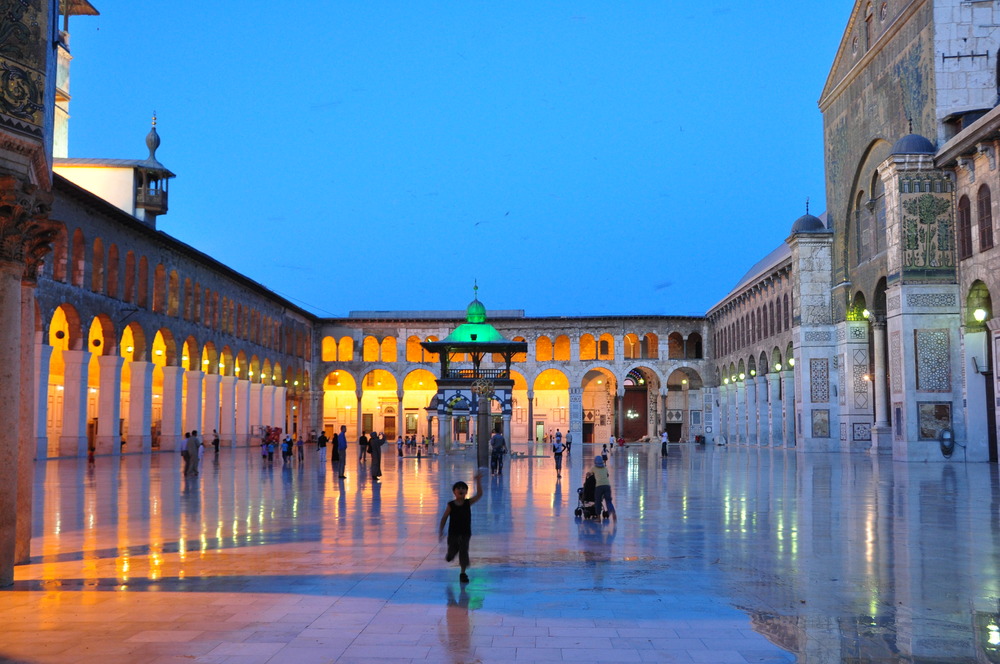
We spent some time in Damascus’ marquee religious building, the Ummayad Mosque which is pictured above. The Shrine of Hussein (Prophet Mohammed’s grandson) is here and is an important site of pilgrimage for Shiite Muslims. Beside the mosque lies the mausoleum of Saladin, a Kurdish-born hero of the Muslim world who kicked the Crusaders out of Jerusalem (also the antagonist to dreamy Orlando Bloom in the movie “Kingdom of Heaven”). The interior of this mosque is lined with stunning golden mosaics which supposedly represent the paradise Prophet Mohammed saw in Damascus. Though it was a religious place, the immense courtyard was filled with children running around laughing and chasing each other. We were enjoying the experience, but many of the eyes were curiously looking at us the whole time we were inside. Though not unwelcoming, we were unsure of how we were supposed to react in this place of worship to all the eyes and whispers. Then finally one woman came up with her young son and camera phone and asked to take a picture with us. After her the floodgates opened, and Di, Jon (a fellow Canadian we were traveling with) and I were smiling for cameras for a good half an hour until darkness descended upon the courtyard. This has happened to Di and I quite consistently on this trip so far (almost daily in fact, I guess Asians aren’t common around these parts) but this mosque was definitely where we were photographed most. People were actually lining up, but they were excited so we were happy to oblige.
One day 6 of us decided to hire a driver to take us to the ’Disengagement Zone’ of the Golan Heights, a region between Israel and Syria that is now under UN control. This was a sobering reminder of the political issues that plague the region. In the 6 day war of 1967, Israel took this area from Syria and expelled almost all of its residents. With UN negotiations, Israel agreed to leave the area as a demilitarized zone administered by the UN, but they bulldozed much of everything remaining before they left. The former town of Quneitra here is now comprised of flattened concrete, twisted steel, mine-filled fields, and a bullet riddled hospital (supposedly used for target practice after all residents left). UN vehicles are the only ones really still using these roads. Visiting here was definitely heavy, similar to how I felt being in the demilitarized zone between the two Koreas. Except here, there was no theatre, museum or tourists like in Korea. It was just us, our driver, and UN soldiers; quite an experience.
It’s quite unfortunate that the western world views Syria as a ‘rogue state’ (George W Bush’s exact words). For a ‘rogue state’, its people are pretty darn friendly. We’ve never heard the word “Welcome” so many times in our life. Children would run up to us to say this, drivers and passengers would yell this out their windows, and fellow pedestrians would always smile and try to shake our hands. Anytime we took out a map someone was eager to help us or walk/guide us, and this always had no strings attached. Syrians were constantly giving us tea or drinks, asking if we liked their country. Though we’ve experienced hospitality everywhere, I would say so far here and Libya take the cake. (Though as an unfortunate aside, Libya and Syria are also the only 2 countries where we’ve gotten a little sick. I had a case of ‘Damascus Belly’, not fun. One day of Cipro though and I was fine).
Syria has been held by Phoenicians, Egyptians, Persians, Greeks, Romans, Arabs, Crusaders, Mongols, Turks…basically a who’s who of the empires of the region. As such they’ve all left their marks: architectural, cultural, culinary, artistic, religious etc. Finding these relics in the everyday life of this ancient land is fascinating, but don’t be fooled by the word ‘ancient’. Syria is modernizing quickly, so if you want to catch it before tourists outnumber locals in the old city walls, now would be the time. It’s an easy country to travel as it’s not large and all sites are within driving distance of Aleppo or Damascus. The travelers that make it here also tend to be very experienced, as Syria is usually not on the top of a newbie’s list like Thailand or Western Europe would be. As a result, there are ample opportunities to discover the country with sociable, adventurous and extremely open-minded explorers who are on the same route as you. What I’m trying to say is that making new friends, both local and foreign, will not be a problem at all. Just don’t try to add them to facebook here, it’s banned.
The Oldest Cities of the World

Right after crossing the land border to Syria, our driver stopped by a gas station to fill up gas. It was a ghetto looking gas station and it had a ghetto looking slurpee machine with three colours – florescent orange, blinding yellow, deadly purple. Just as I was thinking ‘eew gross!’ our nice driver opened up Eug’s door with one of each in his hands and gestured Eug to choose. Eug politely took the two of the less deadly looking ones and our driver gestured us to taste them. We reluctantly took a small sip each and nodded until he gave a satisfying smile and continued driving towards Aleppo. For the rest of the car ride, we were thinking of ways to get rid of these fatal liquids without him noticing. It was only our first day in Syria and neither of us wanted to risk the chance of getting traveler’s diarrhoea. We ended up finishing the small bottle of water we had in our bag so we could pour the slurpees into the empty bottle. But because of the ice, Eug couldn’t pour it directly into the water bottle, so he ended up using the slurpee straw to transfer the slush into the bottle one straw-full at a time using his index finger to retain and release. At the same time he was pretending to be enjoying the border town scenery too. It took a good half an hour but his mad straw skills saved our stomach.
Syria isn’t a big country. Our itinerary was to start with Aleppo in the North, followed by a picturesque train ride to a coast town Lattakia, then the famous water wheel town Hama, next the desert town Palmyra, and we were to end in the capital Damascus. All cities were within 3 hours drive of each other.
Aleppo is one of the oldest inhabited cities in the world. The main sights in the city that we visited were the Citadel, the Old City, and the Christian Quarter. We made the Christian district of Al-Jdeida our base for three days. It’s a much quieter neighbourhood than the hustling and bustling souq of the Old City, and this charming cobbled area has a few age-old townhouses being converted into beautiful boutique hotels. The Citadel sits atop a huge mound east of the Old City, it was quite an enjoyable walk inside the citadel after having a fit and FPH to Eug right before that. We also took a day tour outside Aleppo to visit the Basilica of St. Simeon (Qala’at Samaan). He built a pillar to preach from, and kept making it higher and higher so people couldn’t touch him, and at night he would chain himself to it so that he wouldn’t fall off the pillar in his sleep. Quite a peculiar guy if you ask me. After the Basilica we went to the Dead Cities of Al-Bara and Serjilla. These are ancient deserted ghost towns that still have some remaining ruins. Even though Al-Bara is supposed to be the most extensive of the Dead Cities, we found Serjilla to be more interesting. It has been deserted for about 15 centuries but the buildings’ stone facades are remarkably well preserved. We also met some nice young Syrian guys who were just having a picnic under one of the columns. They immediately invited us to join them for lunch when we walked by and after we gestured ‘we are full’ by patting our stomach, they insisted for us to have something to drink by shoving 2 full cups of Sprite into our hands. Since we didn’t speak Arabic and they didn’t speak English, it was one of the longest Sprite drinking moments ever, until eventually one of them bent down and picked up a dried weed and split it in half and asked Eug to teach him how to use chopsticks. He was quite talented and was able to pick up an olive after 10 seconds of practicing.
After Aleppo, we headed towards the coast to Lattakia. Lonely Planet says it has some fine beaches so we decided to relax there for a few days. It turned out to be a busy port town with high cranes and countless shipping containers so we ended up spending only one night and we took off the next day to Hama.
Besides seeing the water wheels in Hama, many tourists stay in Hama to visit the impressive Roman ruins of Apamea and Crac Des Chevaliers, which TE Lawrence (Lawrence of Arabia) simply called ‘the finest castle of the world’. We enjoyed both very much, especially the castle. It’s a Crusader fortress in Syria. We’ve visited a few castles on this trip already and this one is definitely our favourite so far.
We then went east towards Palmyra (Tadmor in Arabic), the Bride of the Desert (the picture above). In ancient times it was a vital caravan city for travelers crossing Syria. Now the sandstone ruins of the city are one of the premier ancient sites in the Middle East. We started our visit with the temple of Ba’al, and then walked along a colonnaded street which led to the rest of the ancient city. We didn’t get to see the theatre since there was a movie being filmed at the time. It was quite funny to see scrawny teenaged Syrian gladiator extras all lined up on top of a small theatre. We also went up to the citadel to get a panoramic view of the city around sunset. It was quite amazing how we could actually picture the ancient city from its remains.
We’ve been seeing a lot of great sites so far, but starting in Syria, we met a lot of travelers also traveling the same regions. So we ended up visiting the sites with them and traveling to different towns together when our itineraries happened to coincide. It’s been really fun and enjoyable with them!
 fromwonderintowonder
Recent Comments