The Kama Sutra, The Taj Mahal, The Pink City, and The Indian Head Bobble
After our time in Varansi (or Verynasty, as Ron so affectionately called It in our previous blog entry’s comments section) we took another quick flight to Khajuraho. Khajuraho is a small town famous for its thousand year old temples. The temples, in turn, are famous for their art, most notably their erotic carvings of the Kama Sutra. After entering the temple grounds I immediately was reminded of Angkor Wat in Cambodia. There were far fewer buildings here, and these temples were Hindu and not Buddhist, but the intricate carvings and the shape of the pillared pavilions were definitely reminiscent. The carvings themselves were really beautiful, and though this place is known for its eroticism, the non-sexual sculptures (gods, warriors, animals, etc.) were far more prevalent. Ok back to the stone-porn. There were a lot of well endowed ladies in sensuous positions all around (so far so good), but the ones with one or more men were what held many peoples’ attention. There were orgy scenes aplenty, with the crazier ones involving people in headstands and/or strength defying positions. Women “helping” each other out was not uncommon, though no homosexual male carvings were to be seen. However, there was one scene involving a man and his unlucky horse. I’m pretty sure that’s not in the Kama Sutra, but if I’m wrong please correct me. The temple complex itself was extremely relaxed compared to Delhi and Varanasi as it was calm, clean, and quite empty inside its walls. It took about 3 hours to check out the whole thing, and even if there was no erotic art on the walls the temples would have still been magnificent (though just not as awesome).
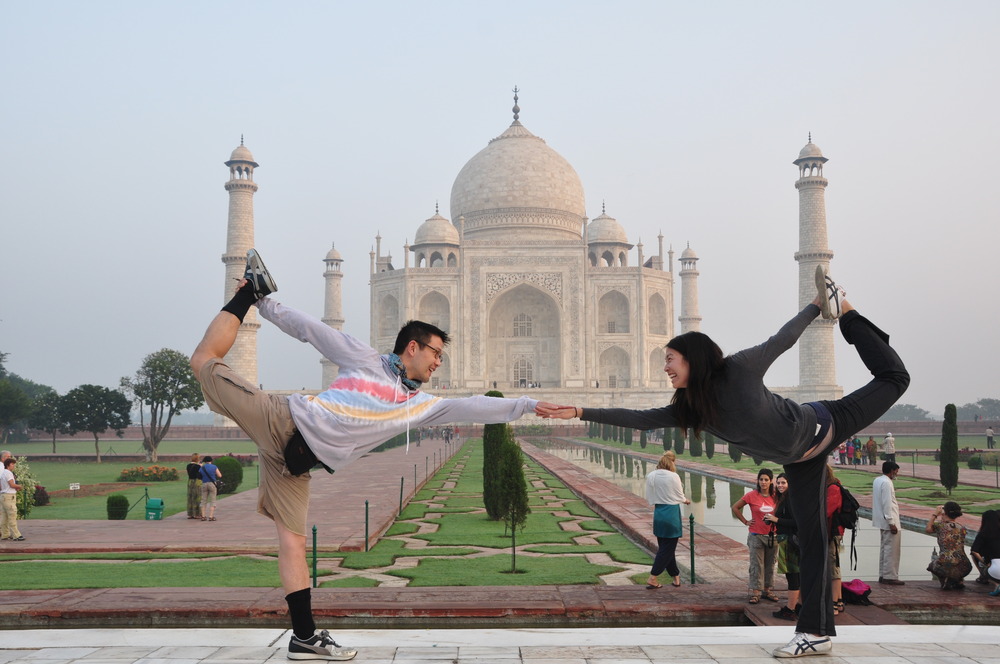
The next day we headed to the town of Agra to see the Jewel of India, the Taj Mahal. We first hired a car to Jhansi before boarding a train in coach class to Agra, which was an interesting and crowded 3 hour experience (before Di’s friends scold me, first class was sold out!). We arrived in the evening after a long day of travelling and crashed early so we could wake up in time for sunrise, supposedly when the Taj Mahal is visually at its best. The Taj, completed in 1653, was erected by Shah Jahan, ruler of the powerful Muslim Mughal empire at the time. He built it in memory of his second wife, Mumtaz Mahal, after she died giving birth to their 14th child. Legend has it that he was so distraught when she passed his hair turned grey pretty much overnight. We woke up at 5 to make it in time for dawn, and when we got there the Taj Mahal not only lived up to the hype, it blew it away. It was the most beautiful building I had ever laid my eyes on, and just looking at it actually invoked an emotional response in me, the first of any edifice to ever do that. Maybe it was its faultless symmetry, or its elegant lines and perfect proportions, or its sparkling white marble with the gentle pink dawn sky as its backdrop. Maybe it was because it was built out of love, or the grieving heartbreak of death. Maybe it was all of that, and something else indescribable. Whatever it was, it was a wonder to behold and something I couldn’t remove my gaze from. It was not only stunning from afar; a view up close revealed the unparalleled skill and mastery of its builders. The carvings, the calligraphy, the domes and arches, they were all amazing. Though obviously biased, when Shah Jahan beheld the finished building he said it made ‘the sun and the moon shed tears from their eyes’. I don’t think he was too far from the truth.
Afterwards we hopped on a bicycle rickshaw for 2 kms to check out the Agra Fort, nicely made of red sandstone and white marble. Much to the rickshaw driver’s delight Ron switched spots with him and pedaled the last bit to see what it was like. The palace/fort actually ended up becoming a prison for Shah Jahan during the last 8 years of his life as his son forced him there after usurping the throne. If we saw that fort anywhere else in India, I would have said it was pretty sweet. The unfortunate truth was that we saw it immediately after the Taj, so it was painfully underwhelming in comparison. Even writing this in hindsight I really don’t have much more to add as I couldn’t hold my attention to the structure while I was there, which is a shame.
Early next morning we parted ways with Ron as we went to Jaipur in the province of Rajasthan while he headed to Egypt. We caught the train (in 1st class this time) and made it in about 6 hours. After we checked into our guesthouse we quickly headed to the Amber Fort just outside of town to fill our afternoon. With a long train ride to compare it to instead of the Taj Mahal, I found the huge hilltop fort to be pretty cool. We actually got lost for a bit inside while checking out its maze of rooms. With a picturesque lake and garden below and defensive battlements all around the fort is definitely a worthy setting for an epic Bollywood story of love and war. The next day we headed to the old part of Jaipur, otherwise known as the Pink City. It was painted “pink” back in 1876 by the then Maharaja to welcome the Prince of Wales and it has remained that colour ever since. I put “pink” in quotation marks because it looked more like an ugly orange with a thick covering of mildew and pollution added in for extra flavour. We first checked out the city palace which also doubled as a museum, housing an impressive collection of art, weapons, and fabrics. We then walked around the corner to Hawa Mahal, Jaipur’s landmark. It’s a 5-story honeycombed structure that was built for the royal ladies so they could people watch in safety. The face of this building was definitely the cleanest and up kept of all the buildings in town, thus giving its viewer a glimpse of what the old city may have looked like at one time if not dirtied by the stains of time and pollution. We did find the unique honeycombed façade to be a lot more impressive than the building’s comparatively plain interior. After sightseeing we walked around the streets of the old city checking out the bazaars and daily Jaipurian activities. The mad traffic, dirty streets, thick smog, aggressive shopkeepers and general craziness prompted us to stop that quickly. Our guidebook recommended that for a break we should experience afternoon tea at Rambagh palace, an ex-residence of the Maharaja now converted to a luxury hotel which costs up to 5000 USD a night. So we walked up to the gates of the massive property looking forward to some cucumber sandwiches and scones. Our eagerness was met with rejection by the gate staff. Ouch, in our face! Supposedly the hotel was fully booked so its courtyard and restaurants were open to guests only. Disappointed, we headed for coffee at a far classier joint, McDonalds. Back in your face Rambagh!
After our sultry coffee in aristocratic red and yellow plastic surroundings we decided to head back to our hotel to call it a day. When we got outside to the waiting rickshaw drivers they surrounded us, vying for our rupees. I showed them our hotel business card, written in Hindi and English, when something very humbling happened. I realized that most (if not all) of them were illiterate as they all asked me to tell them the name of the hotel after blankly looking at the card. I looked up the stats and as of 2008, 40% of India still could not read. I offered 50 rupees to the group to anyone who would take us back, and they all denied, as usual. I turned around to walk away, which usually prompts one to grab me and say OK. I should have known there was something wrong when only a young guy agreed to the price while all the others were shaking their heads. We hopped in, and within 10 minutes we knew he was completely lost. He kept taking our hotel card and showing randoms on the street, asking for directions. These conversations would always attract others, and every time he asked there seemed to be a conglomeration of strangers trying to help us. After about 20 minutes he realized he was in over his head and said in broken English that our hotel was too far and he wanted more money. I could tell by the dejection in his face that he wasn’t lying (plus all the more experienced guys were not willing to take us for that price), but I was still kinda pissed off at the situation as he adamantly said he knew where our lodgings were when we hopped in. So I just gave him his 50 rupees and Di and I got off and started walking away, with both us and him being quite disappointed. We then entered the nearest store and showed the 2 guys there the hotel card and asked for directions. They discussed the issue for maybe a minute before one of them, with a wide smile and decent English, told us to get in his car. He drove us for about a kilometre and dropped us off at the front of our hotel, shaking our hands and wagging his head, grinning as he left. That experience actually sums up a lot of what we’ve felt while in India. At times it can be mind-numbingly frustrating, but then the cheerful help and the warm smile of a stranger inevitably comes, more than balancing out the initial negative experience. Di and I are working on our head-bobble so that hopefully before we move on to the next country we can respond to all the random acts of kindness here with that uniquely Indian gesture we are starting to love.
One response to “The Kama Sutra, The Taj Mahal, The Pink City, and The Indian Head Bobble”
Leave a reply to kyoko Cancel reply
Recent Comments
 | Emma on The Wonders of Ancient Egypt a… |
 | nancy on Home Sweet Home |
| May on Home Sweet Home |
| Andrea Sam on Home Sweet Home |
 fromwonderintowonder
Love the picture of standing bow!! Feel so special!